Kapitel
Why this episode matters to patients
[00:00:04 – 00:04:14]
Most dentists are honest. Some practices, though, run on a business model that shapes the treatment plan before anyone has examined your mouth properly, and it tends to arrive with confident language and plenty of urgency.
This episode covers the words to watch for and how to recognise a sales script. It also explains how to turn down a plan politely and how to check that the person offering you veneers is a registered dentist.
The advice draws on decades of practice in London, the United States, Australia and South Africa. Some dentists have objected to earlier episodes, and any who disagree are welcome to make contact and discuss it.
What production dentistry is and the buzzwords to watch for
[00:04:14 – 00:09:51]
Production dentistry is a term used mostly in the United States for a model where the business decides the treatment before your mouth does. The team sets a daily turnover target, then scans the appointment book for patients who could be sold extra work. It is common where insured practices accept lower fees and look for more procedures to cover their overheads.
The model hides behind impressive phrases. A “full mouth rehab” usually means crowns on every tooth, and a chipped front tooth can turn into a complete Lächeln-Umarbeitung from ear to ear. “Your bite is collapsing” and “you’re a ticking time bomb” are other favourites, when the reality is usually gradual wear over many years.
In one recent case, a long-term patient living in London was told at an insurer-approved practice that three teeth needed treatment that same day, on a plan of about £1,800 against a £300 co-payment. Those cavities had been monitored for years and had barely changed in 18 months. They do need treating at some point, but teeth don’t explode, and crowning every tooth is a poor way to protect them.
How to recognise a sales script
[00:09:51 – 00:13:44]
Sales scripts follow a rhythm, and fear comes first, with photos of your own worn teeth set next to far worse ones and a warning that yours will look like that in five years. Next comes a dramatic diagnosis with one big solution attached, such as ceramic crowns or veneers on every tooth. Urgency closes the pitch.
Another giveaway is a website gallery where every patient received the same plan, usually very white, very straight crowns sometimes called turkey teeth. You don’t need to travel to Turkey for them, since a few practices in most big cities offer the same look. Some practices also bring out finance forms at the first appointment and start treatment once you have signed.
A good dentist can still recommend extensive treatment, backed by evidence on your own x-rays and scans and an honest account of what happens if you wait. Where waiting is never an option and the discount only applies if you start today, you are hearing a script.
Why a modest repair can beat a full makeover
[00:13:44 – 00:17:08]
Instagram dentistry is designed for the camera, and every time a tooth is drilled, some of its limited structure is spent and never comes back. Repairing a chipped edge with Zahnhaftung keeps your options open, and so can reversing an early cavity with fluoride and diet changes.
The goal is a stable mouth with healthy teeth. A makeover belongs at the end of a long story, and some mouths do reach the point where one is needed, though even then it should be done conservatively.
Some philosophies prescribe the same big treatment for almost everyone because anxious patients crave certainty. Trouble starts when a mild bite issue becomes 28 crowns, sometimes drilled in a morning and fitted in an afternoon by a practice milling them in-house. Mouths change and materials age, and when everything is done together it tends to fail together, which gets expensive.
The problem with before and after photos
[00:17:08 – 00:19:28]
Before and after photos show a smile from the front and hide the price. That price is the enamel removed to get the result, along with what the work will cost to maintain over the next 20 years. The real after photo is the one taken ten years later, and nobody posts it.
OptiSmile does show patients individual cases, with permission, and explains the story behind each smile. Many were rebuilt through conservative restaurative Zahnheilkunde, using composite and Spritzgießen or inlays in place of veneers and crowns. Follow-up photos at two and four years show how the work has aged, including where it may need a polish.
Getting a second opinion and saying no
[00:19:28 – 00:22:34]
A good dentist welcomes a request for a second opinion. If a dentist turns defensive when you mention seeing someone else, that tells you something. In South Africa, POPIA entitles you to copies of your x-rays and scans, so you don’t pay for them twice.
Ask the second dentist an open question, such as what they would do if it were their tooth. Be wary of a second opinion that turns out to be the same big plan at a lower price, and get a third opinion if that happens.
Saying no takes calm questions and no dental knowledge. You can say you’re not ready today, ask to see the problem on the x-ray, ask whether the treatment is reversible, or ask which cavities could be monitored while you floss daily and switch to a fluoride toothpaste. An ethical dentist will slow down with you, and a deal that is only good on the day marks a salesperson.
First do no harm and checking who is treating you
[00:22:34 – 00:25:42]
“First do no harm” is one of the oldest principles in medicine and dentistry. Harm caused by the practitioner is called iatrogenic, and it covers more than pain or infection. A healthy tooth cut down without need can enter a lifetime cycle that runs from one crown to the next, sometimes ending in a root canal or an implant.
Money can be earned again, but enamel can’t. Restraint is one of the most valuable skills a dentist has, and one of the least advertised.
In South Africa, you can search the HPCSA’s online register by name to see when a practitioner registered and what they may do. Dental technicians make what a dentist prescribes and may not drill or treat your mouth, and the HPCSA has taken action against bogus practitioners. If someone offers Veneers at R1,000 a tooth when registered dentists charge R10,000 to R15,000, question their qualifications, because cheap veneers on healthy teeth can start a lifetime of expensive dentistry.
The one rule to remember
[00:25:42 – 00:28:17]
Never agree to anything irreversible until you understand your options, including what happens if you wait. Ask for evidence, and ask whether the treatment can be staged.
Unless you have a severe toothache or swelling, rushing does more harm in dentistry than waiting. The next episode looks at 4D printing and shape memory aligners.
Abschrift
Eon Engelbrecht [00:00:04 – 00:01:10]
Welcome back to Save Your Money, Save Your Teeth, where we look at what genuinely protects your teeth and your wallet. Now last time we looked at the future, robots, artificial intelligence and apps that watch your teeth from home. Today we’re coming back down to earth with something every patient needs and that’s a way to protect yourself in the dental chair.
Most dentists are honest but there’s a style of dentistry where the business model quietly writes the treatment plan before anyone has properly looked at your mouth. So it comes with confident language, beautiful photos and a lot of urgency. Today, what are the buzzwords to watch for?
How do you spot a sales script? Why is a humble repair sometimes better than a perfect makeover? How do you say no politely?
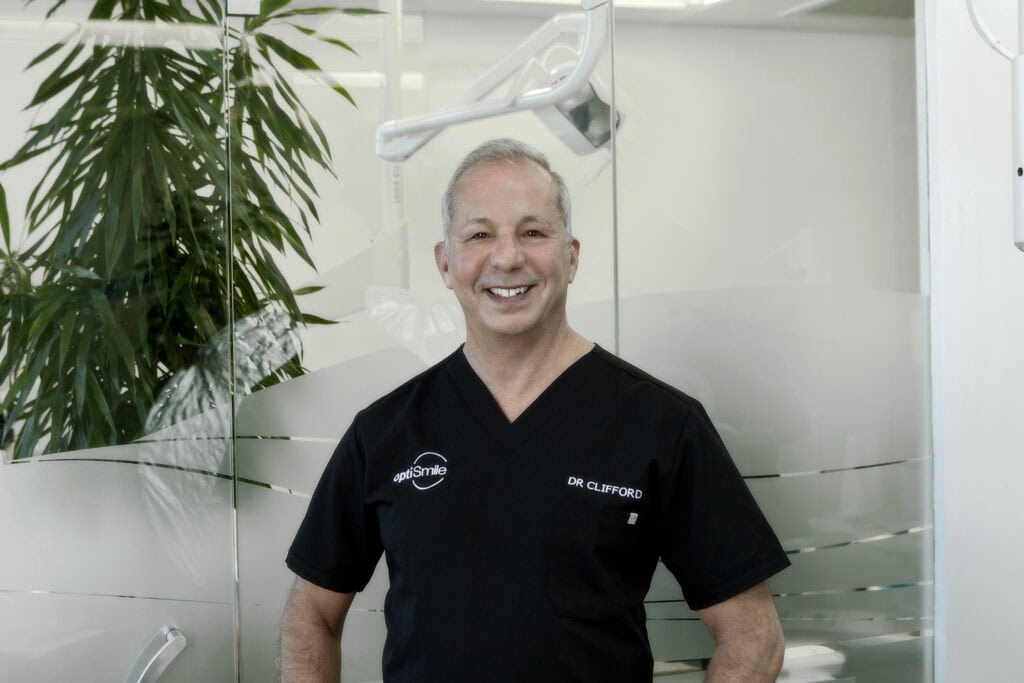
I’d like to know. And how do you check that the person doing your veneers is even a dentist? Joining me as always is Dr Clifford Yudelman from OptiSmile in Sea Point, Cape Town, South Africa.
Dr. Yudelman, willkommen zurück.
Dr Clifford Yudelman [00:01:11 – 00:01:21]
Thanks, Eon. I liked the little chuckle at the end but you’ll have to wait for that question before you hear the answer.
Eon Engelbrecht [00:01:23 – 00:01:24]
I can’t wait. So Dr Yudelman.
Dr Clifford Yudelman [00:01:24 – 00:02:08]
I’m pleased we’re starting off a little bit sort of light-humoured here but today, for me, this is probably one of the most important podcasts that I’ve done so far. It’s really I think one of the things that it’s going to take someone like myself to just get the word out there to people on how to protect themselves. Obviously, there’s dentists now that are listening to these podcasts and a lot of them send me messages that they learn so much and they love what I’m doing and then I hear also sort of by the by from other people that say there’s a lot of dentists that are getting upset with some of the things you’re saying.
Eon Engelbrecht [00:02:08 – 00:02:09]
Ja wirklich?
Dr Clifford Yudelman [00:02:09 – 00:03:17]
Which for me then that means that we’re actually hitting the right nerve. If anyone doesn’t agree with me, they’re welcome to give me a call or we can discuss it. Everything that I say or recommend is based on all my experience in where I practised around the world.
First in London, then in America and then in Australia and now in South Africa. Four years, 16 years, 12 years and now 11 years in South Africa and it’s based on things I’ve heard and things I’ve seen and what really gets me going like in episode 116 about all the nonsense that’s on Instagram and TikTok is where the nonsense, I don’t mind so much if it’s coming from a granny telling you to brush your teeth with banana skins and who knows what, but when you get an actual dentist using some of the words and some of the things that we’re going to talk about today, that is when it’s time to really maybe share this podcast and really open your eyes.
Eon Engelbrecht [00:03:18 – 00:03:29]
I’m looking forward to it and I’m glad you’re ruffling some feathers, doctor, because apparently that means you’re doing it right. You can’t have people liking you all the time. That’s not normal.
Dr Clifford Yudelman [00:03:30 – 00:04:13]
This podcast is really for the listeners, for the consumers. I am very humbled that actually a lot of dental reps, people that come to the different dental practices to show us new materials and the latest technology, a lot of them have told me that they listen to the podcast so that they have a good dentist perspective and a consumer perspective on dentistry and even I saw a dental assistant that works for another dentist and she told me she loves my podcast.
She always listens to them when she commutes, so it’s not for everyone, especially some of the dentists that we’re going to talk about today.
Eon Engelbrecht [00:04:14 – 00:04:28]
Oh, okay. I’m looking forward to it. Now I’m very, very curious.
I want to start off by asking you firstly, what do you mean by production dentistry and what are the buzzwords that patients should watch out for?
Dr Clifford Yudelman [00:04:29 – 00:08:59]
So production dentistry, that’s a common term more in the U.S. when I practised in the U.S. That’s where the business model decides the treatment before your actual mouth does. The dentist will have a meeting with their team in the morning and they’ll decide how much turnover or how much money they need to make that day and then they look through the schedule and see who’s coming in and who they can do what on and look for extra opportunities to upsell. That’s sort of the basic model of production dentistry and often it’s in more of an HMO or PPO when people are in network and they are forced into having lower fees, so they would tend to then look for extra things to do because they obviously need to cover the overheads and make a living.
So it’s all about actually producing more and doing more dentistry, but it hides behind impressive phrases which often these ones are when so-called cosmetic dentists talk about and you see it a lot on Instagram and all of that is one of the things about a full mouth rehab, which means a rehabilitation of your full mouth, which means that you drill on every single tooth in order to rehabilitate your mouth. We did speak about collapsed bites and how one can build up the bite and how to do it conservatively and we’ve spoken about injection moulding, but when people talk about a full mouth rehab, they’re generally talking about putting crowns on every single tooth.
The same thing with a smile makeover. You’re going to hear dentists talking about a complete smile makeover. You go in because your front teeth are chipping and the next thing the dentist is talking you into a complete smile makeover from ear to ear.
Things like your bite is collapsing. It sounds very scary. We did do a podcast on that, but if your bite is collapsing, it’s more like gradual wear over years and years and your bite is not collapsing, so to speak. Another great one is you’re a ticking time bomb. I love that one. I had a patient come in the other day where the dentist told her she needed three teeth done as soon as possible, literally before they explode. This is a patient I’ve been seeing for years. She actually lives in London and she went to a dentist on one of these, it’s sort of like Discovery or one of the local medical aids. It’s called Bupa and you’ve got to go to one of their pre-approved dentists and the dentist will look.
Her co-payment was whatever, £300, but they gave her a treatment plan for £1,800. What’s that? About 50,000 rand.
They insisted on doing that treatment there and then on the day because she was in danger of having an exploding time bomb in her mouth. She came to see me and there were some cavities that we’ve been monitoring for years. They do need doing, but in the last 18 months, they don’t look like they’ve changed very much.
This person was just trying to get her to spend as much money as they can. That wasn’t here in South Africa. That was in the centre of London at one of these.
You go to one of these medical type practices with the name of Bupa, Bupa Care. You’ve got all these. I hope Bupa doesn’t sue me, but I can name a few others.
If you’re in America, Delta Dental. There’s Blue Cross Blue Shield, all the basically contracted in medical aid type practices or for want of a better word, medical aid is South African, but overseas it’s dental insurance. They’re not really insuring anything.
If your mouth has collapsed, rebuilding everything sounds logical, but believe me, teeth don’t explode. There’s mild wear. There’s unstable teeth that need protecting or watching.
The last thing you want to do is crown all your teeth to protect them.
Eon Engelbrecht [00:09:00 – 00:09:25]
Dr Yudelman, it sounds to me like a lot of people also use fear to control people because we see that all over the world, people using fear, especially people in higher up positions or respectable positions. That’s how they get people to listen to them. If a dentist tells me that there’s a ticking time bomb in my mouth, I’m going to take it very seriously and I’ll believe it.
Dr Clifford Yudelman [00:09:26 – 00:09:49]
Yes. You just ask him, should I cut the red wire or the black wire first? That reminds me of a t-shirt I once saw someone wearing and on the front, it said, I’m a bomb disposal technician.
On the back, it said, if you see me running, try and keep up.
Eon Engelbrecht [00:09:51 – 00:10:06]
That’s brilliant. I’d love to see the people’s reaction on that. Dr Yudelman, how can a patient actually tell if a dentist is following a sales script learned at, let’s say, a business seminar?
Dr Clifford Yudelman [00:10:07 – 00:13:04]
Yes. These scripts have got a certain rhythm. First is the fear.
They show you pictures of your own teeth and the wear on your teeth, and then they show you another picture, a really gory view of much, much worse teeth. Then they’ll tell you that this is how your teeth are going to be in five years’ time if you don’t do something about it immediately. Then that’s a dramatic diagnosis.
They give you one big solution. We’re just going to cover all your teeth with ceramic. We’ll do these beautiful zirconia onlays and crowns or veneers.
They call them veneers, but often they put crowns. There’s one big solution. Then there’s the urgency. If you don’t do this now, you’ll lose everything. Two other giveaways is everyone seems to need the same plan. In fact, when you go on these websites, and there’s a lot of before and afters, you can see in the end everyone did have the same plan, which is crowns on every tooth.
They all look very white and very straight, what we sometimes call turkey teeth. Like I always say, it’s become a buzzword for our podcast is you don’t have to go to Turkey to get turkey teeth. There’s one or two turkey teeth dentists in every big city.
They’re in London. They’re in Johannesburg. They’re in Cape Town.
They’re in San Diego. Every place I’ve ever practised, there’s always a few of these. The other thing is they might bring out finance forms at the same appointment.
That’s more common in America, where there’s a particular person called the treatment plan coordinator or they say, oh, Mary is a good closer. It’s like she closes the deal and they make sure that they get you to sign something on the day, whether it’s a payment plan, $100 every month for the next five years. Once you’ve signed something, then they get you back in the chair the same day and they get started. A good dentist can still recommend big treatment, but they show you the evidence on your own x-rays, on your own scans. We’ve spoken about a good exam. It’s called co-discovery and co-diagnosis.
They talk about what happens if you wait. If there’s a script, then waiting is never an option. Someone that wants to sell you on a big treatment plan, a full mouth rehab, a makeover, sort out your collapsed bite before you look like your gran, that kind of thing.
You’ve got to start as soon as possible. We’ll give you a big discount if you start today. I think it’s starting to make sense, doesn’t it?
Eon Engelbrecht [00:13:05 – 00:13:07]
Absolutely. Yes, it certainly does. Doctor, I also want to ask you why-
Dr Clifford Yudelman [00:13:08 – 00:13:44]
I want to say that actually that type of thing actually disgusts me personally. I’m sure many honest dentists that are listening to this are also equally- I think disgust is a strong word, but for me, that’s the way I feel. I think if someone wants to make money, they should go and rob a cash in transit. First of all, make more money and a lot quicker. Just don’t blow it up. That’s Jo’burg for you.
Eon Engelbrecht [00:13:44 – 00:13:58]
Yes, every single day, that’s Jo’burg for you. Moving on, why is patching a tooth sometimes better than the perfect dentistry that we see on Instagram?
Dr Clifford Yudelman [00:13:59 – 00:15:13]
Yes, look, we’ll have to discuss what we mean by patching a tooth because that could mean different things to different people, but Instagram dentistry is designed for the camera. I’ve never encouraged any of my dentists that work with me to get involved with these before and afters on Instagram or on social media. I think we’ve got a question later about that.
Just remember, every time we drill, we spend some of the tooth’s limited budget and you never get that structure back. Repairing the edge of a tooth or bonding a chip or trying to make early cavity go away with fluoride and diet changes, we’ve had plenty of podcasts about that, it keeps your options open. Perfect is not the goal.
What you want is your mouth and your teeth to be stable. And makeover belongs at the end of a long story, not at the beginning. And yes, there are people whose mouths have gotten so bad to where they do need a full makeover.
But even then, it should always be done conservatively.
Eon Engelbrecht [00:15:13 – 00:15:23]
And some dental philosophies seem to recommend the same big treatment for almost everyone. Why do they persist?
Dr Clifford Yudelman [00:15:24 – 00:17:08]
It’s because they’re selling certainty and anxious people crave certainty. They say, oh, we fix everything at once and you’ll never worry again. And some of these systems do have a place in the right patient. But the problem is when the philosophy becomes a template and every mild bite issue turns into 28 crowns. There’s these dentists, these same-day makeover dentists, we have a few in South Africa where they spend the whole morning drilling all your teeth, every single one of them, and then the whole afternoon gluing in new crowns that they do on site. And we do same-day treatment for patients. It takes me two to two and a half hours to fix one tooth or three hours to fix two teeth. So, you can just imagine if somebody is doing a whole mouth in one day what you’re ending up with. And yeah, there might be people who are complete wizards and can do it.
The other thing is you generally, it’s not being sent to an outside lab where the dentist has picked the perfect lab. They might be doing it themselves in-house and they might not even be a technician working on it. You don’t know who’s making the teeth.
Dentists can design and mill one or two teeth while you wait, but 28 teeth, that’s another story. Mouths change, materials age, habits shift, and anything that promises permanent perfection is ignoring the biology. And when everything is done together, it all tends to fail together and that can get very expensive.
Eon Engelbrecht [00:17:08 – 00:17:17]
Now, you’ve mentioned before that you don’t like to use before and after photos, especially to sell a treatment. Can you tell us why, doctor?
Dr Clifford Yudelman [00:17:17 – 00:19:27]
Just to try and keep this answer a bit shorter, because I have had a bit of a rant today. As you can hear, I’m very passionate about today’s subject. But basically, they show a result and it’s always just from the front.
You see the smile. They show the result and they hide the price. You see the smile and you don’t really know how much enamel was removed.
When I talk about price, I’m not talking about how much you paid in rands or dollars or pounds. It’s the price you pay, the biologic cost, how much of your enamel was removed, where the nerves were put at risk, and then what it costs to maintain it over the next 20 years. I’ve seen beautiful work that other dentists have done, and even if it was done nicely, and then they can come in four or five years later and then things are failing.
And the real after photo is the one that is taken 10 years later, and nobody posts that one. So, before and afters, I do show patients before and after, but individual cases where patients are giving me permission and we will sit down with a patient and say, this is Jane or whatever person’s name is, and this is what her teeth looked like. We show a similar case.
She didn’t get any treatment. She came back a few years later. As you can see, a few years later, not much had changed, but now her daughter was getting married, and there’s a story behind every smile. And then we show how we built it up conservatively in many cases with composite and injection moulding or inlays instead of veneers and crowns. And then we show them, this is what it looked like two years later and four years later. Wherever possible, we try to show patients this could pick up a bit of stain here and need a polish.
You want to actually tell people the truth. You’re not just out to get them to get as much dentistry as they can either afford, or in many cases not afford, and not tell them the whole story.
Eon Engelbrecht [00:19:28 – 00:19:38]
Okay. And then I want to ask you, is it rude to ask for a second opinion? And how do you get one that’s actually genuinely useful?
Dr Clifford Yudelman [00:19:38 – 00:21:26]
So I don’t think it’s rude at all. In fact, sometimes I’ll tell a patient, why don’t you get a second opinion? Like if a patient is second guessing me and often I’ll pull up something on Google and just use good old Google, no AI, nothing, and go Google images and pull up actual images and show them other things, try and give them a second opinion along with the first one with Dr Google. But a good dentist welcomes it. Often in my practice, I will get patients a second opinion. I’ll ask them to come back and see one of my other dentists who may have a better idea or a different opinion to me.
And I’ll meet with my dentist sometimes and get second and third opinions for my patients. But a good dentist welcomes further opinions. If someone gets defensive, if you see someone who wants to give you 28 crowns and you say to them, oh, I think I’m going to go see my brother’s dentist, and they get all rude and defensive, then that tells you something.
You can ask for copies of your x-rays and your scans, which you’re entitled to under POPIA in South Africa, so that way you don’t pay for them twice. And then you ask a second dentist an open question rather than, do you agree? You can say something like, what would you do?
What are my options? What would you do if this was your tooth? And beware that the second opinion, that’s just a cheaper quote for the same big plan.
In other words, you go for a second opinion and the dentist now agrees with the other dentist but wants to do it for you cheaper, then I’d go for a third opinion.
Eon Engelbrecht [00:21:27 – 00:21:35]
And then how can you actually say no to a treatment plan when you feel that it feels pushed?
Dr Clifford Yudelman [00:21:35 – 00:22:34]
Okay, so you don’t really need dental knowledge, just a few calm questions. Then you say, I’m not saying no forever, I’m just not ready today. Or can you show me the problem on the x-ray?
That’s a good one. You can say, is this reversible? If someone says you need five fillings, you can say, I’ve heard, I listened to Save Your Money, Save Your Teeth podcast and this crazy dentist in Cape Town said if I floss every day and I switch from my non-fluoride toothpaste to fluoride toothpaste that I could make some of these cavities go away, which of these do you think we could just monitor?
And what happens if we stabilise things and look again in three months or six months? And an ethical dentist will slow down with you. So pressure isn’t confidence, it’s, you know, if the deal is only good on the day, like, oh, if you don’t do this today, then you know you’re dealing with a salesman.
Eon Engelbrecht [00:22:34 – 00:22:41]
And then tell us more about first do no harm. Does that apply to a patient’s bank account too?
Dr Clifford Yudelman [00:22:42 – 00:24:07]
Yeah, so that comes from the Hippocratic Oath, which dentists and doctors undertake when they, before they get their certificate to practise. And one of the things in there is first do no harm. I mean, obviously it’s in Latin, people just know that like the very first thing you should do is not to harm the patient. That’s called iatrogenic. So if a doctor, you know, takes out the wrong kidney, that’s iatrogenic, meaning it was caused, it was a problem caused by the doctor, either misjudgment, poor judgment, or something intentional, same with dentistry. So, but that’s obviously one type of harm.
So the harm isn’t only pain or infection, it’s a healthy tooth that’s taken away unnecessarily. And then it’s on a lifetime, you know, crown replacement cycle where you get one crown, then five, 10 years later, if you’re lucky, another crown, then another one, maybe then a root canal, maybe an implant. So then that’s financial stress from treatment that you didn’t need in the first place.
And you know, money can be earned again, but your enamel can’t. And restraint is one of the most valuable and least advertised skills that a dentist has.
Eon Engelbrecht [00:24:08 – 00:24:21]
And cheap veneers, we see them all over social media. You know, sometimes they’re actually done by people who aren’t even dentists. What is the legal position here in South Africa?
And how do you check who you’re dealing with?
Dr Clifford Yudelman [00:24:21 – 00:25:42]
So, you know, look in South Africa, you can go to the HPCSA. I can look it up. Recently, I was looking up something, but there’s a portal and you can put in the first and last name of the dentist, and or the hygienist or doctor for that matter.
And you can see when they were registered and what they are allowed to do, what type of registration they have. So basically, there’s something called Section 17 of the Health Professions Act. And for instance, a dental technician can only make things that a dentist prescribes.
So a dental technician can’t drill or bond or treat your mouth. And the HPCSA has been arresting either dentists who let their licenses lapse or bogus practitioners. And so just go to the online register and make sure that the person actually is a dentist.
If something sounds too good to be true, if the person doing your veneers wants to charge you 1,000 rand a veneer, and the best price you can get from a regular dentist is 10,000 or 15,000 rand, then you should start wondering about the person’s qualifications, because cheap veneers on healthy teeth can be the start of very expensive dentistry for the rest of your life.
Eon Engelbrecht [00:25:42 – 00:25:50]
And then finally, Dr Yudelman, if listeners remember just one rule to protect themselves, what should it be?
Dr Clifford Yudelman [00:25:50 – 00:26:16]
Never agree to anything that’s irreversible until you understand the options. You know, what it commits you to in the long term, what happens if you wait, ask for evidence, ask for options, ask if you can stage your treatment. You know, time, unless you have a severe toothache or swelling, time is rarely your enemy in dentistry, but rushing is.
Eon Engelbrecht [00:26:16 – 00:26:30]
There we go. That’s it for Save Your Money, Save Your Teeth today. It was a nice episode and I think very insightful and so nice to know that you have the consumer’s back, Dr Yudelman.
Dr Clifford Yudelman [00:26:31 – 00:26:33]
Thank you. That’s my main goal with this podcast.
Eon Engelbrecht [00:26:34 – 00:26:38]
Yeah, yeah, you’re definitely achieving it. Well done.
Dr Clifford Yudelman [00:26:39 – 00:26:39]
Danke.
Eon Engelbrecht [00:26:40 – 00:26:48]
And that’s it for Save Your Money, Save Your Teeth for today and join us again next week. What are we talking about next week, doctor?
Dr Clifford Yudelman [00:26:48 – 00:26:55]
Next week will be 4D printing. You’ll have to tune in to find out what 4D printing is.
Eon Engelbrecht [00:26:55 – 00:26:55]
Sicher.
Dr Clifford Yudelman [00:26:56 – 00:27:01]
And something called shape memory aligners and a few other things about aligners.
Eon Engelbrecht [00:27:01 – 00:28:17]
That sounds awesome. Can’t wait. Thank you so much, Dr Yudelman once again. And this has been Save Your Money, Save Your Teeth. Remember, better decisions, not more dentistry.
Haftungsausschluss: Der Inhalt dieses Podcasts „Save Your Money Save Your Teeth“ an Medical Mondays dient ausschließlich Informations- und Bildungszwecken. Es ist nicht als zahnärztliche oder medizinische Beratung gedacht. Die von Dr. Clifford Yudelman und etwaigen Gästen geäußerten Erkenntnisse und Meinungen sollen ein besseres Verständnis der Zahngesundheit, vorbeugender Maßnahmen und des allgemeinen Wohlbefindens fördern, sollten jedoch nicht als professionelle zahnärztliche oder medizinische Empfehlungen interpretiert werden.Dr. Clifford Yudelman diagnostiziert, behandelt oder bietet Präventionsstrategien für Gesundheitszustände nicht direkt über diesen Podcast an. Diese Plattform ist kein Ersatz für die persönliche Betreuung und Beratung durch einen zugelassenen Zahnarzt oder Arzt. Wir empfehlen unseren Zuhörern dringend, sich mit ihren eigenen Zahnärzten in Verbindung zu setzen, um individuelle Zahngesundheitsbedürfnisse und -probleme zu berücksichtigen. Die hier geteilten Informationen zielen darauf ab, den Zuhörern Wissen über Zahngesundheit zu vermitteln, dürfen jedoch nicht als Grundlage für gesundheitsbezogene Entscheidungen ohne Zahngesundheit verwendet werden professionelle Anleitung. Ihr Zahnarzt ist die beste Quelle für Ratschläge zu Ihrer Zahn- und allgemeinen Gesundheit. Bitte lassen Sie sich bei Fragen oder Bedenken bezüglich Ihrer Zahngesundheit immer von Ihrem Zahnarzt oder anderen qualifizierten medizinischen Fachkräften beraten.