Comités
Why Medical Aid Falls Short on Dental Treatment
[00:00:03 – 00:03:32]
Most medical aid schemes were designed around a hospital-based model, not restorative or preventive dentistry. As a result, treatments like endodoncias and crowns — which preserve teeth and prevent far greater costs down the line — are typically seen as expensive and receive little or no cover.
From an evidence-based perspective, saving a natural tooth is almost always better for long-term oral health than extracting it. Yet schemes tend to prioritise immediate cost containment over that lifetime value, leaving patients to fund the most tooth-saving treatments themselves.
South Africa’s medical aid system is particularly complex, with hundreds of procedure codes and a structure that can make it genuinely difficult for patients to understand their bills or successfully claim for treatment.
Medical Aid Is Not Home Insurance — But the Analogy Holds
[00:03:33 – 00:04:49]
Medical aid operates much like home or car insurance: the insurer is always looking for a reason not to pay out. If you sign up for a plan and your tooth breaks the very next day, do not expect the scheme to cover expensive restorative work when you have barely contributed to premiums.
Pre-existing conditions and old restorations are treated in much the same way as a leaking roof on a house you’ve just purchased — the insurer is unlikely to fund a complete fix simply because you’ve recently taken out a policy.
Risk Benefits vs Savings Accounts: Understanding the Difference
[00:04:49 – 00:07:07]
Risk benefits cover unpredictable, high-cost events — think hospitalisations, heart attacks, or emergency surgery. These costs are spread across all members of a scheme, which is how insurance fundamentally works.
Savings accounts, by contrast, are simply your own money set aside for day-to-day healthcare. Most routine dental care is drawn from savings, not risk cover. Once those savings are depleted, you pay out of pocket.
A savings account is not insurance — it does not spread risk, it only manages cash flow. Understanding this distinction helps you judge whether you are genuinely covered or simply prepaying your own care. Schemes also bank on the fact that a large proportion of members never use their dental benefits at all.
Is Self-Insuring a Smarter Strategy for Dentistry?
[00:07:07 – 00:08:26]
When it comes to dentistry specifically, self-insuring can make strong financial sense. High-tier plans often cost significantly more per month yet deliver only limited additional dental benefit. Over the course of a year, redirecting those premiums into a dedicated savings fund gives you far greater flexibility — particularly for a family where not every member will need treatment in the same period.
Health economics research supports the idea that self-insuring predictable costs is often financially sound, provided you still carry adequate cover for catastrophic events such as accidents or hospitalisation. A sensible balance might be robust hospital cover for emergencies, combined with a disciplined personal savings strategy for the family’s dental care.
Prescribed Minimum Benefits and Dentistry
[00:08:27 – 00:10:18]
Prescribed minimum benefits (PMBs) are conditions that South African medical aids are legally required to cover regardless of your plan. In dentistry, however, PMB cover is extremely limited — it generally applies only to acute emergencies where an infection poses a direct threat to your overall health.
Even where a dental condition qualifies as a PMB, the scheme is typically only obliged to fund the cheapest treatment option, which is usually an extraction rather than a tooth-saving procedure. Cover for surgical extractions performed under general anaesthetic, or for properly conducted root canal treatment over multiple visits, is highly unlikely to be forthcoming.
Why Dentists Charge Above Medical Aid Tariffs
[00:10:18 – 00:13:05]
Medical aid dental tariffs were set years ago and have not kept pace with the actual cost of delivering high-quality modern care. They fail to account for advances in materials, infection control protocols, digital technology, and specialist expertise. A practice that charged strictly at scheme rates would either be financially unviable or would need to compromise significantly on quality.
Charging above scheme rates is not about profiteering — it reflects the real cost of doing things properly. Even a straightforward filling involves disposable equipment, premium anaesthetics, high-grade composite materials, specialist cavity-preparation technology, and adequate appointment time. The consumable costs alone can far exceed what a scheme is prepared to reimburse.
Transparency matters here: patients deserve a clear explanation of fees and the clinical value behind them, rather than confusion arising from the gap between an itemised bill and a scheme’s outdated reimbursement model.
Gap Cover and What It Can — and Cannot — Do
[00:13:06 – 00:14:27]
Gap cover is primarily designed for in-hospital procedures, and dental benefits under these policies are limited at best. Many policies exclude dentistry altogether, so the small print must be read carefully before assuming any benefit applies.
For specific scenarios — such as the surgical removal of impacted wisdom teeth under general anaesthetic — gap cover may help reduce out-of-pocket costs. It is not, however, a substitute for dental savings. Given that wisdom teeth are removed only once per person, the maths of paying premiums over many years rarely favours the member.
Do Medical Aids Cover Implants or Cosmetic Work?
[00:14:27 – 00:15:58]
In most cases, medical aids either do not cover implantes or odontología cosmética at all, or they cover only a small fraction of the actual cost. This mismatch frequently causes frustration: a patient receives a quote for a procedure, the scheme indicates a contribution, and the patient then assumes the dentist is overcharging — when in reality the scheme’s tariff bears no relation to modern clinical costs.
The scheme is not in business to restore your smile or preserve every tooth. Understanding that commercial reality helps set realistic expectations about what your plan will and will not fund.
How to Read a Dental Quote Against Your Scheme Rules
[00:15:49 – 00:18:13]
When reviewing a dental quote, look for procedure codes, treatment descriptions, and the sequencing of planned work. These allow you to compare the proposed treatment against your scheme’s benefit schedule and identify any likely exclusions. In practice, scheme benefit documents can run to forty or fifty pages, making this a daunting exercise.
Artificial intelligence tools can help significantly here. Uploading both your dental quote and your policy document into a tool such as ChatGPT or a similar AI assistant can surface potential shortfalls and exclusions far more efficiently than reading the document manually.
Where a practice is contracted with your scheme, a pre-authorisation request can be submitted before treatment begins. This gives you an indication of what the scheme is prepared to pay — though it does not guarantee payment after the fact.
Why Pre-Authorisation Must Be in Writing
[00:18:13 – 00:19:56]
Verbal approval from a medical aid is unreliable. It is not uncommon for a patient to call their scheme, receive confirmation that a procedure is covered, proceed with treatment, submit the claim — and then find that payment is declined. Written confirmation, obtained before treatment starts, gives you a basis for disputing a refusal later.
Even with written pre-authorisation, schemes will typically only reimburse at their own tariff, so it is essential to clarify the exact rand amount they will contribute before committing to treatment. Think of documentation as financial self-defence in modern healthcare.
How a Private Practice Can Still Help With Claims
[00:19:56 – 00:22:42]
Even practices that do not accept medical aid as upfront payment can still support patients with their claims. This means providing detailed invoices with the correct procedure codes and any clinical documentation that strengthens a claim submission.
What a private practice is unlikely to do is liaise directly with your scheme on your behalf or dispute payment decisions — that responsibility sits with the patient. The goal is informed choice: understanding your risks, knowing what will and will not be covered, and planning accordingly rather than relying on a system that may not serve your long-term oral health.
Transcripción
Eon Engelbrecht (0:03)
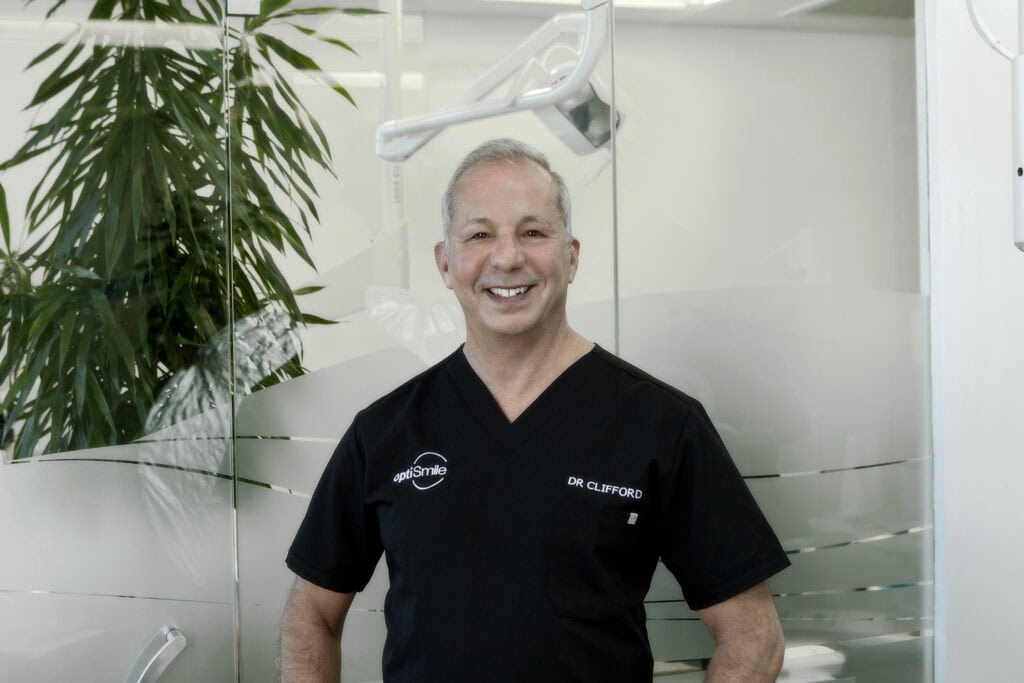
Welcome back to Save Your Money, Save Your Teeth with myself Eon Engelbrecht and, as always, joined by Dr Clifford Yudelman from OptiSmile. Today we’re talking about the frustrating gap between what your medical aid pays for and what actually saves your teeth for the long run. Yes, medical aid versus dental savings.
So get ready for some really good advice again today on how to protect your oral health without compromising your financial health. Here to join us again is Dr Yudelman from OptiSmile. How are you, Dr Yudelman?
Dr. Clifford Yudelman (0:44)
Good, how are you doing? Great to speak to you again. It’s good that we’re having a bit of rain.
Eon Engelbrecht (0:50)
It is, absolutely, yes, but doing well. Thank you so much and nice to chat to you again. This is quite an interesting topic.
I want to start off by asking you, why does medical aid often not cover the treatments that actually save your teeth best — like root canals or crowns?
Dr. Clifford Yudelman (1:12)
That’s a great question to start with because this frustrates many, many people and understandably so. The core issue is most medical aid schemes were designed years ago around a medical and hospital-based model, not preventative or restorative dentistry. And dental benefits are often structured around short-term, low-cost procedures like cleanings, basic fillings and extractions.
Treatments like root canals and crowns are seen as expensive, even though they preserve teeth and prevent far greater costs later. From an evidence-based perspective, saving a natural tooth is almost always better for long-term oral health and function than removing it. However, medical aid schemes tend to prioritise immediate cost containment rather than that lifetime value.
The mismatch leaves patients having to fund the most tooth-saving treatments themselves, even though these are often the most cost-effective decisions in the long run. I was in America, I was in London where they had a national health system, and then America where there were different things called HMOs and PPOs. And then in Australia, they had a different private health system.
And then, of course, in South Africa, we’ve got our own version of medical aid with hundreds of codes. They make it so complicated. It makes it so difficult for patients to understand their bill even, and to claim back for any treatment.
There are hundreds of different codes for why certain treatment is denied. The medical aids generally have people there working especially just to make sure that your bills are not paid. Since I’ve been back in South Africa, our practice, OptiSmile, doesn’t actually accept medical aid as payment up front. So I’m not the expert on this, but I do know a lot about these types of things in general. If some of the stuff is outdated, or it’s not true about your plan, then you need to check with your own particular plan.
We’re talking more generalities, and also something that, if people from overseas are listening, will make sense for them as well.
Eon Engelbrecht (3:33)
It’s basically like your home insurance, or your car insurance. They’re always looking for a reason not to pay out.
Dr. Clifford Yudelman (3:39)
Yeah, exactly. It’s like we were just chatting before we started about a roof. If you buy a house and your roof leaks, the insurance isn’t necessarily going to pay for a new roof.
Depending on your policy, they might pay for some damage caused by water coming into your house, or they might pay to repair a roof. If you bought a house like I did with an old asbestos roof, and then you discover after you buy the house that the house is leaking, your insurance isn’t going to give you a couple of hundred thousand rand and say, here you go, put on a new roof. It’s the same with your teeth.
If you’ve got some cracked teeth and old fillings, and you sign up all of a sudden on whatever insurance it is — there’s a few big ones in South Africa; medical aid, I call it insurance because that’s what it’s called overseas, but here it’s called medical aid — then the next day your tooth breaks. Don’t expect that your medical aid is going to say, okay, here’s 20,000 rand, why don’t you go fix your tooth, when you’ve only paid them 1,000 rand so far.
Eon Engelbrecht (4:49)
Yeah, exactly. Now I want to ask you, what is the difference between risk benefits and savings when it actually comes to dentistry?
Dr. Clifford Yudelman (4:59)
Risk benefits are the portion of your medical aid that covers unpredictable high-cost events, such as hospitalisation or trauma. You fall and you break your hip, or you don’t have any heart problems, and next thing you know, you have a heart attack, or you burst your appendix — you need an operation that’s urgent. That’s like a risk that’s spread out over the whole population, or all the people that they insure.
They know that if they insure 1,000 people, in the next month, five people are going to need stents placed for heart attacks and another three are going to need an appendix removed, but the rest of the people will be paying in and not using it. That’s how basically insurance works. They tend to have all the tall buildings.
If you go up to Sandton, you have a look — Discovery Headquarters, even here, the same with the banks. They always have these huge buildings with lots of people and they’ve got lots of money, and they don’t get that from just paying stuff out. They’re very good at collecting money.
Savings accounts, by contrast, is essentially your own money that’s set aside for day-to-day healthcare. Most routine dental care comes from savings, as far as I know, not from risk. Once your savings are depleted, you’re going to pay out of pocket. The key point is that savings accounts is not insurance. They do not spread the risk. They simply manage cash flow.
If you understand that distinction, it helps you to make informed decisions whether you truly are covered or you’re just prepaying your own care. A lot of the time, they actually count on the fact that maybe 50% of people won’t go to the dentist. Say you and I and another five people each have 10 grand in savings — they know that between the 10 people, only two or three are going to actually go and use it, but they’re going to keep the rest of the money from the other people. So they always come out ahead, especially when it comes to dental.
Eon Engelbrecht (7:07)
Exactly. So is it not better to self-insure by actually saving cash than upgrading to a high-tier medical aid?
Dr. Clifford Yudelman (7:17)
Well, when it comes to dentistry, yes, definitely. The high-tier plans often cost a lot more per month and you only get limited additional dental benefit. Over a year, you could save that premium and use it directly and flexibly, especially if you’re paying for dental benefits for the entire family.
Maybe one of you might need treatment, but you’re paying for everybody’s dental benefits and the other family members may not need it. There’s a lot of evidence from health economics that shows that self-insuring predictable costs often makes financial sense, providing patients still carry adequate cover for catastrophic events — like accident insurance or hospital cover.
An ideal strategy is maybe a balance: strong medical cover for hospital and emergencies, and then a disciplined personal savings plan for the family’s dentistry. That puts the control back in your hands.
Eon Engelbrecht (8:27)
What are PMBs — prescribed minimum benefits — and do they actually apply to dentistry as well?
Dr. Clifford Yudelman (8:35)
PMBs are legally mandated sets of conditions that medical aids must cover in South Africa, regardless of your plan. In dentistry, it’s extremely limited. It usually applies to acute emergency conditions, such as bad infections that are threatening your general health, and not routine or preventive care.
Even when a dental condition qualifies as a PMB, the scheme may only cover the cheapest treatment option, which is often an extraction rather than tooth-saving care. For instance, if you have a lower molar that’s got an infection and you leave it and leave it because you’re worried that your medical aid won’t cover it, and then you wake up one morning and your whole side of your face is swollen to the point that you’re in the emergency room because you can’t breathe — in the hospital, the medical aid will pay for antibiotics to save your life. That’s the medical part of the care. Then they would actually pay, once the infection has gone away, for you to get that tooth extracted, but only a limited amount.
If you needed a surgical extraction with an oral surgeon, or you needed it done under general anaesthetic because you were nervous, good luck trying to get payment for that. In the meantime, a root canal — which will cost a lot more than an extraction — might be the preferred treatment, but good luck trying to get your medical aid to pay any decent amount for a root canal done properly with a microscope and over several visits.
Eon Engelbrecht (10:18)
Why do dentists charge above medical aid rates?
Dr. Clifford Yudelman (10:23)
Medical aid dental tariffs are often far below the real cost of providing high-quality modern care. These tariffs don’t reflect the advances in materials, technology, infection control, and professional expertise. If dentists charge strictly at medical aid rates, many practices would not be financially viable, or quality would be very compromised.
Charging above scheme rates is not about profiteering — it’s about sustainability and delivering care that meets current clinical standards. Patients deserve transparency and dentists should clearly explain their fees and the value rather than relying on outdated reimbursement models.
If I look at something simple — even say a small filling on a lower molar — by the time I’ve used my special machine for numbing and the cost of that, the wand which is disposable, the very high-grade local anaesthetic, and the most expensive type of filling material, and then we might book an hour for that appointment because we wait until the anaesthetic is completely working, and then we include a follow-up visit at no charge to check your bite when it’s not numb — we’ve got a special machine for cleaning out the cavity that uses a special water spray and powder. That machine alone is R100,000, and the powder that goes in there costs R4,000 just for four tubs, and they don’t last very long. If the medical aid was going to pay me back R500 for a filling, it wouldn’t even cover the actual costs before we pay rent or before we pay for any of those materials.
Eon Engelbrecht (13:06)
How can patients get gap cover to help with dental surgery costs?
Dr. Clifford Yudelman (13:13)
Gap cover could be interesting, but it’s primarily designed for in-hospital procedures, and some policies offer very limited dental surgical benefits, particularly when treatment is performed in a hospital setting. You must always read the small print. Not all gap cover policies are equal, and many exclude dentistry altogether.
For procedures like impacted wisdom teeth under general anaesthetic, gap cover may help reduce out-of-pocket costs. But gap cover is not a substitute for dental savings — it’s a supplementary tool for specific scenarios.
If it’s a husband, a wife, and three kids, that’s only three sets of wisdom teeth over a lifetime. One kid might be 12, so you’re going to pay six years of premiums until that kid is 18. The insurance, the medical aid — just like with gambling and casinos, the house always wins.
Eon Engelbrecht (14:27)
So true. I also want to ask you, does medical aid ever cover implants or cosmetic work, doctor?
Dr. Clifford Yudelman (14:36)
In most cases, as far as I know, they don’t — or they say they do, but the amount they cover is very, very low. Then patients get upset because they think the dentist is charging too much for a particular procedure, like an implant.
When I sometimes do free video consults for patients, they want to know how much an implant is. To place an implant can be as much as 20,000 rand, but the dentist’s fee is a percentage of 7,000. All the other costs are for a high-quality implant, for the lab to make a guide, the 3D X-ray, and everything that goes into making sure the implant is placed properly in a way that it’s going to last. Then they send it to their medical aid, and the medical aid says they’ll pay 2,000 rand — or if you’re lucky, whatever it is that they cover for an implant — and you go, but it’s 20,000 rand. Why don’t you cover that? It’s because they’re not in business to make you happy. They’re in business to make money.
Eon Engelbrecht (15:49)
And can you give us some advice on how patients should read a dental quote and check it against their scheme rules?
Dr. Clifford Yudelman (15:58)
You should look for procedure codes, the descriptions, and the sequencing of the treatment. This allows comparison with scheme benefits and you can identify any exclusions — but it’s always like a 40 or 50 page PDF, so good luck with that.
These days, with ChatGPT and Gemini and Claude, if you’ve got a quote from a dentist and you put it into AI and you put your policy into the AI, I think the AI would do a good job of telling you where all the pitfalls could be. In practices that are contracted-in with medical aids, they can do a pre-authorisation — you send it to your medical aid, and then your medical aid looks at it and says, okay, out of that 20,000 rand, we’ll pay 4,000 rand. Which is still not a guarantee that they won’t change their mind and find some reason to refuse it once you get the treatment done.
That’s why for a lot of specialists, if you think of dentists similar to a medical specialist — it’s as if you went to an ENT or a cardiologist, good luck finding a specialist that’s on medical aid like that.
Eon Engelbrecht (18:05)
And what is pre-authorisation, and why is it critical to get it in writing?
Dr. Clifford Yudelman (18:14)
A lot of people get a quote from the dentist, call up their medical aid, the medical aid says yes, they’ll cover it — and then they get their bill, pay it, send it to the medical aid, and the medical aid doesn’t pay. You need to send it in and get an email back.
Verbal approval is unreliable. If you get written confirmation, it helps you if there is a dispute later. And even with pre-authorisation, they often will only reimburse at their own tariff, which you need to make sure of ahead of time. They might say yes, they cover root canals, but they might only pay for a molar root canal up to a certain amount — which, as I said before, doesn’t cover much.
Documentation is a form of financial self-defence in modern healthcare. It’s so easy these days with AI to get it to write the email for you. It’s like — have your AI call my AI and we’ll have lunch one day.
Eon Engelbrecht (19:38)
Hey, we’re not too far off.
Dr. Clifford Yudelman (19:41)
That’s got to happen. Speak to my agent.
Eon Engelbrecht (19:47)
It’s crazy, man. But yeah, I also love my AI nowadays. It’s so helpful.
Dr. Clifford Yudelman (19:52)
I mean, I managed to twist your arm, man.
Eon Engelbrecht (19:56)
Yeah, I know. I love it, man. Just one more question. How can OptiSmile help patients submit claims even as a private practice?
Dr. Clifford Yudelman (20:08)
If you’re seeing a private practice like ours, we still play into that game to help the patients. We give detailed invoices with the proper medical aid coding, and any supporting documentation to help patients with their claims.
I saw a patient recently from Uganda — a retired civil engineer with actual insurance through a French company from his employer. Those plans are often more like insurance and they pay really well, but they need extensive documentation. When we’re done recording the podcast, I’ll be doing that with the help of some AI, to document everything we diagnosed and the treatment we did and all of the codes.
The practice, even if they don’t accept medical aid, will generally make sure everything’s coded properly — but we’re not going to phone your medical aid for you and fight with them. Those days when I was in the States, we had special insurance clerks whose entire job was to find out why the medical aid didn’t pay this or that. This maintains clinical independence and supports the patients financially. The goal is informed choice, not dependency on systems that may not serve your long-term oral health. You need to know where you’re headed, what your risks are, who’s paying for what, and when they won’t pay.
Eon Engelbrecht (22:13)
And that concludes our discussion for this week. Thank you once again to you, Dr Clifford Yudelman, for shedding light on these critical financial and health decisions. I think it’s important to remember that informed patients make better long-term decisions. Do you agree?
Dr. Clifford Yudelman (22:32)
Yes, and hopefully these podcasts are helping people to do just that.
Eon Engelbrecht (22:39)
And next week, what are we talking about next week, Dr Yudelman?
Dr. Clifford Yudelman (22:43)
Next week is very exciting because we’re back on the cosmetic front and we’re talking about a dental facelift, or anti-ageing dentistry.
Eon Engelbrecht (22:52)
Oh, can’t wait. That’s coming up next week. But that’s it for now. Thank you so much, Dr Yudelman. Until next time.
Dr. Clifford Yudelman (22:59)
Thank you and have a great week and speak to you next week.
Locutor (23:22)
Descubra el mundo de la excelencia dental con OptiSmile. Únase a nosotros para un podcast semanal con el Dr. Clifford Yudelman, un experto experimentado con 40 años de experiencia dental en cuatro continentes. Obtenga información única y asesoramiento dental experto visitando OptiSmile.co.za para obtener artículos que iluminan el camino hacia una salud bucal óptima. Si busca atención dental incomparable en Ciudad del Cabo, póngase en contacto con OptiSmile o reserve directamente en línea en OptiSmile.co.za. OptiSmile, donde la experiencia global se une a la atención local.
Descargo de responsabilidad: El contenido proporcionado en este podcast, “Ahorre su dinero, salve sus dientes” los lunes médicos, tiene fines informativos y educativos únicamente. No pretende servir como consejo médico o dental. Los conocimientos y opiniones expresados por el Dr. Clifford Yudelman y los invitados están diseñados para fomentar una mejor comprensión de la salud dental, las medidas preventivas y el bienestar general, pero no deben interpretarse como recomendaciones médicas o dentales profesionales.Dr. Clifford Yudelman no diagnostica, trata ni ofrece estrategias de prevención para ninguna condición de salud directamente a través de este podcast. Esta plataforma no sustituye la atención y el asesoramiento personalizados proporcionados por un profesional de la salud o dental autorizado. Recomendamos encarecidamente a nuestros oyentes que consulten con sus propios proveedores de atención dental para abordar las necesidades e inquietudes individuales sobre la salud dental. La información compartida aquí tiene como objetivo capacitar a los oyentes con conocimientos sobre la salud dental, pero no debe usarse como base para tomar decisiones relacionadas con la salud sin orientación profesional. Su proveedor de atención dental es la mejor fuente de consejos sobre su salud dental y general. Busque siempre el consejo de su dentista u otros profesionales de la salud calificados ante cualquier pregunta o inquietud sobre su salud dental.