Chapters
Intro
[00:00:00]
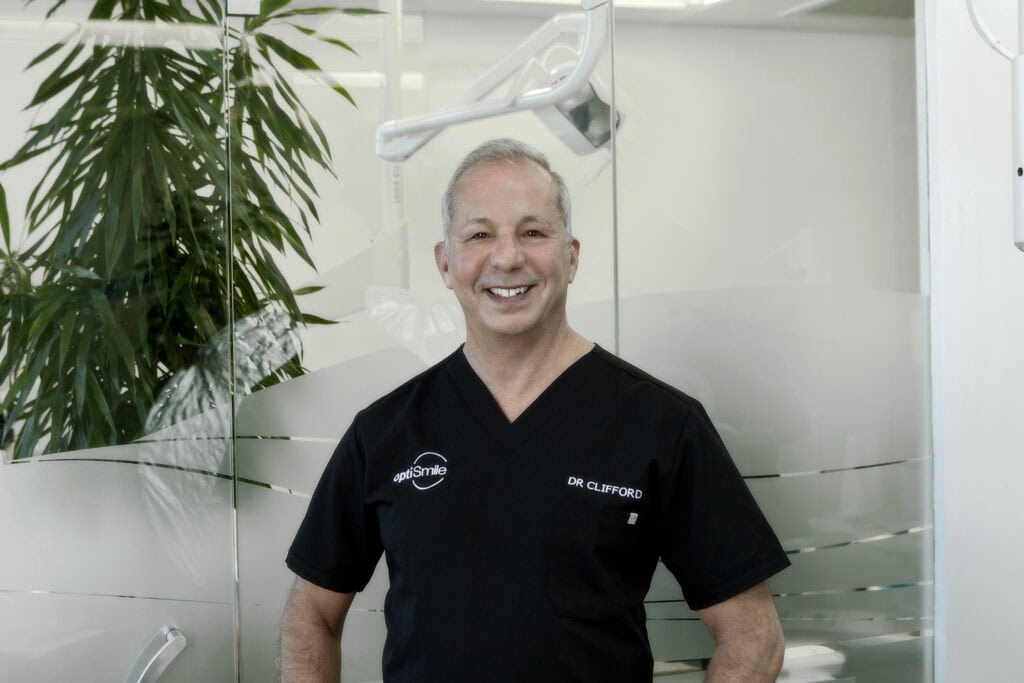
In this episode, Dr Clifford Yudelman from OptiSmile joins Eon Engelbrecht from E-Radio-SA to discuss the 10 smartest questions patients should ask their dentist in 2025. Drawing on past episodes covering digital dentistry, whitening scams, clear aligner confusion, and how gut health and menopause affect the mouth, this episode arms listeners with practical tools to save money and protect their smiles.
1. What makes non-dental teeth whitening risky?
[01:38 – 03:42]
Non-dental whitening often uses unregulated gels without gum protection or proper exams. Risks include gum burns, uneven results, and sensitivity. Fixing these issues often costs more than choosing safe, dentist-supervised whitening.
2. How do Invisalign aligners differ from copycats?
[03:55 – 05:52]
Invisalign uses 3D scanning, digital planning, and high-quality materials. Cheaper versions lack precision and oversight, leading to poor results and higher correction costs later.
3. When should you choose veneers, and what are the alternatives?
[06:06 – 09:05]
Veneers require tooth reduction. Affordable, minimally invasive alternatives like injection moulded composite bonding reshape your smile without drilling. Ideal for chips and worn edges.
4. How to choose the right dentist?
[09:16 – 12:46]
Look for HPCSA registration, professional memberships, and modern diagnostics like 3D x-rays and intraoral scanners. Transparent communication and detailed treatment plans help avoid overtreatment.
5. Why digital consultations reduce unnecessary treatment
[12:56 – 17:15]
Digital scans and smile design tools offer accurate planning and co-diagnosis. Patients can preview their future smiles, reducing misunderstandings and unnecessary treatments. OptiSmile’s Digital Smile Design uses AI to personalise outcomes.
6. What to know before getting dental implants
[17:27 – 19:50]
Always start with a CBCT scan. Cheap implants may fail, leading to costly corrections. High-quality dental implants preserve bone and avoid damaging adjacent teeth.
7. How oral hygiene saves you thousands
[20:06 – 21:52]
Preventative care such as cleanings and targeted sealants prevent decay and the “restoration cycle.” Early intervention reduces the need for root canals and crowns, saving money long term.
8. The risks of relying solely on medical aid or cheap dentists
[22:07 – 25:04]
Low-cost options often lack proper planning and follow-up. Dental tourism can lead to poor outcomes. South Africa offers world-class dental care at competitive prices when done right.
9. Can combining treatments save time and money?
[25:16 – 26:51]
Yes. The ABC sequence—Aligners, Bleaching, Composite bonding—delivers optimal results with fewer visits and lower biological and financial costs. Ideal for patients wanting a natural smile makeover.
10. What to do with a toothache or broken tooth?
[27:05 – 31:17]
Proper diagnosis is key. Don’t rush into extractions or root canals. X-rays, vitality tests, and bite adjustments may resolve the issue cost-effectively. Always consult a qualified dentist before deciding.
Outro
[31:30 – 33:51]
It’s not just about price—it’s about long-term care, quality, and results. Visit the OptiSmile Podcast Archive or find episodes on Spotify, YouTube, and Apple Podcasts. Share this episode to help someone avoid costly mistakes at the dentist.
Transcript
[Eon Engelbrecht – E-Radio-SA] (0:05 – 0:50) Welcome back to Save Your Money, Save Your Teeth, I’m Eon and here’s a thought. When was the last time you asked your dentist a really smart question? In this episode, we’re flipping the script, Dr Clifford Yudelman from OptiSmile will walk us through the 10 most powerful questions to ask any dentist in 2025. These questions are built on episodes that we’ve already explored, such as digital dentistry, whitening scams, and clear aligner confusion, and even how your gut or menopause may impact your mouth. So if you’re ready to protect your smile and your bank account, this one is for you today. First of all, let’s welcome Dr Clifford Yudelman. How are you, Doctor?
[Dr Clifford Yudelman – OptiSmile] (0:51 – 1:18) I’m great. Thanks. Thanks for having me back, nice to speak to you and last week’s episode was very popular so we thought we’d carry on recapping on some of our previous podcasts, going back to things like digital dentistry and whitening, aligners, there’s lots of stuff today, just reintroducing some of the things we’ve already spoken about before.
[Eon Engelbrecht – E-Radio-SA] (1:18 – 1:37) Yes, and ultimately helping our listeners to avoid wasting money at the dentist and we’ve got Dr Yudelman to thank for that, helping us with all these wonderful tips. The first one, Dr Yudelman, what makes non-dental teeth whitening risky and why can salon whitening actually cost you more?
[Dr Clifford Yudelman – OptiSmile] (1:38 – 3:42) Yeah, that’s a good subject right there to start off with. So non-dental whitening, which means a tooth whitening treatment that’s not done by a registered dentist or a registered hygienist under instruction of a dentist, they can use unregulated gels. If you go to a whitening salon or a beauty salon that offers much cheaper whitening and they claim that it’s better than the dentist, etc. and they show lots of before and afters. There’s no proper examination, there’s no gum protection. We’ve seen patients who’ve had their gums burnt when people are using the really strong stuff that they’re not allowed to use, they maybe buy it over eBay or who knows from Temu. We’ve seen uneven whitening and also patients that have had severe sensitivity or even patients that have had whitening on teeth and then they’ve got a veneer or a crown and now the veneer or the crown doesn’t match anymore and they had no idea before that this was going to happen. So in the end, it costs you far more than a safe supervised whitening. You should always start with a dental exam to rule out decay, leaking fillings, gum disease and also to make sure that everything that’s in the front of your mouth is going to whiten evenly and for risks and what to avoid, you can listen to episode number 33 that’s going back about 50 weeks almost a year ago, risks of non-dental teeth whitening and then for safe options, see episodes number 30 to 34. We did four or more podcasts on this which is teeth whitening overview, tips and advice, in-chair teeth whitening, take-home teeth whitening. We did a lot of stuff on teeth whitening and they’ve been very, very popular both on Apple and Spotify, on E-Radio SA, on CastBox and now on YouTube as well.
[Eon Engelbrecht – E-Radio-SA] (3:43 – 3:54) And then how do Invisalign clear aligners differ from the cheaper copycat aligners and why might bargain orthodontics end up costing you more at the end?
[Dr Clifford Yudelman – OptiSmile] (3:55 – 5:13) So proper systems like Invisalign which has been researched for over 25 years, integrates precision 3D scanning, there’s digital tooth movement planning and quality controlled materials and that means predictable movements, fewer surprises and fewer refinements. So copycat aligners may look similar but often lack the proper diagnostics and oversight and that can lead to relapse or bite issues and then people come and see us. In fact, I got a WhatsApp yesterday from someone that came to see us a while back, they didn’t get Invisalign with us, they ended up living in Germany for a while and they got some cheap German version, it’s not Invisalign, I’m not sure what it’s called and now their teeth are all over the show and now they want to know what the price is for the Invisalign because now they’re coming back for us to fix not only the original problem to now sort out what these other things did for them. It doesn’t translate very well into English when you say cheap becomes expensive but I think in Afrikaans we say, what’s that, goedkoop is duurkoop, am I saying that properly in Afrikaans? Yes, pretty much, ja, goedkoop is duurkoop, it’s true. True story. Duurkoop, ja, duurkoop. Duurkoop, ja.
[Eon Engelbrecht – E-Radio-SA] (5:13 – 5:14) There you go.
[Dr Clifford Yudelman – OptiSmile] (5:14 – 5:52) So for the full journey and comparisons, go and listen to episode 26 which is understanding clear aligners, we’ve done a general one on orthodontics, there’s episode 27 Invisalign versus other clear aligners, there’s 25 Invisalign versus traditional braces and then we did 28 and 29 Invisalign journey and life with Invisalign and beyond. That’s like walking off into the sunset with a wonderful smile. So that’s enough on Invisalign but those episodes are great, I remember recording them like it was yesterday.
[Eon Engelbrecht – E-Radio-SA] (5:53 – 6:05) Ja, ja, it feels like just the other day. Dr Yudelman, I also want to ask you, when should you choose veneers? What are the most or the more affordable alternatives for a smile makeover?
[Dr Clifford Yudelman – OptiSmile] (6:06 – 9:05) Ja, we get that question all the time. I mean, veneers are brilliant for shape, colour, proportion but they’re not the only route and we frequently design minimally invasive injection moulded composite bonding or composite veneers which is guided by digital smile design for patients who want a more affordable and I wouldn’t say reversible option but there’s no drilling, we don’t drill away any tooth. When we do veneers, we have to drill away some of your tooth to make space for the veneers. When we do injection moulded composite bonding or composite veneers, actually it’s all additive so we’re just adding onto your teeth especially, we use targeted composite bonding for chips and edges and we can use inlays and onlays or overlays when there’s heavy wear on your back teeth. There’s a lot of other options other than filing down your teeth and a lot of people, we discuss it in these episodes which I’ll tell you about now but a lot of people think they’re getting veneers and they end up with turkey teeth. If you just Google turkey teeth, you go on YouTube, you go on TikTok, there’s lots of people who’ve gone off to Turkey and they think they’re getting veneers and in fact, the teeth have been filed down into little pegs and in some cases, all the way into the soft part of the tooth into the pulp, people end up with big infections and I always say you don’t have to go to Turkey to get turkey teeth. I know several places right here in Cape Town that you can get turkey teeth obviously to remain professional, I’m not going to mention names but just be aware that turkey teeth, you can get them in Cape Town, you can get them in Johannesburg and I’m sure you can get them in places like Boksburg or wherever you live, there’s someone that’s willing to shave down your teeth when maybe composite bonding or injection moulded composite. When we started doing injection moulded composite six years ago, we were one of the first and we’ve concentrated on it, we still do it, we’ve seen great results, some of it going back five, six years now and it’s become very popular all over South Africa, it’s not just OptiSmile that does it now. Many dentists should offer injection moulded composite, some dentists have maybe only just done a course and done one or two cases and other practices like myself or at OptiSmile, we’ve done probably over a thousand teeth or more than that. So yeah, for your options and decision-making, you can listen to episode 22, the advantages of injection moulded composite veneers, episode 21, the art and science of dental bonding and in episode 20, we do an in-depth look at dental veneers and a bonus episode for you would be episode 19, which is about more like inlays and overlays, which are veneers for your back teeth instead of putting crowns on them.
[Eon Engelbrecht – E-Radio-SA] (9:06 – 9:15) Okay. And what criteria helps you choose the right dentist and how can technology and qualifications save you money in the long run?
[Dr Clifford Yudelman – OptiSmile] (9:16 – 12:46) Yeah. So the first step is to always check that the dentist is registered with the HPCSA. I mean, this is just an aside, there have been people that have gone to dentists that are not actually registered dentists and or people that go to a tooth whitening place and they see a hygienist or just a technologist or even a dental assistant, make sure that whoever’s working on your mouth is properly registered. I think, look, a lot of dentists these days don’t belong to SADA, South African Dental Association. I belong to SADA. If you belong to some of these associations, it just shows that you’re answerable to your peers. At OptiSmile, I also belong to something called SAAAD, S-A-A-A-D, which is the South African Academy of Aesthetic Dentistry. And these are dentists that go to talks, there’s lots of lectures and there’s always webinars and so on. On ongoing education, it is legislated, you have to do X amount of hours per year. And also, you can see if the practice is using modern diagnostics like intraoral scanners, CBCT which is a 3D x-ray, there’s so many times we do an x-ray and we see something that looks a little bit dodgy or maybe sometimes we don’t even notice and we do a 3D x-ray and we can find all kinds of things on these 3D x-rays. So that these days I think is very helpful. Not every dentist can afford to have a CBCT, they’re very expensive. So perhaps if you’ve got a complex mouth going to a larger group practice like OptiSmile where the dentists are all sharing one or two of these expensive pieces of equipment. We use AI-assisted radiology, which means we put all of the x-rays through an AI called Diagnocat. Very important that there’s transparent communication, that there’s written treatment plans, that the dentist takes photographs and has scans, helps you understand your choices and helps you to avoid overtreatment. You need to understand it’s not rocket science or brain surgery, it’s dentistry. If you look at a tooth, you should be able to see the problem on the x-ray or on the photo and the dentist should be able to explain why they want to file your whole tooth down and do a crown as opposed to doing an inlay or a filling. And I think it’s important to ask questions. And you know, convenience matters. Maybe you want to just go around the corner, but quality and continuity save you money over years, not just weeks. And there was a saying when I lived in Australia, I learned what LBS is, which means your local bike shop. And your local bike shop isn’t necessarily the one that’s closest to you around the corner. Your LBS might be three suburbs away, it’s where they look after you and they don’t sell you the wrong bicycle or they don’t over-service your bicycle. And it’s the same with teeth. Sometimes people spend more on their hobbies like bicycles than they do on their teeth. So yeah, and for checklists and red flags, you can go to episode seven, where we talk about choosing your dental care provider wisely.
[Eon Engelbrecht – E-Radio-SA] (12:47 – 12:56) And Doctor, can you tell us why digital consultations and 3D scans reduce unnecessary treatment and costs?
[Dr Clifford Yudelman – OptiSmile] (12:56 – 17:15) I don’t know if I’d say always reduces unnecessary treatments and costs. It depends on how the dentist is using these. If you’re using it ethically, then, you know, in our case, the digital dentistry lets us see and plan precisely. The intraoral scans replace messy impressions. The intraoral scan is like a little video camera that flashes on and off and we move it around your mouth and it does a 3D full colour image of your teeth and we can pull it up on the screen and show you really big on the screen, exactly what’s going on in your mouth. There’s digital smile design or DSD. It’s become, it’s now known as DSD or digital smile design that helps to preview outcomes. So just recently, there’s a new programme that we’ve been using a lot at OptiSmile. It’s called Smile Cloud, where we can take a photo and almost instantly with you looking over our shoulder, we can help to visualise your smile, how your smile could look with orthodontics or with bonding or with whitening and not only in 2D, but now we can actually pull in your 3D scan and start planning your smile while you wait. I’ve done this just in the last couple of weeks. We do a scan inside the patient’s mouth. They come back and I’ll take a few photos with us in a special little studio and then they go and get the x-ray done. By the time they finish with the x-ray, they come back and I’ve already started on their 3D design. It uses a lot of AI. By the time, as I say, the patient’s x-ray is ready, they can already see what their new smile might look like. And then what’s even more amazing is we click on a little button and it takes about 15 minutes and it will render that new smile as a video side-by-side that makes a single image that looks like you speaking and you can see them side-by-side with your new teeth and how things would look. It’s unbelievable. And then we share it with you. We put your email in and you get a link. You load an app on your phone and you can show your husband or wife or girlfriend. And yeah, it just gives you an instant preview. And these are not just imaginary. It’s not a filter like on your phone. It’s actually, we can export those exact shape and size of teeth and use those when we make your injection moulding or use them when we 3D print your veneers or whatever it is that we’re going to do for you. And yeah, 3D printing speeds up night guards, mouth guards, things like that. The aligners, the AI helps to detect early decay and any changes in your bone. So we like our patients to sit and to co-diagnose with us. We call it co-discovery and co-diagnosis. We only look in the mouth for the last 10 or 15 minutes of the appointment. The patient will be there for a one-and-a-half-hour exam. And the initial part of that is speaking to the patient, finding out what they want and need, and then taking the x-rays and the photos and the scans and doing some of this AI stuff. And then right at the end, we actually look in the mouth, but we feel like we already know everything that’s going on. And so does the patient. It makes things a lot less scary. It prevents misunderstandings. And also, I think in our hands, it reduces unnecessary procedures. It’s quite different to lie back, the dentist looks around your mouth and he says, book an appointment. You need three crowns. It’s going to be this and this. And your medical aid will cover x and y. Make sure you bring some money with you. You don’t even know what you’re doing, what you’re getting. Yeah, we’ve got a three part, we’ve got different episodes, episode 54, an introduction to digital dentistry, episode 55, which is digital dentistry, part two, AI and 3D printing, and episode 56, which is digital dentistry, part three, which is 3D printing, AI scans and changing care. Yeah, we’ve done a lot on that. We feel very strongly about it.
[Eon Engelbrecht – E-Radio-SA] (17:15 – 17:26) Okay, and Doctor, what should you know before choosing dental implants? And also, why is quality more cost effective than the cheapest option?
[Dr Clifford Yudelman – OptiSmile] (17:27 – 19:27) Yeah, I’ll try to keep this answer a bit shorter, although you can tell I’m very passionate about these subjects. So, you know, success starts with proper case selection, making sure, I mean, nobody should get an implant without getting a CBCT, which is a cone beam scan, like a CAT scan. So if you see a dentist for an implant, and they don’t have a CBCT, they should at least refer you for a CBCT or send you to a qualified periodontist or oral surgeon who’s going to place the implant, they should do a CBCT. Quality components, you know, there’s a lot of off-brand, like very cheap implants. Some of them, they just clap them in with a hammer. For people from overseas, that means they just get knocked in with a hammer. And you know, if they don’t work, then they’ll just pull it out and knock another one in. I’m not even kidding. Yeah, we’ve seen these. That’s not the most common one in use, but there’s some very high end implants available in South Africa. And some of the very good ones are not that more expensive than some of the very cheapest ones. So yeah, you got to ask a few questions. But we look at bone volume, gum health, bite forces, habits like smoking or bruxism. And like you mentioned in the question, if they cheap, poorly planned implants, you know, they’ll fail more often. And revision surgery, like taking out an implant, getting bone grafts, all of that will cost a lot more than doing it right the first time. And implants will preserve your bone and avoid drilling adjacent teeth. A bridge is very rarely called for. Sometimes we’ll do a bonded bridge, which is another story. I won’t talk about it here now, but we could even do an episode. We haven’t spoken properly about bonded bridges. I don’t think we have. We’ve done, what, 18 podcasts as of today.
[Eon Engelbrecht – E-Radio-SA] (19:27 – 19:28) Yeah, I don’t remember.
[Dr Clifford Yudelman – OptiSmile] (19:28 – 19:50) But yeah, look, if it’s done, if it’s done properly, it’s a long term financial win when it’s done properly. And yeah, for the big picture, we’ve got episode 35, are dental implants right for you? Episode 36, from single to full mouth implant options. And episode 37, the long term value of dental implants.
[Eon Engelbrecht – E-Radio-SA] (19:51 – 20:01) All right. And Doctor, I also want to ask you, how does good oral hygiene actually slash your dental bills over your lifetime?
[Dr Clifford Yudelman – OptiSmile] (20:01 – 20:04) I like the way you say the word slash.
[Eon Engelbrecht – E-Radio-SA] (20:05 – 20:06) Yeah, slash.
[Dr Clifford Yudelman – OptiSmile] (20:06 – 21:52) It’s like some of those slash, let’s slash your dental bills. Yeah, look, prevention isn’t a slogan. It’s actually the most cost effective strategy in dentistry, routine, professional cleanings, doing fissure sealants only where needed, in kids where they need them, and early, small fillings that where the tooth is cavitated. We do speak about not every cavity actually needs a filling. Some of these cavities can be remineralised. One of my peeves is when I see a patient come in and they’ve had 10 or 12 very small fillings put in between every single tooth. And I think a lot of those fillings are not necessary. If that patient was instructed on how to floss and given dietary advice and trays to use with tooth mousse or fluoride and some other strategies, they could have avoided fillings, which obviously you’re going to need replacement every five, 10 years, and it just gets worse and worse. So these types of prevention strategies are very inexpensive compared to getting root canals and crowns or implants triggered by neglect and patients who commit to the basics spend a lot less and they keep more tooth structure, enjoy better health, and all the studies have shown you actually live longer with your own teeth. And so episode six, the economics of preventative dentistry. So listen to episode six if you want to know more about slashing your dental bills.
[Eon Engelbrecht – E-Radio-SA] (21:52 – 22:07) That’s right. And now I also want to ask you, Dr Yudelman, why is relying solely on medical aid or shopping for the cheapest dentist risky? And also, how does dental tourism fit into this?
[Dr Clifford Yudelman – OptiSmile] (22:07 – 25:04) Yeah, it’s a bit of a mixed question. You know, talking about medical aid in the UK is in a lot of trouble. They have the general medical aid there that everybody has. It’s called NHS or National Health Dentistry, the NHS system, National Health System. And I saw something the other day that some practice in the countryside in the UK added three new dentists. And so they were allowed to sign up 1,000 patients per dentist. So practice was allowed to now accept 3,000 new patients. And there was people lined up overnight like it was for a free Rolling Stone tickets or something. They were interviewing people in the line that haven’t seen a dentist in years. So medical aid is not just something here in South Africa, it’s all over the world. And in many cases, people come out worse off. And shopping like for cheap treatment abroad, like going to Bangkok or even to Turkey, which we’ve mentioned, may sound attractive, but often it can be inferior materials and rush planning, no follow up. And we see patients that have rushed into or gone just to the cheapest dentist needing much more work to fix their teeth. In fact, a lot of patients we see at OptiSmile that have found us because we have over 430 Google reviews. They see these reviews and they maybe can’t afford to go to the most expensive or best dentist, but they’ve tried the others. And now they’ve decided just to go slowly and to make sure that they get the type of care that they deserve and spread it out over time. There’s no high pressure for people to fix everything right away. We like to put a lot of the preventive measures in place. And we’ve done quite a few episodes. There’s a lot more about especially dental tourism. Episode 48 is about the dangers and realities of dental tourism for South Africans going abroad. But then also we speak in 49 why South Africa is a top choice for dental tourism, why people should rather come here and see a good, maybe a member of SAAAD, which I’ve mentioned OptiSmile or some of these other great practices around South Africa. I am a bit biased. I think, you know, there’s some really great practices and it’s better than trying to wait for the NHS to fix your teeth. And then there’s episode 50, which is advanced technology and personalised dentistry in South Africa. So, yeah, there’s a lot to be said for getting proper care.
[Eon Engelbrecht – E-Radio-SA] (25:05 – 25:16) OK, and then, Dr Yudelman, can combining cosmetic treatments, that’s now your aligners, whitening and bonding, save you time and also money?
[Dr Clifford Yudelman – OptiSmile] (25:16 – 26:51) Yes, definitely. If it’s planned properly, the ABC sequence, we call it ABC because it’s aligners first, getting the teeth in the right position or situation. And the B is for bleaching, getting the right shade or colour. By whitening, you can whiten in take home trays or in your aligners. Some people like to do the in chair because they feel that it goes a bit quicker. But you do have to do the home whitening as well with any of these systems for it to work properly. Planning composite bonding, especially injection moulding, gives a much more predictable result, fewer visits, fewer remakes. There’s a lower cumulative cost instead of getting veneers or crowns done. This ends up being much less and you end up saving more of your tooth. There’s a reduced biologic cost, which means we don’t drill away your teeth. So yeah, straighten first, whiten second, and then add conservative bonding for edge refinement or to fix small gaps. So we’ve done a podcast, number 45, especially for yachties because we do see a lot of yachties. And it’s called Cosmetic Dentistry for Yachties, Bleaching and Bonding. And then we did the whole aligner series, episodes number 25 to 29. And there’s an entire tooth whitening series as well as a bonding versus injection moulding versus veneer series, which I mentioned earlier.
[Eon Engelbrecht – E-Radio-SA] (26:51 – 27:04) OK, and then finally, Dr Yudelman, what is the smartest way to handle a toothache? This is going to be very handy or a broken tooth without running or rushing into a costly treatment.
[Dr Clifford Yudelman – OptiSmile] (27:05 – 27:27) Yeah, that’s a great question to to end up with. Sadly, when I look at our statistics for our website, there’s often the one of the most often the search terms that’s used most often is, especially in Afrikaans, I think they call it ploppende tandpyn.
[Eon Engelbrecht – E-Radio-SA] (27:28 – 27:34) There’s nothing like that. I can handle any pain, but I can’t handle toothache, no way.
[Dr Clifford Yudelman – OptiSmile] (27:34 – 27:40) And that word ploppende, that ranks very high on Google.
[Eon Engelbrecht – E-Radio-SA] (27:40 – 27:41) Yeah, it’s like sloppy.
[Dr Clifford Yudelman – OptiSmile] (27:41 – 31:17) Sorry, because I mean, yeah, and a lot of those patients, they’re not in Sea Point, they don’t end up coming to us. But we’ve got, you know, we’ve got podcasts all about that. We’ve got pages on our website, what to do in an emergency. But the important thing is, is a proper diagnosis first, always. Sometimes toothaches are reversible. If someone bit something hard on a tooth, all they need is a bite adjustment. But then they go and they get their tooth pulled out or maybe get a filling or a root canal where they didn’t even need treatment. They just needed their bite adjusted because it’s like spraining your ankle and then going and getting a knee replacement. So, yeah, sometimes they got like a lot of sensitivity at the gum line because maybe they had a gin and tonic or they bit into a lemon and they opened up some sensitive dentin near the gum line and the tooth can be, you know, like really zinging and they maybe just need a little bit of desensitiser painted on there. And other times people need a timely root canal therapy where there is an infection. But you first got to do proper x-rays, which means the little x-rays that go in your mouth. It could mean a panoramic x-ray. Often a 3D x-ray or CBCT. There’s vitality testing where we put ice on the tooth to check is the tooth actually dead? Is there a nerve response? You know, how inflamed is the tooth? If you put ice on a tooth and it’s very, very sensitive, but it goes away in 10 to 20 seconds, that means the tooth could survive if more conservative treatment is done. If you put ice on a tooth and you don’t feel anything at all, that means that the tooth is probably dead. And then if you bang on the tooth with a little with your finger or the back of a spoon or with an instrument and it’s very tender when you tap on it, that’s also a sign that there could be an infection in the bone, that it needs a root canal. But sometimes the tooth that feels the ice and is tender when you tap on it, that could mean that you’ve just sprained it and you maybe bit too hard on something. And it just needs a bite adjustment or maybe you’re grinding your teeth. You need proper diagnosis. You know, a lot of dentists maybe don’t have enough training or they’re still in the earlier years of training and maybe they didn’t learn a lot of these things. But if you see an experienced dentist that knows what they’re doing, there’s so many times where you can actually avoid getting expensive treatment. So getting a tooth pulled out is not expensive in the short term. Maybe it can be less than a thousand rand depending where you go, but then you’ve got a gap and that can be expensive because getting a replacement tooth can be 80,000 rand or getting a denture, then it damages your other teeth. So try and avoid snap decisions when you’ve got pain. Try to follow our calm and cost-savvy steps. Episode 12, Managing Dental Pain and Costs. And then episode 16, The Ultimate Guide to Dental Checkups. And episode 15, All About Dental X-Rays. Hopefully, today’s episode along with our previous episodes helps listeners. You know, you don’t have to come to OptiSmile for these podcasts to be of help. So these are for everybody.
[Eon Engelbrecht – E-Radio-SA] (31:18 – 31:24) Dr Yudelman, once again, thank you so much to you. We appreciate it. And until next week.
[Dr Clifford Yudelman – OptiSmile] (31:25 – 31:29) Yeah, thanks very much. Appreciate it as well.
[Eon Engelbrecht – E-Radio-SA] (31:30 – 32:46) And now you know what to ask before you commit to any dental treatment. From veneers to aligners to implants, it is never just about cost. It’s about care, quality and credentials. If you’d like to explore the full episodes again behind today’s smart questions, start with episode 74 on the oral microbiome. Episode 66 exposes whitening scams for athletes. Then episodes 26 to 29 will unpack the clear aligner journey in depth. Episode 54 introduces digital dentistry. Episode 7 covers how to choose your dental provider wisely. And finally, episode 6 reveals why prevention is the smartest investment of all. You can head to OptiSmile.co.za/podcasts or find us on Spotify, YouTube and even Apple podcasts. Remember, while we strive to provide valuable insights, always consult with your own dental professional for advice tailored to your personal health. And if you know someone choosing a new dentist, share this podcast with them. You might just save them thousands. Until next time, keep smiling and taking great care of your teeth.
[Announcer] (33:07 – 33:51) Discover the world of dental excellence with OptiSmile. Join us for a weekly podcast featuring Dr Clifford Yudelman, a seasoned expert with 40 years of dental experience across four continents. Gain unique insights and expert dental advice by visiting OptiSmile.co.za for articles that illuminate the path to optimal oral health. If you’re seeking unparalleled dental care in Cape Town, get in touch with OptiSmile or book directly online on OptiSmile.co.za. OptiSmile, where global expertise meets local care.
Disclaimer: The content provided in this podcast, “Save Your Money Save Your Teeth” on Medical Mondays, is for informational and educational purposes only. It is not intended to serve as dental or medical advice. The insights and opinions expressed by Dr. Clifford Yudelman and any guests are designed to foster a better understanding of dental health, preventive measures, and general well-being, but should not be interpreted as professional dental or medical recommendations.Dr. Clifford Yudelman does not diagnose, treat, or offer prevention strategies for any health conditions directly through this podcast. This platform is not a substitute for the personalized care and advice provided by a licensed dental or healthcare professional. We strongly encourage our listeners to consult with their own dental care providers to address individual dental health needs and concerns.The information shared here aims to empower listeners with knowledge about dental health but must not be used as a basis for making health-related decisions without professional guidance. Your dental care provider is the best source of advice about your dental and overall health. Please always seek the advice of your dentist or other qualified health professionals regarding any questions or concerns about your dental health.