Chapters
Introduction: Biomimetic Dentistry
[00:00:03 – 00:00:49]
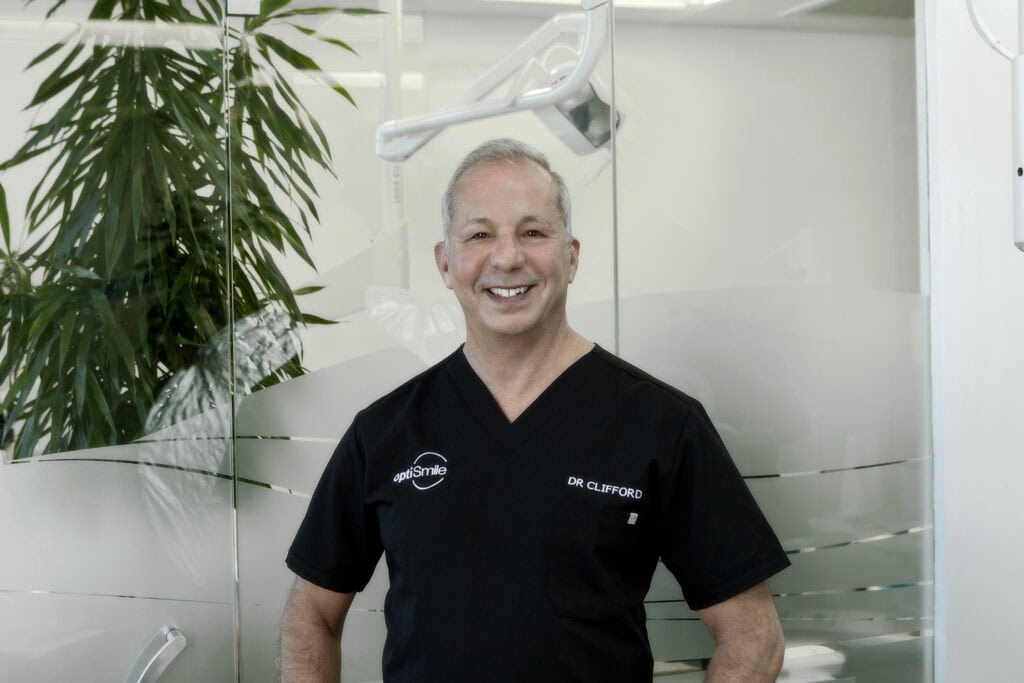
Eon Engelbrecht introduces Dr Clifford Yudelman and explains that biomimetic dentistry aims to mimic how natural teeth work, focusing on preserving as much tooth structure as possible.
Biomimetic vs Biologic Dentistry
[00:00:49 – 00:01:43]
Dr Yudelman clarifies that biomimetic dentistry should not be confused with biologic dentistry, which can oppose treatments such as root canal therapy and implants.
What Is Biomimetic Dentistry?
[00:01:43 – 00:03:41]
Biomimetic dentistry restores teeth to behave more like natural teeth biomechanically, using adhesive techniques and layered materials rather than simply filling cavities or defaulting to crowns.
Why Crowns Are Often Unnecessary
[00:03:42 – 00:05:18]
Crowns can be overused because they require removing healthy tooth structure. Biomimetic techniques often use bonded onlays or partial restorations to reinforce teeth internally while preserving enamel and reducing long-term complications.
Materials That Mimic Natural Tooth Flex
[00:05:18 – 00:07:19]
Dr Yudelman explains how modern composite resins can replicate dentine’s flexibility, and how fibre-reinforced composites such as EverX can act like internal “rebar”, helping the tooth absorb stress rather than fracture.
How Fibre-Reinforced Composite Stops Cracks Spreading
[00:07:34 – 00:09:30]
Fibre-reinforced materials interrupt crack propagation by distributing stress across a wider area. Dr Yudelman shares an example of stabilising a cracked molar with EverX and a bonded ceramic onlay to avoid extraction and reduce emergency failures.
The Peripheral Seal Zone
[00:09:31 – 00:13:42]
The “peripheral seal zone” is the enamel ring at the restoration’s edge. Preserving enamel margins improves bond durability, reduces micro-leakage, and increases restoration longevity, which is central to biomimetic success.
Does Biomimetic Dentistry Take Longer?
[00:13:42 – 00:14:41]
Biomimetic work can take longer because it is technique-sensitive and relies on careful moisture control and precise bonding. The trade-off is fewer failures and less retreatment over time.
Cost Up Front vs Long-Term Value
[00:14:41 – 00:16:57]
While biomimetic dentistry can cost more initially due to time and specialised materials, it can reduce lifetime costs by slowing the “restorative cycle” and avoiding larger procedures such as crowns, root canals, and extractions.
Can Biomimetics Avoid Some Root Canals?
[00:16:58 – 00:18:44]
Dr Yudelman explains that biomimetics cannot replace a root canal when the nerve is irreversibly infected, but some teeth recommended for root canal treatment can be stabilised by sealing cracks and stopping bacterial leakage, allowing the nerve to recover.
Why Tooth Conservation Is the Golden Rule
[00:18:44 – 00:20:04]
Preserving enamel and dentine is critical because lost tooth structure cannot be regenerated. OptiSmile’s approach prioritises conservative, evidence-based dentistry that supports tooth survival over decades.
How Injection Moulding Fits Biomimetic Dentistry
[00:20:04 – 00:21:25]
Injection moulding is a biomimetic technique that uses clear moulds to place composite precisely, restoring worn teeth with minimal or no drilling. Dr Yudelman links this to injection moulding as a practical way to recreate natural shape and function.
Conclusion and Next Episode
[00:21:25 – 00:23:53]
Eon summarises how nature-inspired restorations can lead to stronger, longer-lasting teeth. Dr Yudelman previews the next episode on cracked tooth syndrome, and listeners are encouraged to learn more at OptiSmile.
Transcript
Eon Engelbrecht:eRadio: (0:03 – 0:49) Welcome back to Save Your Money, Save Your
Teeth. I am Eon from eRadio SA, joined today by Dr Clifford Yudelman from OptiSmile in
Sea Point, Cape Town, discussing a revolutionary approach to dental care: biomimetic
dentistry. Biomimetic literally means to mimic life, instead of the old-school drill-and-fill
method or jumping straight to crowns. This approach focuses on saving as much of
your natural teeth as possible by copying how nature intended your teeth to function.
Dr Yudelman, it is great to have you back to explain how this philosophy is changing
the game for patients.
Dr Clifford Yudelman:OptiSmile: (0:49 – 1:43) Hi Eon, great to hear your voice again.
Thanks for having me back, and I am looking forward to today. I just want to say right
up front that we must not confuse biomimetic dentistry with biologic dentistry. These
are two very different things. Biologic dentistry is where dentists have a philosophy
that root canals do not work, that all teeth with root canals should be pulled out, and
that implants are bad for you. That is almost the opposite of biomimetic dentistry.
Eon Engelbrecht:eRadio: (1:43 – 1:49) So, what exactly is biomimetic dentistry, and
how does it differ from traditional dentistry, Doctor?
Dr Clifford Yudelman:OptiSmile: (1:50 – 3:41) A lot of modern digital dentists and
higher-end practices have incorporated biomimetic dentistry into their everyday
traditional dentistry. Biomimetic dentistry literally means imitating nature or imitating
life. The aim is to restore the teeth in a way that closely mimics how natural teeth
behave biomechanically, rather than simply filling holes or covering damage with large
restorations.
Traditional dentistry often focused on removing weakened tooth structure and
replacing it with rigid materials, culminating in crowns. While that approach can work,
it almost always sacrifices healthy tissue and changes how forces are distributed
throughout the tooth. Biomimetic dentistry takes a different view: it asks how a natural
tooth flexes, absorbs load, and dissipates stress. It then tries to recreate those
properties using adhesive techniques and layered materials.
Evidence from restorative and material science shows that preserving enamel and
maintaining bonded interfaces significantly improves long-term tooth survival.
Therefore, biomimetic dentistry is not a trend; it is an evolution driven by a better
understanding of both biomechanics and modern adhesive technology.
Eon Engelbrecht:eRadio: (3:42 – 3:47) Okay. And why do you say crowns are often
unnecessary with this approach?
Dr Clifford Yudelman:OptiSmile: (3:48 – 5:18) Crowns are sometimes necessary, but
historically—and even currently in many practices—they have been overused. They are
often seen as the most predictable way to reinforce a weakened tooth after a large
filling or a crack. However, crowns require the substantial removal of healthy tooth
structure to create space for the material. This can weaken the tooth biologically, even
if it looks strong from the outside. Research shows that losing internal tooth structure,
especially dentine near the nerve, significantly increases the risk of fracture or tooth
loss.
When a biomimetic technique is used, we can often reinforce the teeth internally using
bonded onlays or partial restorations that preserve the cusps and the cervical enamel
—the enamel around the neck of the tooth near the gum. By maintaining natural tooth
architecture and bonding restorations to enamel, we reduce stress concentration and
crack propagation. The result is that many teeth that would have previously been
crowned can now be restored conservatively, saving tooth structure, reducing
complications, and saving money over the lifetime of the tooth.
Eon Engelbrecht:eRadio: (5:18 – 5:25) Doctor, what materials are used to mimic the
natural flexibility of a tooth?
Dr Clifford Yudelman:OptiSmile: (5:25 – 7:19) Natural teeth are not 100% rigid. Enamel
is hard but brittle, whereas dentine is more flexible and shock-absorbing. Biomimetic
dentistry uses materials that aim to replicate this balance. We use modern composite
resins, especially those for bulk dentine replacement, almost every day. They have a
modulus of elasticity—how it flexes—that is very similar to dentine, unlike rigid
ceramics or metal.
We use a special material called EverX. It is a fibre-reinforced composite that adds a
layer of toughness by acting like internal “rebar”, similar to how metal bars distribute
stress in concrete and stop cracks from propagating. When I work under a microscope,
I can actually see these Kevlar-like fibres, similar to what they use in bulletproof jackets.
When it is dispensed from the syringe, you see these tiny hairs, but as it warms up in
the mouth before we cure it with a light, those hairs disappear. Once cured, it is solid
but retains a little flex because of those fibres inside.
These adhesive systems play a critical role. Strong, durable bonds between the tooth
and the restoration allow the whole complex to function as a single unit, which is
essential for mimicking natural biomechanics. Material science shows that restorations
with dentine-like elasticity reduce catastrophic fractures compared to rigid
restorations.
Eon Engelbrecht:eRadio: (7:19 – 7:28) Okay, and I like that you used that example of
rebar in the concrete; that really paints the picture quite well.
Dr Clifford Yudelman:OptiSmile: (7:30 – 7:33) It solidifies the fact.
Eon Engelbrecht:eRadio: (7:34 – 7:43) Yeah, it does. How does a fibre-reinforced
composite prevent teeth from cracking any further?
Dr Clifford Yudelman:OptiSmile: (7:44 – 9:30) Cracks in teeth behave a bit like cracks in
glass; once initiated, they tend to propagate under repeated load. Fibre-reinforced
composites help by interrupting the crack’s propagation. The fibres act as stress
distributors, spreading the load across a wider area rather than concentrating it at the
crack, reducing the likelihood that it will progress to the nerve or root.
Just the other day, I treated someone with a split lower molar that many dentists would
have pulled out. We prepared it for an onlay, not a crown. Under the microscope, we
followed the crack, cleaned it out, filled it with EverX, smoothed it down, and bonded
ceramic on top. We basically placed a microscopic Kevlar lattice inside. Laboratory and
clinical studies show that fibre-reinforced restorations significantly improve fracture
resistance on these compromised teeth. While it doesn’t make the tooth indestructible,
it buys time and stability, delaying the need for aggressive treatment. For the patient,
this means fewer sudden failures and less emergency dentistry.
Eon Engelbrecht:eRadio: (9:31 – 9:40) Okay. And what is the peripheral seal zone, and
why is it critical for long-lasting bonds?
Dr Clifford Yudelman:OptiSmile: (9:40 – 13:42) It is a bit of a mouthful, isn’t it?
“Peripheral” means the outside edge or border, and the “seal zone” is the outer rim of
enamel around the restoration. Biomimetic dentistry places a huge emphasis on
preserving this enamel ring because adhesive bonds to enamel are far more
predictable and durable than bonds to dentine. When restorations are primarily
bonded to the enamel margins, micro-leakage is reduced, bacteria are excluded, and
the restoration lasts much longer.
Research shows that restoration failure often begins at poorly sealed margins, not in
the middle of the filling. Preserving enamel at the edges is one of the most powerful
predictors of long-term success. For example, if you have a big hole with an old silver
filling and a crack, many dentists will drill away all the surrounding enamel to put a
crown over it. This leaves no enamel to bond to, ruining the tooth inside.
Instead, our approach is to clean out the decay, save that peripheral enamel zone, and
fill the tooth internally with EverX. We then polish it back, scan the tooth with a 3D
scanner, and mill a ceramic restoration from a solid block of e.max or Lisi Block. We
bond this over the EverX, sealing it completely onto the outer enamel. This is how we
save teeth. I have patients who have had these biomimetic restorations going strong
for nearly 11 years, whereas traditional crowns can sometimes pop off or break.
Eon Engelbrecht:eRadio: (13:42 – 13:50) I am sure our listeners also want to know if
biomimetic dentistry takes longer than a standard filling?
Dr Clifford Yudelman:OptiSmile: (13:50 – 14:41) Oh yeah, sometimes twice as long.
Biomimetic dentistry is highly technique-sensitive. You must ensure everything is
completely dry and carefully follow layering and bonding protocols. However, the time
spent upfront saves time later. A properly sealed and reinforced restoration is far less
likely to fail or leak, reducing the need for retreatment. The trade-off for this extra time
is fewer future appointments and less invasive dentistry over the long term.
Eon Engelbrecht:eRadio: (14:41 – 14:48) And is this approach more expensive up front,
or does it actually save money long term?
Dr Clifford Yudelman:OptiSmile: (14:48 – 16:57) Both. Up front, it can and often does
cost more than a simple filling. There is extra time, specialized materials, magnification
equipment, and extensive training involved. However, the real value lies in the lifetime
cost. Studies on “restorative cycles” show that once a tooth enters a repair spiral, each
replacement becomes larger and more expensive. By preserving tooth structure early,
biomimetic dentistry slows or stops that spiral.
Avoiding crowns, root canals, and extractions represents substantial financial savings.
When viewed through a lifetime cost lens, these conservative restorations are often the
most economical option. It is important for patients to be cautious of aggressive
“cosmetic” recommendations that unnecessarily involve covering all the teeth, as
anyone following modern dental evidence knows that preserving enamel is always
better.
Eon Engelbrecht:eRadio: (16:58 – 17:06) Can a tooth that has been recommended for a
root canal actually be saved with biomimetics, Doctor?
Dr Clifford Yudelman:OptiSmile: (17:06 – 18:44) Yes. While biomimetics cannot replace
a root canal when a nerve is irreversibly infected, teeth recommended for root canals
often simply have cracks or deep fillings causing sensitivity. The nerves are not always
dead. By sealing the crack or overlaying the tooth to eliminate bacterial leakage, the
nerve can actually recover. We do that a lot at OptiSmile. Clinical studies show that
nerve inflammation can be reversible if you stop the bacteria from entering early.
Proper diagnosis is critical. The goal is not to avoid root canals at all costs, but to
ensure they are truly necessary. Jumping straight to a root canal and crown is
expensive biologically and financially. Saving a living tooth is biologically superior
whenever the symptoms support it.
Eon Engelbrecht:eRadio: (18:44 – 18:53) Absolutely. Why is the conservation of tooth
structure the golden rule at OptiSmile?
Dr Clifford Yudelman:OptiSmile: (18:53 – 20:04) At OptiSmile, and other top-tier
practices, we know that every millimetre of natural tooth structure has value. Enamel
cannot be regenerated. Removing dentine permanently weakens teeth. Research
consistently shows that tooth survival is strongly linked to how much structure
remains. The more we remove, the higher the risk of fracture, nerve damage, and
eventual tooth loss. Our conservation approach is data-driven; preserving enamel and
sealing effectively gives teeth the best chance of lasting decades rather than years.
Eon Engelbrecht:eRadio: (20:04 – 20:13) Okay. And then one more question: how does
this relate to injection moulding, which we’ve discussed before?
Dr Clifford Yudelman:OptiSmile: (20:13 – 21:25) Thanks for asking that. Injection
moulding is a practical application of biomimetic principles. It allows highly controlled
placement of composite material using clear moulds, mimicking the natural tooth
shape and load distribution. We can restore worn or damaged teeth with minimal, and
often no, preparation.
From a biomechanical standpoint, injection-moulded restorations integrate seamlessly
with the remaining enamel. They allow patients to avoid crowns and extensive drilling
—we have built up entire mouths using this technique. When used appropriately,
injection moulding is conservative, evidence-based, and fits perfectly within biomimetic
dentistry.
Eon Engelbrecht:eRadio: (21:25 – 21:43) This was very interesting. Thank you so much
once again, Dr Yudelman, for breaking it down for us. It is fascinating to see how
moving away from rigid, aggressive treatments towards nature-inspired solutions can
lead to stronger, longer-lasting teeth.
Dr Clifford Yudelman:OptiSmile: (21:43 – 22:22) Thank you. Next week, in episode 97,
we will be discussing “Cracked Tooth Syndrome or Invisible Pain”, which ties in really
well with today’s episode. It is about having pain when biting something hard when the
dentist cannot see anything on the X-ray.
Eon Engelbrecht:eRadio: (22:22 – 22:48) We will keep you in suspense. Thank you so
much, Dr Yudelman. If you want to learn more about biomimetic dentistry or see if
your teeth can be restored without a crown, remember you can visit OptiSmile.co.za.
Save your money, save your teeth; join us next time as we help you protect your smile
and your wallet.
Announcer: (23:09 – 23:53) Discover the world of dental excellence with OptiSmile. Join
us for a weekly podcast featuring Dr Clifford Yudelman, a seasoned expert with 40
years of dental experience across four continents. Gain unique insights and expert
dental advice by visiting OptiSmile.co.za for articles that illuminate the path to optimal
oral health. If you’re seeking unparalleled dental care in Cape Town, get in touch with
OptiSmile or book directly online on OptiSmile.co.za. OptiSmile: where global expertise
meets local care.
Disclaimer: The content provided in this podcast, “Save Your Money Save Your Teeth” on Medical Mondays, is for informational and educational purposes only. It is not intended to serve as dental or medical advice. The insights and opinions expressed by Dr. Clifford Yudelman and any guests are designed to foster a better understanding of dental health, preventive measures, and general well-being, but should not be interpreted as professional dental or medical recommendations.Dr. Clifford Yudelman does not diagnose, treat, or offer prevention strategies for any health conditions directly through this podcast. This platform is not a substitute for the personalized care and advice provided by a licensed dental or healthcare professional. We strongly encourage our listeners to consult with their own dental care providers to address individual dental health needs and concerns.The information shared here aims to empower listeners with knowledge about dental health but must not be used as a basis for making health-related decisions without professional guidance. Your dental care provider is the best source of advice about your dental and overall health. Please always seek the advice of your dentist or other qualified health professionals regarding any questions or concerns about your dental health.