Chapters
Introduction
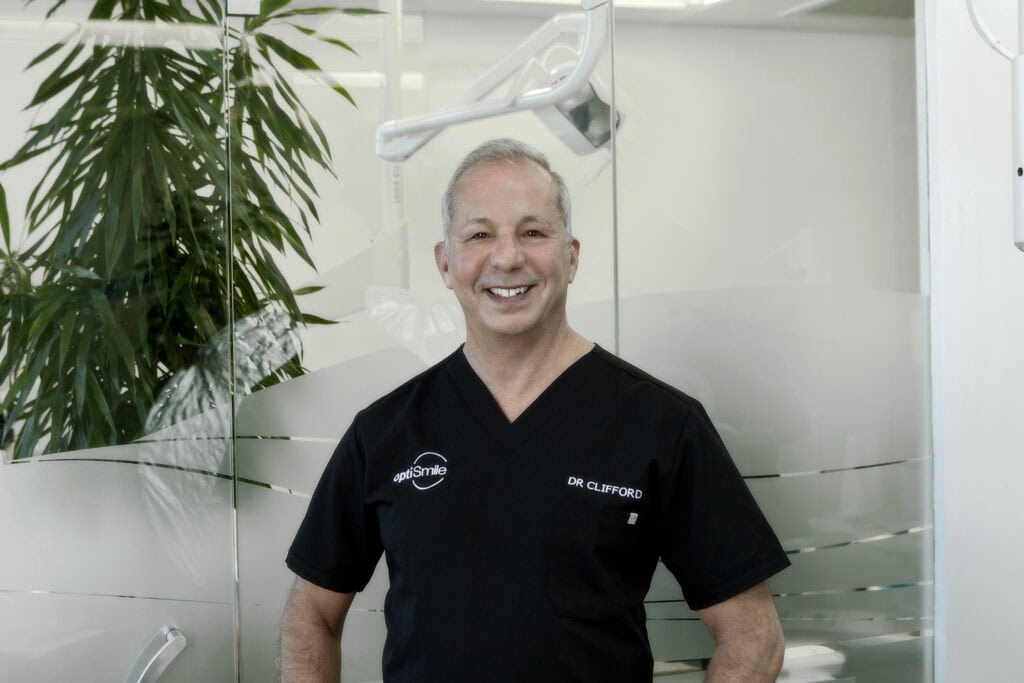
[00:00:04 – 00:01:10]Eon Engelbrecht introduces Dr Clifford Yudelman and frames today’s topic: the sharp, sudden pain that appears when eating yet the tooth looks completely normal. The episode focuses on cracked tooth syndrome — the invisible pain.
Symptoms and Causes of Cracked Teeth
[00:01:10 – 00:07:20]Pain on biting and releasing is the hallmark symptom of a cracked tooth. When you bite down, the crack compresses; when you release, it springs back and irritates the nerve.
Cracked teeth often look completely normal — no visible decay, no cavity, and frequently no crack visible to the naked eye. Standard X-rays typically appear normal because vertical cracks are too fine for standard imaging to detect.
Large silver fillings, clenching, grinding, and chewing accidents are the most common causes. Untreated cracks propagate over time — much like a windscreen crack that grows — and can progress to nerve inflammation or complete fracture if not stabilised early.
Diagnosis and the “Tooth Sleuth”
[00:07:58 – 00:12:31]Diagnosing a cracked tooth is a process rather than a single test. A specialist instrument called a tooth sleuth (or fracture finder) isolates individual cusps to reproduce and pinpoint the pain on release.
Magnification and a dental microscope allow the clinician to see whether a crack is actively opening, while transillumination — shining a small light through the tooth — reveals cracks when light fails to pass through.
Cold testing and 3D X-rays can assist, but the patient’s own description of pain on biting and releasing is often the most diagnostic indicator of all. A thorough dental check-up is often the first step towards identifying the source of unexplained tooth pain.
Craze Lines vs. Structural Cracks
[00:12:32 – 00:14:01]Craze lines are superficial cracks confined to the enamel — extremely common in adults, generally harmless, and not requiring treatment.
Structural cracks extend beyond the enamel into the dentine, flex under pressure, and allow bacteria to travel deeper into the tooth. The two can look similar on the surface, which is why diagnostic tests are essential.
Aggressively treating a craze line wastes healthy tooth structure; ignoring a structural crack risks losing the tooth entirely.
Can a Cracked Tooth Heal Itself?
[00:14:02 – 00:15:29]Unlike bone, teeth cannot heal cracks by themselves. Detected early, a crack can be stabilised using fibre-reinforced filling material to seal and reinforce the tooth.
Left untreated, repeated chewing forces will deepen the crack, eventually inflaming the nerve, causing infection, or splitting the tooth. Early intervention is the difference between a conservative repair and losing the tooth.
Crown vs. Onlay: Which Treatment Is Right?
[00:15:29 – 00:17:09]The choice between a crown and a bonded onlay depends on how much tooth structure remains and the extent of the crack.
Where one or two cusps are involved, a bonded onlay preserves far more natural tooth structure than a crown and is equally effective in most cases. A full crown is reserved for situations where the crack is extensive and compromises the overall integrity of the tooth.
In Dr Yudelman’s experience, over 95% of cases can be treated conservatively with an onlay-type approach.
When a Crack Reaches the Nerve
[00:17:09 – 00:20:25]When bacteria penetrate the pulp, root canal treatment is typically required to remove the inflamed or infected nerve and save the tooth. The tooth must then be reinforced with an onlay or crown to prevent further fracture.
Patients who have seen multiple dentists without a clear diagnosis are advised to consult an endodontist, who can identify cracked tooth syndrome using a microscope and recommend the most conservative treatment path.
Grinding (bruxism) is also a major risk factor — night-time grinding generates far greater forces than normal chewing and can crack even healthy, unrestored teeth over time. A custom night guard can significantly reduce crack risk.
Vertical Root Fractures and Prevention
[00:20:25 – 00:23:48]A vertical root fracture — most common in teeth that have had root canal treatment without subsequent protection — splits the tooth lengthwise, allows bacteria into the bone, and typically results in extraction followed by a dental implant.
Prevention focuses on managing grinding, reinforcing teeth with large existing fillings before they fail, and adjusting the bite to reduce stress on vulnerable cusps. Rather than waiting for symptoms to appear, patients should ask their dentist why a large filling is being monitored rather than upgraded to an onlay.
Cracked tooth syndrome is a clear example of why proactive dentistry saves teeth, saves money, and reduces stress over a lifetime.
Conclusion and Next Episode
[00:23:48 – 00:25:51]The episode closes with a reminder that invisible pain should never be ignored and that early intervention is the key to saving both the tooth and the wallet. The next episode will cover crown lengthening and fixing gummy smiles.
Transcript
(0:04 – 0:41) Eon Engelbrecht:
Hello and welcome to another edition of Save Your Money, Save Your Teeth. I’m Eon
and as always, we are joined by Dr Clifford Yudelman from OptiSmile to help you
navigate the world of oral health without breaking the bank. Today we’re diving into a
topic that is as frustrating as it is common. It’s that sharp, sudden pain that appears
out of nowhere when you’re eating, yet your tooth looks perfectly fine in the mirror.
We’re talking about cracked tooth syndrome, the invisible pain. Dr Yudelman, welcome
back.
(0:42 – 1:10) Dr Clifford Yudelman:
Thanks, thanks for having me back and yeah, already looking forward to helping a lot
of people today. Hopefully with today’s episode, it will help people to make sense of
something that’s maybe worried them for a long time, where perhaps they’ve gone to
speak to a few dentists and it’s still a bit of a mystery. So yeah, let’s shed some light on
cracked tooth syndrome, the invisible pain.
Symptoms and Causes of Cracked Teeth
(1:10 – 1:24) Eon Engelbrecht:
So Dr Yudelman, let’s get straight into the mystery of these hidden fractures. I want to
start off by asking you, why does my tooth hurt only when I bite down and release, but
I can’t see any cavity?
(1:25 – 3:49) Dr Clifford Yudelman:
That’s a best question to start with. Fantastic. So that’s a very common symptom of a
cracked tooth as opposed to sensitivity purely to cold air or too hot, which we’ve
covered before, speaking about sensitivity or root canals. There’s a number of episodes
about that, this is exactly the one thing that sets cracked teeth apart. So that on off
pain that you get, especially when you biting on say a pizza crust and then you release
or you biting into a piece of toast and you hit something hard and it’s usually as you
open your mouth, you get like a ping. That’s one of the classic signs of cracked teeth.
And the reason it feels so specific is it’s mechanical. When you bite down, the crack
compresses slightly. And when you release it, it springs back and the tiny movement
irritates the nerve inside the tooth. And what makes it so confusing for patients is that
cracked teeth often look completely normal. There may be no visible hole, no decay,
and sometimes not even visible, a visible crack to the naked eye. X-rays will often
appear normal. And that’s because the cracks run vertically and they’re actually too fine
to show on any standard imaging.
And, you know, from a biological point of view, the nerve is reacting to the sort of
repetitive micro movement, the fluid inside the dentine shifts. And that explains why
the pain is often sharp and brief. And it’s linked to pressure rather than a constant
aching. You know, the danger of ignoring this symptom is that the cracks tend to
propagate means they actually keep getting worse and worse, like a bit of a crack, like
if you’ve got a small crack in your windshield and you leave it in a week later, it’s gone
bigger and bigger. And, you know, what starts as a reversible irritation can actually
progress to nerve inflammation or even a split or a complete fracture if the tooth is not
stabilized early. And, you know, early diagnosis allows us to reinforce and protect the
tooth before the tooth becomes, before the crack becomes catastrophic. And so we’ll
shed some light on these invisible cracks now.
(3:49 – 3:56) Eon Engelbrecht:
I want to ask you what actually causes cracked tooth syndrome? Are fillings actually to
blame?
(3:56 – 5:41) Dr Clifford Yudelman:
So cracked tooth syndrome or CTS, if you Google that, or often the first article that
comes up is either Wikipedia, which often comes up, or these days with AI answers,
you’ll get all kinds of things on Google, but it’s sometimes known as a CTS, a cracked
tooth syndrome. And it really comes from, it’s multifactorial. It rarely comes from one
dramatic event. Instead, it’s the result of cumulative stress over time. You know, large
fillings are a big risk factor when a tooth has lost internal structure due to decay or
previous restorations, especially large silver fillings, which expand and they can actually
be one of the main causes for these cracks.
Sometimes those silver fillings, you know, don’t need replacing because of decay or
because of leaking, but mainly because they’re causing these cracks in the teeth. And
the tooth becomes more flexible when there’s like a lot of internal structure missing.
And it’s not able to distribute the biting forces evenly. And this makes it more prone to
cracking, especially under like a heavy load.
Other contributors include like clenching or grinding, biting hard objects, especially
something that we call a chewing accident, which is say you’re eating a hamburger and
there’s a little bit of a bone in there, or you’re eating granola and there’s a shell from a
walnut or something, or you’re eating a salad and you don’t realize that the olives
actually still got pips inside. It’s quite common. Or maybe you’re eating an oyster and
you bite on a pearl. Wouldn’t you be so lucky?
(5:43 – 5:45) Eon Engelbrecht:
I’ve had all of the above except that one.
(5:46 – 7:20) Dr Clifford Yudelman:
Pearly whites. Yeah. You know, so some people say sudden temperatures changes if
you’re drinking ice water and you eat soup, but I’ve never really seen that happen. But
age is one of the things. If you live, you know, if you’re 65, your six, your molar came in
when you were six, that tooth is the tooth that’s been in your mouth. Your toenails and
your fingernails have grown and all your blood vessels have changed over time, but
your teeth are still the same teeth. And if you think about it, that’s a long time.
Whatever you got that’s 50 years old, that still looks like it’s brand new. You know, it’s
amazing that teeth do last as long as they do.
But the teeth that look intact on the outside may actually be structurally compromised
on the inside. And, you know, teeth with big fillings are much more likely to develop
cracks than untouched or what we sometimes call virgin teeth. Yeah, they’re still,
they’re starting to frown on that term, but that’s still something that we call teeth that
are untouched virgin teeth. So go figure. And that doesn’t mean that fillings are bad. It
just means that the tooth needs reinforcement once a certain threshold of structure
loss is reached. And, you know, understanding the cause helps us to focus on
prevention, managing bite forces, reinforcing weakened teeth early and preserving
enamel in the first place are the key strategies to avoiding cracks.
(7:21 – 7:38) Eon Engelbrecht:
Yeah, I just want to say it’s so terrible when you’re eating something confidently, you
know, you’re eating it confidently, you’re enjoying it, it’s nice and soft. And then all of a
sudden there’s that crunch. And you just, oh, it’s just a terrible feeling. And immediately
your finger goes into your mouth to check if your tooth is still there.
(7:39 – 7:45) Dr Clifford Yudelman:
It’s just the worst feeling. You know, you know, the feeling that sounds like you’ve
experienced.
(7:45 – 7:51) Eon Engelbrecht:
Yeah, it is. Or somebody tells you it’s seedless grapes, and then you you bite and it’s
not seedless. Oh, my word, all the olives.
Diagnosis and the “Tooth Sleuth”
(7:58 – 8:11) Eon Engelbrecht:
So, doctor, how do you diagnose a crack if it doesn’t show up on a normal X-ray?
(8:11 – 12:31) Dr Clifford Yudelman:
It’s actually a process rather than a single test. We rely on a combination of a clinical
exam, the symptom patterns and special tests. Often while we’re just talking to the
patient in the chair, when they report exactly like what I mentioned before, you’re
eating a pizza crust or a piece of toast, a lot of time they might report that it was fine.
But a few weeks before they bit on something in a salad or whatever, bite tests are
specifically, we have a special instrument called a tooth sleuth. It’s S-L-E-U-T-H, like a
detective or a fracture finder. That’s quite obvious.
It’s like a little pyramid shaped, like a handle with a little pyramid. And on the point of
the pyramid, the flat side will go, let’s just say it’s a lower molar that’s sore. We could
actually put the point which has got a little hollow in it on each of your individual cusps.
And then the top of it’s flat, so your upper molars will bite down on the top of this tooth
or fracture finder. And then you’re putting all of that force down onto, say the inside
front cusp, which is often one that we see fracturing on lower molars. And then you
bite on the outside cusp and the neck and the next cusp and the next cusp. And then
we get to the one that we suspect and we ask you to bite slowly. And then you bite a
little bit. And as you release, you kind of, and you can reproduce it. And also, so that’s
like the most obvious one. Then we actually know exactly which cusp it is.
And then magnification and good lighting. We can see fracture lines and staining, but
we often see a lot of fracture lines and staining and craze lines. They don’t all need
restoration. It’s only these ones that are symptomatic. But to be honest, using a
microscope really helps because we can not only see that there is a crack, but we can
see whether the crack is opening up and all other kinds of things that you can’t see
with a naked eye.
And also there’s something called transillumination, where we can shine a special, a
tiny little light on the one side of the tooth. And then the light will travel right through
the tooth if there’s no crack, especially if a tooth without a filling. And then if the tooth’s
got a split or a crack, that doesn’t let the light continue. And then the one side of the
tooth will be bright. And then the other side past the crack will be dark. Like the light is
not getting past the crack. So that’s usually a giveaway. Cold testing. Crack teeth often
respond a lot more to cold. They linger or have exaggerated sensation or even blowing
a bit of air in the crack.
Sometimes a CBCT, a 3D x-ray will help, but normally the cracks too, because the tooth
is cracked, but the pieces are still touching. So that’s why you can see it with a
microscope or transillumination, but you can’t actually see these things on x-ray unless
the tooth is completely split and the parts are moved apart. In that case, you’re going
to notice, you’re going to see it without a CBCT x-ray. So a lot of time we get patients,
I’ve been to two dentists and they’ve taken x-rays and they don’t know why my tooth is
sore. And then you know what you’re dealing with. And what’s critical, as I said in the
beginning, is listening to the patient’s description. The story of the pain on release is
often the most diagnostic, more than any scan or test.
And early identification allows conservative stabilization rather than emergency
treatment later. So sometimes one can just replace the filling that’s expanding and
causing the crack and then reinforce the slightly broken part. We spoke about Ever-X in
the biomimetic chapter podcast, just a few podcasts back. And that was a special filling
that we can put to reinforce the cracked teeth. But often it requires an overlay, which is
a ceramic filling that covers the broken cusp as opposed to a crown. So we don’t like to
do crowns if at all possible.
Craze Lines vs. Cracks
(12:32 – 12:37) Eon Engelbrecht:
Okay. And is there a difference between a craze line and a structural crack doctor?
(12:38 – 14:01) Dr Clifford Yudelman:
Yeah. Yeah. A hundred percent. And sometimes people get told the wrong thing or
dentists might say, oh, you need a crown? Yeah. In the meantime, it’s just a craze line.
It’s always good to get a second opinion if you’re not quite sure you’re understanding
what the dentist is saying. So craze lines are just superficial cracks and they confine to
the enamel. They’re very common, like I said, especially in adults and they’re usually
harmless. And they don’t compromise. They don’t compromise the tooth strength and
they don’t cause pain.
Structural cracks extend beyond the enamel into the dentine. And these cracks can flex
when you put pressure on them. And they communicate with the nerve and the more
sensitive dentine. They can also allow bacteria to travel deeper into the tooth. The
challenge is that the craze lines and cracks can look very similar at first, but the
difference lies in the symptoms and the depth and how they behave when you put
pressure. That’s why we do all of those tests. And they’re not all visible lines like craze
lines are dangerous. It’s really unnecessary to treat craze lines aggressively. So
hopefully that helps people to save their money and save their teeth. But on the other
hand, if you ignore a structural crack or a tooth that’s pain on biting and releasing one
of these, you can you can lose your tooth.
Treatment and Prevention
(14:02 – 14:09) Eon Engelbrecht:
All right. And I also want to ask you, can a cracked tooth actually heal itself or will it
always just get worse?
(14:10 – 15:29) Dr Clifford Yudelman:
Well, wouldn’t that be great? There’s so many things now on Facebook and Instagram
about how the Chinese or who knows where India, you know, they’ve developed
something you just painted on the tooth and I don’t know, little nano robots or
whatever will fix the tooth. That’s still a ways off, but I think it is coming. But unlike
bone, teeth don’t heal cracks by themselves. Once you’ve a crack, it remains. You know,
sometimes progression is not inevitable, but most of the time, unless we actually treat
it, we see these things getting worse.
If a crack is detected early and stabilized, we can often prevent it from getting worse.
We reinforce the tooth, like I said, we redistribute the bite forces, we seal the crack,
often using that Ever-X, the special Kevlar fiber reinforced white filling material that’s
put over the crack, left untreated, just every time you chew, it’s going to cause that
crack to get bigger. And over time, it’s going to cause your nerve to get inflamed. You’re
going to get an infection or even a complete split of the tooth and you lose the tooth.
And, you know, while they do not heal, they can be successfully managed. And as
always, early intervention is the difference between a conservative repair and losing
the tooth.
(15:29 – 15:35) Eon Engelbrecht:
And when is a crown necessary versus a bonded onlay for a crack?
(15:36 – 17:09) Dr Clifford Yudelman:
So the decision depends on how much tooth structure remains and where the crack is.
If the crack involves one or two cusps and sufficient enamel remains, a bonded onlay
can often stabilize the tooth effectively. Onlays preserve more tooth structure and
maintain natural biomechanics. If the crack is extensive and involves multiple cusps
that compromise and compromises the structure of the tooth, a full crown may be
necessary to encircle and protect it. You know, evidence from restorative dentistry
journals shows that the bonded partial coverage restorations, the onlays, can be as
effective as crowns in select cases with a big advantage of that they are more
conservative.
And, you know, the key is proper assessment. Over-treatment wastes healthy tooth
tissue. Under-treatment risks catastrophic fracture. And in my experience, 95% or more
of the time, I can do some kind of onlay type of tooth. I never, hardly ever will drill the
tooth down to the gum line all the way around the tooth. Structurally, I always try to
save as much of the tooth as possible. Even if it’s, even if it’s, you know, like a third of
the tooth, that cusp, we won’t overlay it or very small overlay, but just drilling it down, I
think is, is very destructive in almost every case.
(17:09 – 17:14) Eon Engelbrecht:
And what happens if a crack goes all the way into the nerve?
(17:15 – 19:14) Dr Clifford Yudelman:
So when it gets into the nerve or the pulp bacteria get into the nerve, this leads to, we
did a podcast, we spoke about reversible or irreversible pulpitis. So the pulp is the
nerve. And then if you got irritation that, that if you fix irritation, the nerve will return
to normal, that’s called reversible pulpitis. And if it’s irreversible, that means that it’s on
the way to getting an infection or already has a partial infection. And at this stage, root
canal treatment is usually required to remove the infected or inflamed nerve and save
the tooth. And then the tooth must be reinforced with an overlay in many cases, and
sometimes a fracture to prevent, I mean, sometimes a crown to prevent further
fractures.
And if you delay treatment once the nerve is involved, that increases the risk of getting
an abscess or even splitting the tooth, getting a vertical root fracture, which means you
can’t save your tooth. And that’s why early symptoms should never be ignored. Acting
before a nerve gets involved gives us far more options. And if you have been to two
dentists already, and neither of them can see what’s going on, the best type of dentist
to see is one that, like an endodontist, a root canal specialist, because they’re not going
to do a root canal unless you really need it. In many cases, they’ll tell you, oh, you’ve
got a crack tooth syndrome, or they can see the crack with a microscope. So a lot of
general dentists these days have microscopes, like at OptiSmile, we have three of
them. And an advanced dentist like that would be able to tell you. And in many cases,
an endodontist might be able to tell you which dentist you could go to that would do
an onlay rather than pulling the tooth out or doing a root canal or doing a crown when
you don’t need it.
(19:14 – 19:20) Eon Engelbrecht:
And can grinding your teeth also cause these cracks even on healthy teeth?
(19:21 – 19:25) Dr Clifford Yudelman:
A hundred percent. So bruxism, there’s my hundred percent. I love that, don’t I?
(19:26 – 19:27) Eon Engelbrecht:
Ah, that’s your line, yeah.
(19:27 – 20:25) Dr Clifford Yudelman:
Bruxism or teeth grinding, we’ve done a number of podcasts about these types of
things. And it’s one of the biggest risk factors. Grinding, especially at night, it creates
far more forces than normal chewing. And when you do this overnight, you’re not
doing it once or twice, you’re doing it all night. And even healthy unrestored teeth can
crack under these loads over time. And also the grinding accelerates the wear, it
shortens your teeth, it changes the bite, it further increases stress on the remaining
tooth structure. And managing grinding through behavioral awareness, stress
management, and also a bite guard or night guard, a special bite splint which protects
your teeth can significantly reduce crack risk and preserve your tooth long term or your
teeth in general.
(20:25 – 20:33) Eon Engelbrecht:
And what is a vertical root fracture? I think you mentioned it earlier. Why is it also a
worst case scenario?
(20:33 – 22:11) Dr Clifford Yudelman:
So there’s different types of fractures. You’ve got a simple fracture, a complex fracture,
and then a split. So a simple fracture, imagine like we mentioned, you put pressure on
a cusp and the cusp is sensitive when you bite on it. If you left that, that cusp could just
break off. I mean, I saw two patients today that had cusps that just broke off. The one
patient, the cusp broke off above the gum line. So that’s fairly simple. You can just
patch it and then the patient comes back for an onlay. The other patient, it was almost
complex where it broke below the gum line. So we put something temporary and that
patient will have to come back and we’re going to laser away some of the gum with a
little laser and then do an inlay onlay. If it’s a complex crack, that means that it’s gone
through the nerve and then a nerve root canal might be needed. And the last one is
this vertical root fracture or a split.
It’s very common when a tooth has already had a root canal and the tooth wasn’t
protected. And you already want to prevent cracks before they get to this stage
because if you get a split, say an upper premolar and then your outside part of your
tooth and your inside part of your tooth separate right between the roots, the tooth is
split down the middle like a log that’s been split and you can’t do anything because the
bacteria goes straight down all the way between the roots into the bone and you get a
big abscess and that’s when you got to then get an implant and it’s a whole big deal.
(22:11 – 22:17) Eon Engelbrecht:
And just one more question, how can we prevent our teeth from cracking in the first
place?
(22:17 – 23:48) Dr Clifford Yudelman:
So prevention focuses on reducing stress and preserving structure. This includes
managing clenching and grinding, reinforcing teeth with big fillings before they fail.
When the dentist says, oh, you got a big filling there, we really should change it out
sometime for an onlay. The thing to do is to ask the dentist, well, why are we waiting?
Are you worried about my finances? Are you, you know, what is the reason for delaying
this? It would be a good thing to ask. The dentist might say, oh no, if it’s not hurting,
we can just wait until, you know, it bothers you, but that’s always the wrong thing to
do. I’m not saying go and change every big filling. A lot of the time, adjusting the bite
or reducing a cusp that’s standing up higher than a filling can prevent the tooth from
breaking in the first place. I do a lot of that. I’m very conservative, enamelplasty or
ameloplasty or bite adjusting, smoothing off cusps that are sticking up that are prone
to breaking and, you know, monitoring wear, craze patterns, doing 3D scans and
checking for wear by comparing or overlaying a scan that you had done today with one
we did two years ago and comparing them with a little heat map. Crack tooth
syndrome is a perfect example of why proactive dentistry saves teeth, saves money
and saves you from stress over a lifetime.
Conclusion
(23:48 – 24:07) Eon Engelbrecht:
Dr Yudelman, thank you so much for shedding some light on why those invisible pains
shouldn’t be ignored. I think it’s clear when it comes to cracks, early intervention really
is the key to saving both the tooth and the wallet. Thank you once again for your time,
Dr Yudelman.
(24:07 – 24:18) Dr Clifford Yudelman:
Thank you, and it’s great to chat with you, and looking forward to next week, when
we’re going to be talking about crown lengthening and fixing gummy smiles and
similar.
(24:19 – 24:43) Eon Engelbrecht:
Looking forward to it and that’s it for this week’s Save Your Money, Save Your Teeth. If
you’re experiencing the sharp bite-and-release pain we discussed today, don’t wait for
it to become a disaster. Head over to OptiSmile.co.za to book your consultation. But
until next time, keep smiling and keep those teeth intact.
(25:06 – 25:51) Announcer
Discover the world of dental excellence with OptiSmile. Join us for a weekly podcast
featuring Dr Clifford Yudelman, a seasoned expert with 40 years of dental experience
across four continents. Gain unique insights and expert dental advice by visiting
OptiSmile.co.za for articles that illuminate the path to optimal oral health. If you’re
seeking unparalleled dental care in Cape Town, get in touch with OptiSmile or book
directly online on OptiSmile.co.za. OptiSmile, where global expertise meets local care
Disclaimer: The content provided in this podcast, “Save Your Money Save Your Teeth” on Medical Mondays, is for informational and educational purposes only. It is not intended to serve as dental or medical advice. The insights and opinions expressed by Dr. Clifford Yudelman and any guests are designed to foster a better understanding of dental health, preventive measures, and general well-being, but should not be interpreted as professional dental or medical recommendations.Dr. Clifford Yudelman does not diagnose, treat, or offer prevention strategies for any health conditions directly through this podcast. This platform is not a substitute for the personalized care and advice provided by a licensed dental or healthcare professional. We strongly encourage our listeners to consult with their own dental care providers to address individual dental health needs and concerns.The information shared here aims to empower listeners with knowledge about dental health but must not be used as a basis for making health-related decisions without professional guidance. Your dental care provider is the best source of advice about your dental and overall health. Please always seek the advice of your dentist or other qualified health professionals regarding any questions or concerns about your dental health.