Chapters
What Is a Maryland Bridge?
[00:04 – 04:49]
A Maryland Bridge, also known as a resin-bonded bridge, offers a conservative way to replace missing teeth without drilling down neighbouring teeth. Named after research from the University of Maryland, this technique has been used successfully for over 40 years.
Unlike traditional bridges that require significant tooth reduction, a Maryland Bridge uses thin wings bonded onto the back surfaces of adjacent teeth. The replacement tooth sits in the gap whilst the wings attach to the enamel on the inside surfaces of neighbouring teeth.
This approach preserves healthy tooth structure and keeps future treatment options open. Traditional bridges sacrifice two teeth to replace one, whilst Maryland Bridges aim to preserve the teeth you already have.
Minimal Intervention Philosophy
[04:49 – 06:00]
Maryland Bridges embody minimal intervention dentistry by doing the least amount of irreversible damage necessary to solve a problem. In most cases, there’s no drilling or only very minimal surface preparation required.
Preserving natural tooth structure is one of the strongest predictors of long-term dental health. Once enamel is removed, it’s gone forever, and every subsequent restoration becomes part of a repair cycle.
The flexibility of Maryland Bridges provides a major advantage, particularly for young patients or situations where long-term plans may change. If needed in the future, the bridge can be removed whilst your natural teeth remain intact.
Preparation and Bonding Process
[06:00 – 08:29]
Most Maryland Bridges require no significant drilling of neighbouring teeth. The wings bond directly onto the enamel surface on the inside of adjacent teeth.
The most common application is for upper lateral incisors, the front side teeth that sit between the main front tooth and the canine. Modern techniques often use a single wing design, bonded to either the main front tooth or canine, which has proven more durable than two-wing designs.
Some cases require minimal preparation, such as creating a small dimple behind the supporting tooth to ensure precise fitting. This preparation remains entirely within the enamel layer, making it scientifically sound and highly durable.
Strength and Durability
[08:29 – 09:24]
When designed and bonded correctly, Maryland Bridges can be surprisingly strong. They’re designed to handle normal forces from activities like chewing apples, carrots, speaking, and smiling.
Clinical studies show very good survival rates, especially when the bridge is placed in low-load areas such as front teeth. The strength comes from intelligent force management and respect for biomechanics rather than brute force.
Ideal Solution for Teenagers
[09:24 – 11:45]
Dental implants should generally wait until jaw growth is complete, as placing an implant too early can result in submergence or misalignment as the jaw continues developing. Maryland Bridges provide an excellent interim solution for teenagers who want a natural-looking smile.
Once growth is complete, the bridge can be removed and replaced with an implant if desired. Alternatively, many patients keep their Maryland Bridge long-term if it remains functional and aesthetic.
Many implant specialists now recommend Maryland Bridges for replacing missing upper front teeth to avoid the submergence issue, where teeth appear to grow longer whilst implant crowns look progressively shorter. This approach avoids rushing into invasive treatment before the body is ready.
Materials: Zirconia vs Metal
[11:46 – 14:09]
Earlier Maryland Bridges used metal wings made from non-precious metal, which could sometimes make teeth appear grey. Special white cements were used to block out the metal, but aesthetics were sometimes compromised.
Modern Maryland Bridges use zirconia, which bonds very well to teeth with special adhesives. Zirconia can be made extremely thin whilst maintaining exceptional strength, providing superior aesthetics and durability.
Some practitioners use lithium disilicate (Emax), but zirconia has proven more reliable for Maryland Bridge applications. Material selection should be based on biomechanics rather than marketing claims.
What Happens If It Falls Out?
[14:10 – 18:06]
If a Maryland Bridge debonds, it’s usually not an emergency. The bridge can often be cleaned and rebonded without damage to the supporting teeth, which is actually one of the key advantages.
The failure tends to be non-destructive, unlike failed crowns or traditional bridges where failure often means further tooth loss or more aggressive treatment. Patients should keep the bridge safe and contact their dentist promptly for rebonding.
Rebonding is straightforward with zirconia bridges using sandblasting, special primers, and adhesives. Patients are typically provided with a retainer that can hold the replacement tooth in position if the bridge comes out, maintaining aesthetics and preventing tooth movement until rebonding occurs.
Cost Comparison with Implants
[18:06 – 20:50]
Maryland Bridges are generally less expensive than dental implants, as they avoid surgical procedures. Implant placement alone can cost around 20,000–22,000 Rand, plus the cost of the implant fixture and crown.
Long-term costs should consider that Maryland Bridges can last many years, though they may occasionally need rebonding or replacement. Implants, whilst durable, also don’t last forever, and crowns on implants sometimes need replacing.
The choice between Maryland Bridges and implants should consider biology and patient preference alongside costs. Each solution involves maintenance and risk, but Maryland Bridges offer reversibility and preservation of future options.
Permanent or Temporary Solution?
[20:51 – 22:28]
Maryland Bridges can serve as either temporary or permanent solutions depending on the situation. In young patients awaiting implants, they function as an interim restoration. In other cases, they successfully serve as long-term solutions for many years.
Some patients lack sufficient bone for implants or have orthodontic limitations that make Maryland Bridges the ideal permanent solution. If a bridge needs replacement after 5–10 years, this is comparable to replacing a crown on an implant.
The main advantage remains reversibility and preservation of options, allowing patients flexibility as dental technology and personal circumstances evolve.
Ideal Candidates
[22:29 – 24:01]
Ideal candidates have healthy, unrestored neighbouring teeth with good enamel quality. The missing tooth should be in a low to moderate pressure area, and patients should have realistic expectations about the restoration.
Maryland Bridges aren’t suitable for patients with large fillings on adjacent teeth, severe grinding habits, or very deep bites that leave insufficient space for wing attachment without drilling into dentine. They work best for young, healthy patients who value tooth conservation.
Patients not ready for implants or those wanting to avoid drilling healthy teeth are excellent candidates. When done properly, a Maryland Bridge represents one of the most tooth-friendly replacement options available.
Transcript
Full Transcript
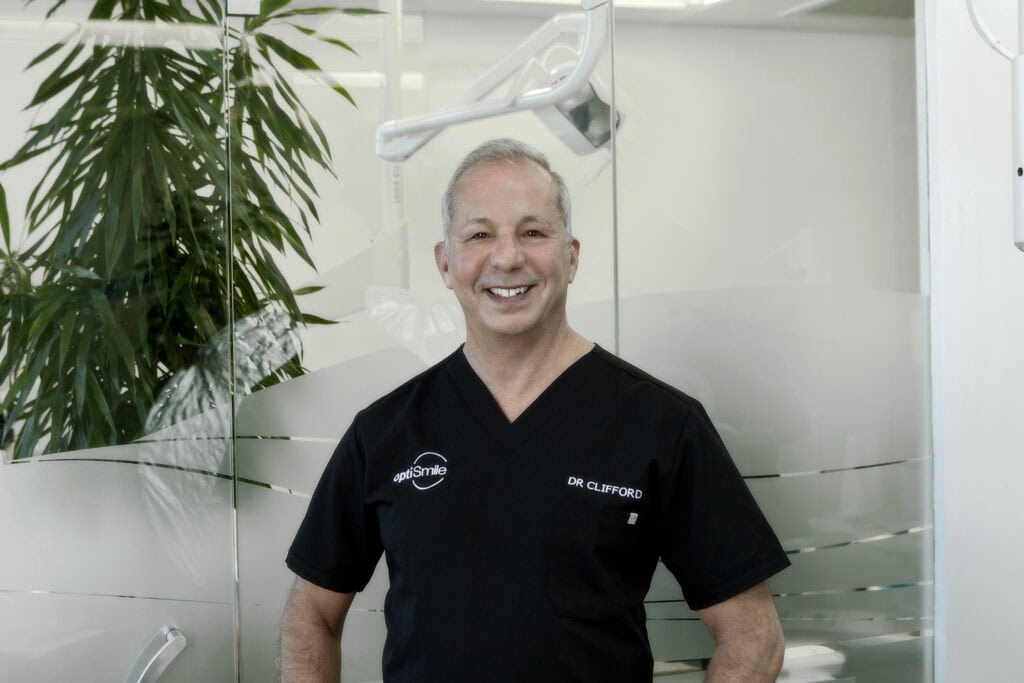
[Eon Engelbrecht – E-Radio-SA] (0:04 – 0:48)
Welcome back to Save Your Money, Save Your Teeth, episode 100. And today we are diving
into a topic that offers a truly tooth-friendly alternative for replacing missing teeth, the
Maryland Bridge. So joining me to walk us over this bridge, through this conservative
replacement option, is OptiSmile’s Dr. Clifford Yudelman, and we’ll be finding out why this
solution is often a better choice for preserving your natural teeth than just a traditional bridge,
and also how it fits perfectly into a philosophy of minimal intervention dentistry. Dr.
Yudelman, welcome back and congratulations on 100 episodes of Save Your Money, Save
Your Teeth.
[Dr Clifford Yudelman – OptiSmile] (0:49 – 1:23)
Thank you, thank you, and great to be back. And yes, can you believe it, over two years now,
and we’re still going strong. My book based on the podcast is reaching completion.
We’ll let people know when we’re ready. It still has to get published, but we’re putting all of
these podcasts into a book. I might have mentioned it a few times before, but yes, it’s looking
good. And today, Maryland Bridges, I’ve got a few stories about these, so I’m ready whenever
you are.
[Eon Engelbrecht – E-Radio-SA] (1:23 – 1:34)
It almost sounds like a tourist attraction somewhere in America. What is a Maryland Bridge
and how is it different from a traditional bridge, doctor?
[Dr Clifford Yudelman – OptiSmile] (1:34 – 4:49)
Okay, so just a little bit of history there. A Maryland Bridge is named after someone at the
University of Maryland in the US who figured out a way to glue a tooth onto the adjacent
teeth, which is what I’m going to talk about now, but it was first done or reported from the
University of Maryland, and that’s why it’s called a Maryland Bridge, or otherwise known as
a resin-bonded bridge or a bonded bridge. And I have been doing these in one form or
another since they first came out.
I went to a lecture when I was in London in the eighties, and when I was in California I did
quite a lot of Maryland Bridges over the years before implants were even available, and I
didn’t want to drill down adjacent teeth, and they worked well for back teeth back in those
days. And basically a Maryland Bridge is a conservative way of replacing a missing tooth
without drilling down the neighbouring teeth like a traditional bridge. So in a traditional
bridge, or a conventional bridge, the teeth on either side of the gap are drilled right down, like
turkey teeth style, to act as supports for crowns, and that permanently removes healthy
enamel and dentine.
Even I did a video consult with someone just before this podcast and they were in Jo’burg,
and they were down in Cape Town a while back and we did some treatment for them, and
they’re thinking of coming down to Cape Town to get some treatment done. A dentist up
there told them about getting a bridge and drilling down the two adjacent teeth. And so we
always look at other options to putting teeth into a pencil sharpener and filing them to a little
point because they don’t last forever, and then you could end up with three missing teeth
rather than one.
And so a Maryland Bridge works very differently. Instead of crowns, it uses thin wings
bonded onto the back of the adjacent teeth, and the replacement tooth sits in the gap, and the
wings are bonded to enamel on the inside surfaces of the neighbouring teeth. And from a
biological point of view, this is far less destructive. The enamel is the strongest structure we
have to bond to, and preserving it dramatically improves long-term tooth survival.
And evidence from adhesive dentistry shows that when restorations are bonded to this intact
enamel, they are more predictable and in some cases reversible, but not that you would
necessarily want to take out your Maryland Bridge and then have a gap. But sometimes you
do a Maryland Bridge while someone is still growing and waiting to do an implant, and then
you could just take the bridge off and they still have their own tooth. You haven’t drilled
away another tooth.
And so the key difference is philosophy. A traditional bridge sacrifices two teeth to replace
one. A Maryland Bridge aims to preserve the teeth you already have.
[Eon Engelbrecht – E-Radio-SA] (4:49 – 4:52)
Okay, and why is it called a minimal intervention option?
[Dr Clifford Yudelman – OptiSmile] (4:53 – 6:00)
Yes, so we’ve spoken a lot about minimal intervention, and this is about doing the least
amount of irreversible damage necessary to solve a problem, and a bonded or a resin-bonded
bridge, or Maryland Bridge, fits this philosophy perfectly. In most cases, there’s no drilling or
very minimal surface preparation is done. And if something happens in the future, like I just
mentioned, the bridge can be removed and your teeth are still there.
From an evidence-based perspective, preserving the natural tooth structure is one of the
strongest predictors of long-term dental health. Once your enamel is removed, it’s gone
forever, and then every restoration after that just becomes part of a repair cycle, and a
Maryland Bridge allows us to restore appearance and function while keeping future options
open. And that flexibility is a major advantage, particularly in young patients or younger
patients, or situations where long-term plans may change.
[Eon Engelbrecht – E-Radio-SA] (6:00 – 6:05)
And does a Maryland Bridge require drilling the neighbouring teeth as well?
[Dr Clifford Yudelman – OptiSmile] (6:05 – 8:29)
So in most cases, I say no significant drilling. I’ll explain in a minute. So the wings are
bonded directly onto the enamel surface on the inside of the adjacent teeth. In many cases
now, we say the most common tooth to do a Maryland Bridge is the upper front side tooth.
So you’ve got your main front tooth, and then the side or lateral incisor sits next to the front
tooth. And those are very often missing, or if someone’s had trauma and has had a root canal
in the past, they can be lost. Those teeth are not very robust because they’ve got thin little
roots. And then you’ve got your canine tooth.
And we often bond now, we don’t bond it to two teeth, we’ll bond it with one wing, kind of
like a springboard, like a diving board, often to the main front tooth or to the canine tooth.
And then the fake tooth sits in the gap and then you’ve only got one wing. The reason why we
do that, when we used to do two wings, one of them would de-bond and then we would just
trim off the wing that was de-bonded.
And we found that these things lasted much, much longer with just one wing. So we started
doing them with one wing. I saw a patient just recently, he was in two years ago, he was
missing his two front teeth and somebody did a bonded composite. They built up something
freehand and it was looking really ugly. And he came to us the following year, two years ago,
and we removed all of that. We did injection moulding on his two front teeth and his canine
teeth.
That’s where we do bonding using a mould, which we’ve done complete episodes on. And
then we did a little bit of drilling behind his two upper front teeth, just made like a little
dimple so that when we glue the bridge on, it’s got a little place that we know exactly where it
fits, and very minor preparation. In fact, if you look with the naked eye, you can’t even see it.
It doesn’t look like we drilled anything.
And we did two bridges for him, one for each side. And we’re still 100% in enamel. But when
you bond to this intact enamel, it’s very, very durable and it’s scientifically sound. It works
really well.
[Eon Engelbrecht – E-Radio-SA] (8:29 – 8:35)
Now, the big question is, how strong is it? Can you, for example, bite into an apple with one
of them?
[Dr Clifford Yudelman – OptiSmile] (8:36 – 9:24)
Yes, so when it’s designed and bonded correctly, it can be surprisingly strong. That said, it’s
not designed to take the same forces as a natural tooth or an implant. Things like apples, even
carrots, I think are fine.
Normal chewing, speaking, smiling is well tolerated, especially when the bridge is placed in a
low-load area such as a front tooth. And clinical studies show very good survival rates,
especially when we make sure that the bridge is designed so it doesn’t get excessive force and
that it’s bonded to good enamel. The strength here is not about brute force, but it’s about
intelligent force management and respect for biomechanics.
[Eon Engelbrecht – E-Radio-SA] (9:24 – 9:29)
And why is it a good option for teenagers who are too young for implants, doctor?
[Dr Clifford Yudelman – OptiSmile] (9:30 – 11:45)
So dental implants should generally wait until jaw growth is complete. Placing an implant too
early can result in the implant becoming submerged or misaligned as the jaw continues to
grow. And teenagers, however, still want a natural-looking smile and normal function.
And a Maryland Bridge provides an excellent interim solution that restores aesthetics without
interfering with the jaw growth and without committing the patient to irreversible treatment.
Once the growth is complete, the bridge can be removed and replaced with an implant if
desired. Alternatively, some patients keep the Maryland Bridge long term if it remains
functional and aesthetic.
And from a cost and biological perspective, this approach avoids rushing into invasive
treatment before the body is ready. And that part that I just told you is more common now. In
fact, a lot of people, even implant specialists, are recommending Maryland Bridges for
replacing missing upper front teeth because they attach to the adjacent teeth and they don’t
get this submergence, which means that your teeth sort of grow longer and the side front teeth
keep looking shorter and shorter.
And then you’ve got to get the implant replaced later on or the crown replaced. We’ve got a
few cases on now. I’ve got one patient, he lost his two front teeth and now they look really
short. All his other teeth are much longer and he’s now having to get Invisalign, and then he
has to get new crowns. Luckily, we’re able to save his implants. He’s about 35.
So, and males, we sometimes say, oh, you’re a male, they stop growing sooner, we can do an
implant. Some people are a bit gung ho to put implants in right away or too early. But that’s
why we’re doing these podcasts and the book, to give people the opinion as to what has been
shown to be true.
[Eon Engelbrecht – E-Radio-SA] (11:46 – 11:52)
And regarding the materials, what materials are used? Is it metal or porcelain?
[Dr Clifford Yudelman – OptiSmile] (11:52 – 14:09)
So we always used to use metal wings. Specifically, it was called non-precious metal, like a
silver metal, not gold. Although I did make some out of gold and you had to tin-plate it and
there was special cement. I’m giving away my age now. I’ve been practising 43 years. So I’ve
been doing Maryland Bridges probably for about 40 years.
I went to California in 86. So yes, around 40 years ago, I started doing Maryland Bridges. In
those days they were metal and the wing would bond behind. There would be a thin metal
wing behind the upper front tooth that could make the tooth look a bit grey. We had special
cements that were very white to try to block out the metal.
But the new ones now that work very well, like this young man that came from California
and we saw him now two years later and they look absolutely perfect, those are made from
zirconia. Some dentists say zirconia doesn’t bond to teeth really well. But actually, that’s just,
you know, sometimes these things take a while to get accepted. The zirconia works very, very
well. And there’s special glues for them.
So a lot of dentists will use lithium disilicate, which is your Emax, which we do for our inlays
and so on. But I’ve had some of those break. They’re supposed to be good for Maryland
Bridges. I had a late auntie, my dad’s late sister, and I made her a lithium disilicate Emax
bridge. And yes, unfortunately that wing broke off. And we had to make her a new one.
So I don’t like to make them out of Emax. I just think it’s a great material, yes, but zirconia
works really well. There might be a case in the future where I decide to do one out of metal,
but I doubt it. And zirconia, you can make them really thin and they’re very, very strong.
A well-designed ceramic Maryland Bridge, it’s an amazing option. And yes, we use the
material based on biomechanics, not just on marketing.
[Eon Engelbrecht – E-Radio-SA] (14:10 – 14:17)
And I’ll have another scenario for you, doctor. What happens if it falls out? Is this actually
seen as a dental emergency?
[Dr Clifford Yudelman – OptiSmile] (14:17 – 18:06)
So if a Maryland Bridge de-bonds, it’s usually not an emergency. The bridge can often be
cleaned and re-bonded without damage to the supporting teeth. This is actually one of the
advantages. The failure tends to be non-destructive. So that’s if it just de-bonds, if the wing
de-bonds.
You compare that to a failed crown or traditional bridge. That’s where failure often means
further tooth loss or more aggressive treatment. So patients should keep the bridge safe and
contact their dentist promptly. Or if they’re travelling, their dentist can maybe help find, like
we’ve got networks all over the world. If I did one for someone and they got hold of me, I
would try and find a dentist who knew what they were doing, who was familiar with this.
Re-bonding is very straightforward, especially with a zirconia-type bridge. You have a
special sandblaster. We would just sandblast the fitting surface, the wing, and then use little
fine diamonds to clean any cement off the tooth, re-etch the tooth, put the glue on the tooth,
put the special primer on the zirconia, and put it straight back in.
You know, non-catastrophic failure is a feature, not a flaw, of conservative dentistry. And
what we always do, so the young man in California is actually a rocket scientist. Aaron, if
you hear this episode on Maryland Bridges, I hope you’re doing well. It was great to see you.
His name’s Aaron. I won’t give his last name, but we give patients a retainer.
So if a Maryland Bridge does pop out, you can just pop it into the retainer and then wear the
retainer like Invisalign. And that will stop your teeth from moving. And it looks great. It
looks like you’ve got your tooth back in. And it can also be used to help a dentist to reseat the
bridge when you’re gluing it back in because it keeps the position.
It just looks like you’re wearing Invisalign. You can’t eat with a retainer in. So obviously it’s
an emergency. It’s a cosmetic emergency because nobody wants to walk around, and it’s
usually a front tooth, although we have done molars. I’ve done a lot of missing molars.
That leads me to another quick story. When I said I’ve been doing these for years, I had a
patient back in the eighties in California. It was an elderly gentleman, but in those days if you
were about 65, you were retired and elderly. Now I’m 65 and I’m working five days a week.
But he used to love duck hunting and his eyesight wasn’t so great, and he didn’t clean the
duck shot.
I hope there’s no vegetarians listening to this. He always used to eat. He wouldn’t just shoot a
whole bunch of ducks and leave them there. He used to go hunting and then they’d camp and
then they would cook the duck. But the duck got the better of him on four occasions. He bit
down on a piece of shotgun, what do you call it, shot. It’s like a round ball bearing. And I
think he gave up duck hunting after I did tooth number four.
He kept cracking his molars on duck shot or whatever they call it. And I did. I did. The rest of
his teeth were perfect, funnily enough. He had no fillings anyway, but he had four missing
molars and all of them were replaced with metal-bonded Maryland Bridges. And over the, I
was in California for 16 years, and I saw those bridges seven, eight, nine years later. And he
could eat anything. I think he was even eating more duck shot on those. So they were good.
[Eon Engelbrecht – E-Radio-SA] (18:06 – 18:12)
That’s a lovely story, Dr. Yudelman. I also want to ask you, how does the cost compare to…
[Dr Clifford Yudelman – OptiSmile] (18:12 – 19:03)
Sorry, I’ve got another story about that very same gentleman. It’s a long time ago. I don’t
remember his name, but he was so impressed with the practice, he brought his elderly mum in
and when I say elderly, in those days you didn’t really get to meet people who were 92 years
old. And she had an upper denture and she had a few of her own lower teeth.
And one of the lower teeth was extremely sharp and she was a bit hard of hearing and the
nurse was worried that this tooth was going to cut her lip. So they brought her in for me to
polish or smooth off the sharp tooth. And I explained it to her and she was registering, and I
was just about to polish the sharp edge and she grabbed my hand and she said, you know, she
was hard of hearing, so she said quite loudly, she said, young man, that is the tooth that I use
to chew my steak. Don’t you dare touch it.
[Eon Engelbrecht – E-Radio-SA] (19:06 – 19:07)
Oh, that’s sweet.
[Dr Clifford Yudelman – OptiSmile] (19:09 – 19:19)
So you always want to inform patients what you’re going to do. We could have ruined her
steak dinner Tuesday, whatever it was.
[Eon Engelbrecht – E-Radio-SA] (19:21 – 19:26)
Doctor, how does the cost compare to a dental implant?
[Dr Clifford Yudelman – OptiSmile] (19:26 – 20:50)
So it should be quite a lot less expensive. You’re avoiding surgery, you know, to place an
implant can be 20 or 22,000 Rand. You still have to pay for the actual implant. Then you’ve
got to get a crown on the implant. I mean, implants are great. I’m not saying one shouldn’t get
an implant, and usually it’s either or.
So there are times where a Maryland Bridge is done specifically for specific reasons, and
there are other times where an implant would be much better. So it’s not generally done
because of the costs for one reason or another. And so over the long term, Maryland Bridges
can last many years, while in other cases they need re-bonding or replacement.
Implants, which are durable, don’t last forever. The crown on the implant could be, I was just
at a conference a couple of weeks ago with the dentist from the practice, a two-day
conference, and they were talking about how long implants last and how long the crowns on
implants last. And while the implant might last 10, 20, 30 years, the crown on the implant
sometimes needs replacing, just like a regular crown needs replacing.
So costs should always be considered, but you should also consider the biology and the
patient preference.
[Eon Engelbrecht – E-Radio-SA] (20:51 – 20:56)
Okay. And can a Maryland Bridge be a permanent solution or is it just a temporary?
[Dr Clifford Yudelman – OptiSmile] (20:57 – 22:28)
Yes, so it can be both. In some cases they use it just as a temporary in young patients where
you’re definitely planning on an implant or some other type of work. In other cases, they
function successfully for many, many years as a long-term solution.
In the case with Aaron, when they did his orthodontics, they put his teeth in a good position,
but they didn’t move the roots over. And he didn’t have space. He doesn’t have space to move
his roots out of the way. And there isn’t enough bone to get implants. And he just finished
university as an aerospace engineer and he’s busy working and he doesn’t want to get braces.
And now that he’s got these bonded bridges, he’s very happy. And we expect these to actually
be a lifetime solution for him. Unless they were falling off every two or three years and it was
a big headache, and he decided in the future to get implants or whatever the next best thing is
after that, but they can last very well. And if you have to do a new one five, six, 10 years
later, it’s not a big deal.
If you’ve got an implant and you’ve got a crown on it, you might need a new crown 10 years
later. And the main thing is, you know, they’re not indestructible, but neither is a crown or an
implant. Every dental solution involves maintenance and risk, but the big advantage is
reversibility and the preservation of options.
[Eon Engelbrecht – E-Radio-SA] (22:29 – 22:34)
And just one more question, who is the ideal candidate for this type of bridge?
[Dr Clifford Yudelman – OptiSmile] (22:34 – 24:01)
Obviously you want to have healthy and unrestored neighbouring teeth with good enamel
quality. The missing tooth must be in a low to moderate sort of pressure area, with realistic
expectations.
So you’re not going to do it in someone who’s got big fillings on the adjacent teeth, or that’s a
severe grinder, and the tooth that they lost was lost because they ground it right out of their
mouth, or in a patient with a very deep bite and there’s no space to actually bond a wing onto
the back of the tooth without grinding away half a millimetre, and then you’re going to be
into dentine because you can’t bond to dentine.
Yes, it’s generally young, healthy patients. It’s not for some person who’s 50 and their teeth
are all ground down and they knocked out the side front tooth or their main front tooth. Those
are cases where you’re going to probably do an implant, and definitely not a bridge. An
implant is really the way to go, based on the individual circumstance.
But it’s where patients value conservation, tooth conservation, maybe they’re not ready for
implants or want to avoid drilling healthy teeth. Those are all good candidates. And when it’s
done properly, a Maryland Bridge can be one of the most tooth-friendly replacement options
available.
[Eon Engelbrecht – E-Radio-SA] (24:02 – 24:22)
I think it’s a brilliant cost-effective solution that actually preserves your future options, and
that makes it ideal for young patients who are not yet ready for an implant or anyone who
values keeping their natural tooth structure intact. Dr. Yudelman, that was a very incredible,
insightful chat again today. Thank you so much.
[Dr Clifford Yudelman – OptiSmile] (24:23 – 24:27)
Thank you. And that wraps up episode number 100. One hundred.
[Eon Engelbrecht – E-Radio-SA] (24:28 – 24:39)
Let’s have some champagne. Let’s pop a cork. Dr. Yudelman, thank you so much. Brilliant.
And congratulations once again on 100 podcasts.
[Dr Clifford Yudelman – OptiSmile] (24:39 – 24:44)
Yes. Thank you very much. And looking forward to speaking to you again next week.
[Eon Engelbrecht – E-Radio-SA] (24:45 – 24:46)
Absolutely. Until next time.
[Dr Clifford Yudelman – OptiSmile] (24:47 – 24:48)
Thank you very much. Bye.
[OptiSmile Announcer] (25:08 – 25:52)
Discover the world of dental excellence with OptiSmile. Join us for a weekly podcast
featuring Dr. Clifford Yudelman, a seasoned expert with 40 years of dental experience across
four continents. Gain unique insights and expert dental advice by visiting OptiSmile.co.za for
articles that illuminate the path to optimal oral health. If you’re seeking unparalleled dental
care in Cape Town, get in touch with OptiSmile or book directly online on OptiSmile.co.za.
OptiSmile, where global expertise meets local care. That’s OptiSmile.
Disclaimer: The content provided in this podcast, “Save Your Money Save Your Teeth” on Medical Mondays, is for informational and educational purposes only. It is not intended to serve as dental or medical advice. The insights and opinions expressed by Dr. Clifford Yudelman and any guests are designed to foster a better understanding of dental health, preventive measures, and general well-being, but should not be interpreted as professional dental or medical recommendations.Dr. Clifford Yudelman does not diagnose, treat, or offer prevention strategies for any health conditions directly through this podcast. This platform is not a substitute for the personalized care and advice provided by a licensed dental or healthcare professional. We strongly encourage our listeners to consult with their own dental care providers to address individual dental health needs and concerns.The information shared here aims to empower listeners with knowledge about dental health but must not be used as a basis for making health-related decisions without professional guidance. Your dental care provider is the best source of advice about your dental and overall health. Please always seek the advice of your dentist or other qualified health professionals regarding any questions or concerns about your dental health.