Chapters
Introduction
(0:09 – 1:16)
Host: Eon Engelbrecht
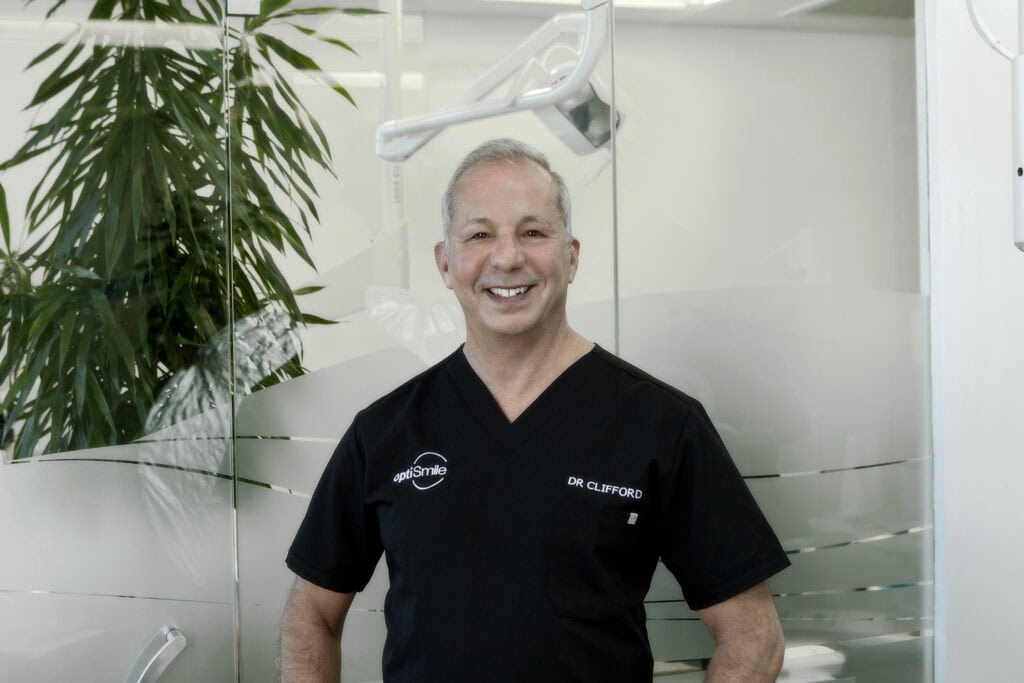
Guest: Dr. Clifford Yudelman, OptiSmile
Eon Engelbrecht welcomes listeners to the “Save Your Money, Save Your Teeth” podcast, where dental health meets financial savvy. Each week, Eon and Dr. Clifford Yudelman explore practical dental advice and insights. This episode focuses on the ultimate guide to dental check-ups.
Importance of Prevention
(1:16 – 2:09)
Dr. Yudelman explains why prevention is better than cure in dental health. Regular check-ups help detect issues early, preventing costly treatments and promoting proactive dental care. Learn more about the Benefits of Regular Dental Check-Ups in Cape Town.
Cost Savings from Regular Check-Ups
(2:10 – 3:45)
Dr. Yudelman discusses how early detection saves money. Small cavities can be managed with preventive advice, avoiding costly treatments like root canals or extractions. The principle of “a stitch in time saves nine” applies here, emphasising the importance of addressing minor issues early.
Frequency of Dental Check-Ups
(3:46 – 4:48)
Dr. Yudelman recommends scheduling a check-up every six months. For those without high-risk factors, an annual check-up may suffice, especially if all previous treatments are up to date. Regular check-ups allow for timely intervention and tailored advice. Regular cleanings are essential for maintaining oral health. Discover our Affordable Dental Cleaning and Polishing Services.
Components of a Thorough Dental Examination
(4:49 – 8:42)
Dr. Yudelman details what to expect during an initial dental exam, especially for new patients or those returning after a long absence. At OptiSmile, these exams include a comprehensive assessment of teeth, gums, and soft tissues, using diagnostic tools like X-rays and photographs. The process involves co-discovery, where the patient and dentist review the findings together, fostering a collaborative approach to dental care.
Quick Check-Ups vs. Comprehensive Examinations
(8:43 – 10:03)
Dr. Yudelman distinguishes between brief visual exams and thorough initial examinations. Quick check-ups are suitable for routine follow-ups, while comprehensive exams are essential for new or returning patients after a long period.
Preparing for Dental Check-Ups
(10:04 – 12:28)
Dr. Yudelman offers advice for patients preparing for their check-ups. He emphasises the importance of maintaining consistent oral hygiene and bringing a list of concerns or questions. Updated medical history and recent dental records are also crucial for a productive visit.
Benefits of Early Intervention
(12:29 – 12:57)
Aside from less extensive and costly treatments, early intervention helps maintain overall well-being by preventing related health issues.
Addressing Cost Concerns
(12:58 – 14:05)
Preventive care leads to long-term savings, as early detection of issues prevents expensive treatments later on.
Post-Check-Up Advice
(14:06 – 15:28)
To maintain good oral health after check-ups, consistent daily oral hygiene, a balanced diet, and regular follow-up appointments are key to preventing significant dental issues.
Modern Dental Technology
(15:29 – 17:17)
Modern dental technology has improved the effectiveness and efficiency of routine check-ups. Tools like intraoral scanners, digital X-rays, and AI software enhance preventive care and patient education. Explore our use of Modern Dental Technology in Cape Town
Conclusion and Next Episode Teaser
(17:18 – 19:06)
Eon Engelbrecht wraps up the episode, thanking Dr. Yudelman for his insights. He teases next week’s episode on the power of professional cleanings and encourages listeners to subscribe for more discussions. The episode ends with a call to action, inviting listeners to visit OptiSmile’s website for articles and to book appointments.
Transcript
Eon Engelbrecht E-Radio (0:11 – 0:52)
Welcome once again to “Save Your Money, Save Your Teeth”, the go-to podcast where curiosity meets dentistry straight from the experts. It’s Jan with you, and every week, I’m chatting with Dr. Clifford Yudelman, taking a nice deep dive into the world of dental care from a consumer’s perspective. So whether you’re looking to brighten that smile or protect your wallet, we really have got you covered with practical advice and also the latest insights.
So stick around as we uncover the secrets to maintaining both your dental health and also your finances. Dr. Yudelman, welcome back once again.
Dr Clifford Yudelman OptiSmile (0:52 – 1:01)
Hi Eon, thanks for having me back. I hope you had a great week, and I am looking forward to today’s podcast, which is all about dental X-rays.
Eon Engelbrecht E-Radio (1:01 – 1:14)
Yeah, and it’s always so interesting to see how the dentists do that. Could you just firstly explain to us what these dental X-rays are and why it’s such a critical tool for you as a dentist?
Dr Clifford Yudelman OptiSmile (1:15 – 2:41)
Yes, so we call them X-rays. So, the X-ray is actually something that comes out of the X-ray machine, but the piece of film that we used to use or these days the digital image is actually called a radiograph. So that’s the word that dentists use.
They say radiographs, and they’re basically a diagnostic tool that uses very, very minimal radiation compared to any kind of medical X-ray. They capture images of the interior of your teeth, your gums, and your bone level. We can see so many things like cavities, tooth decay and impacted teeth that aren’t visible during a routine dental exam. When we don’t have X-rays, they are definitely crucial for creating a comprehensive dental care plan.
At OptiSmile, we won’t see a patient without taking an X-ray at the first visit or multiple X-rays, which we can get into unless they send us if they had an X-ray done at their previous dentist or, should I say, a radiograph. They can get it sent over to us. In many cases, we do get radiographs that are sent over. If we’re not that happy with the quality, we may still want to take a fresh one because it all depends on the technology and so on, which I think we’re going to get into more later on today.
Eon Engelbrecht E-Radio (2:41 – 2:45)
So, doctor, do you get different types of these dental X-rays?
Dr Clifford Yudelman OptiSmile (2:46 – 5:17)
Oh yes, there are the small little ones that you bite on called bite-wings, and these are for checking for cavities between the teeth and bone levels. There are periapical X-rays; those are the little ones again that you bite on with a little holder, and they show the bottom of the root if you’ve got an abscess. If a dentist is high-tech, they’ll have a panoramic X-ray that in the old days wasn’t very clear, but these days, the panoramic X-rays are super clear, they’re digital, and that’s that large one that shows all your teeth and your jaws.
That’s called an OPG or panoramic X-ray, and we even have something now that’s a 3D X-ray, which is called a CBCT or a cone beam; it’s like a CAT scan, really, and each of these is used for specific diagnostic needs. Like I mentioned, the little bite-wings are for early detection of decay, then the panoramic, we can use it for orthodontic planning. There’s other types of X-rays for orthodontic planning called a lateral CEPH. It’s a side view where we do measurements specifically if someone’s going to get braces or Invisalign, and then the 3D X-rays, the CBCT, we use that to see all the roots, particularly of an upper molar.
If someone’s had a root canal treatment and the tooth is still giving problems, and we do a 3D X-ray, we often will find an extra canal that was maybe missed by a general dentist and then a specialist can treat that, you don’t have to pull the tooth out, and we also use a CBCT for diagnosing or for helping us with the placement of implants. If someone’s lost a tooth, we want to see exactly where the bone is; it’s 3D and it’s an amazing thing to have. At OptiSmile, if we’ve taken a 2D panoramic X-ray and someone needs a 3D, we will always take a 3D, and we actually don’t even charge patients extra but I’m not sure how many dentists in South Africa could do that, it’s about a three and a half thousand rand X-ray but we tell patients we want the information on that 3D X-ray more than we want their money for that because they’re coming to find out what’s going on and without seeing what’s going on, we don’t really know how to help them.
Eon Engelbrecht E-Radio (5:18 – 5:52)
So doctor, now I want to talk to you about safety concerns. I’m sure that many patients are concerned about exposure to radiation. I, for example, remember, but that was many years ago, I was quite concerned about the exposure to radiation and, especially when the dentist ran out after he pushed the button on the X-ray machine, so I was like, why can you go out, why must I stay and what does it mean, why are you running out, you know, so I can imagine that many patients are concerned about exposure to radiation.
Should we be concerned?
Dr Clifford Yudelman OptiSmile (5:53 – 6:15)
Yeah, you bring back memories. My dad, my late dad, was my dentist. I can tell you now that the running out is because the patient’s biting on a hell of an uncomfortable X-ray film or X-ray sensor. They’re running to quickly push the button before you spit it out or before it moves; they’re not running like they’re running from something dangerous.
Eon Engelbrecht E-Radio (6:17 – 6:18)
Wish I knew it back then.
Dr Clifford Yudelman OptiSmile (6:19 – 8:11)
And another thing is, you know, those old film X-rays when I was at dental school. We had normal d-speed film, and they used to push the button and go beep like that. Then we got e-speed film, which reduced the radiation significantly. It was more like a beep like that, and now with digital, it’s like beep, you know, short little beep if you like my sound effects. So, the radiation is reduced by up to 80 per cent compared to the traditional film X-rays. Of course, depending on where you are, your dentist might still use film X-rays even then it’s very low radiation.
There’s quite a lot of controversy with regard to lead aprons. In most cases, many cases, dentists these days don’t use lead aprons. They have them if a patient wants them.
The main thing is we adhere to something called ALARA principle, which is “as low as reasonably achievable” to minimize the radiation. So, at OptiSmile, if you’ve come to see us and we’ve taken a 2D X-ray and a 3D X-ray, we generally won’t take another X-ray for another three years. While there are dentists who believe in taking X-rays every year or every two years, it is often customized depending on what you see.
If you get an X-ray today and there’s nothing there, you don’t need an X-ray for another three years. If we take bite ring X-rays and you need three fillings and there’s two or three other areas where cavities are starting, we may recommend that you have another X-ray. At OptiSmile, we would take another X-ray like that in about 18 months.
We wouldn’t X-ray the same tooth every six months, but it’s generally customized to the patient’s mouth and to what’s going on.
Eon Engelbrecht E-Radio (8:11 – 8:20)
As you just said there with the beeps, you know, it has evolved so much over the years. Can you maybe talk to us about the advancements in the technology over the years?
Dr Clifford Yudelman OptiSmile (8:21 – 9:10)
Yes, so the biggest thing is transitioning from film to digital, which we spoke about. The great thing with digital is we see the X-ray right away. The quality is always there, whereas with developing film by Friday, the developer and the fixer was not as fresh. The films may not have been as clear. Or a few years later, you go back to look at an X-ray and the X-ray is faded.
It’s much easier to store them. It’s easier to send them to other dentists and to share patient records. We can back them up.
There’s continuous improvements, much greater detail and accuracy. The 3D X-rays are amazing. There’s always stuff happening.
We can talk a little bit later about other advances around that.
Eon Engelbrecht E-Radio (9:11 – 9:21)
Okay, and could you maybe also discuss some specific dental issues that X-rays can help diagnose that might not be visible during a regular examination?
Dr Clifford Yudelman OptiSmile (9:21 – 10:36)
So when we look at the surface of the tooth, we used to poke around and use a probe and pick, but these days we use magnification and we air dry the tooth. Some dentists may still pick around a little, but that doesn’t help us to see what’s happening under an existing filling or what’s happening beneath the gum line. So cavities between that are hidden or under fillings, we’ll see those.
Or sometimes there’s a big cavity inside a tooth and on the top of the tooth is just a little brown spot and you can’t really see the cavity. So they are very important. And also for looking at tooth root positions and conditions.
And like we mentioned, planning for dental implants, for braces, for Invisalign, looking at the orientation of the teeth and the jawbone structure. In fact, these days, when we do advanced Invisalign planning, we can superimpose the 3D X-ray into the patient’s oral scan or models of their teeth. And we can predict when we move the teeth, where the root is actually going to move to and whether the root will have enough bone around it.
So we’re not just moving teeth randomly and hoping for the best.
Eon Engelbrecht E-Radio (10:36 – 10:48)
You got to love technology. Hey, the frequency of the X-rays, how often should a patient get dental X-rays? I know you said earlier, it’s not that often.
It’s not necessary to have it that often.
Dr Clifford Yudelman OptiSmile (10:48 – 12:00)
Yes. So to carry on what we were saying earlier is it depends on your existing, your individual risk factors, your existing dental health. If you’ve got a high risk, if you always got new cavities starting or gum disease, maybe more frequently.
It is important when you start with a new dentist to get a full set of X-rays, especially if you haven’t been for several years. If you just moved from overseas and you just had a good quality set of X-rays done or a panoramic, always when you’re moving, ask your previous dentist to email your X-rays ahead of time. These days with HIPAA or PAPIA, the dentist can’t just phone each other and say, can you send me John’s X-rays or Sally’s panoramic?
We ask the patient to contact the dentist and get it sent to themselves and they can send it on to wherever they want. And there are times where we might see a little shadow somewhere and say, let’s make a note, let’s re-X-ray that in a year’s time and measure it. We’ve got tools with digital X-rays where we can actually do measurements on the X-ray.
Eon Engelbrecht E-Radio (12:00 – 12:08)
Okay. We spoke about safety earlier. I wanted to ask you, these X-rays, are they also safe for children?
Dr Clifford Yudelman OptiSmile (12:09 – 13:39)
Yes. So definitely it’s very important. So with children, we do take those little bite ring X-rays because often children will get a cavity between the first and second molars and just one X-ray on each side with very minimal exposure can find a cavity that you won’t see otherwise.
And the child can save, we can save a child’s tooth just by doing a small filling. And obviously the smaller the filling is, the less traumatic it is for a child. A lot of children at six or eight years old can get a filling done with a bit of local and there’s no need for sedation.
It’s critical for monitoring the growth and development. Getting a panoramic X-ray when the permanent teeth are supposed to be coming in sometimes between nine and 11. If it doesn’t look like things are coming in properly, we’ll see that there’s a lot of crowding and maybe do some preventive orthodontic treatment to help the jaws to grow.
And we really consider the child’s age and oral health status and risk factors, but it’s 100% safe. Well, nothing’s ever 100% safe, but there’s a large measure of safety with it. There could be a one in a hundred million chance that it can affect something or if you’re not following a law and you keep X-raying the child every six months, maybe you can cause some kind of problems, but I think that would be very rare.
Eon Engelbrecht E-Radio (13:39 – 13:48)
And then last week we spoke about pregnancy also and safety during pregnancy. What is the protocol for dental X-rays during pregnancy, doctor?
Dr Clifford Yudelman OptiSmile (13:48 – 14:49)
So, there’s controversy around using a lead apron to protect the baby. These days, the X-ray machine to do the little X-rays between the teeth, it’s called a long cone. So in the old days, it had like a little point on it and that scattered X-rays everywhere with a long cone, the X-rays are collimated.
So they’re all going in the direction that it’s pointing. They’re not scattering everywhere. We generally do, we postpone non-emergency X-rays at least till after the first trimester.
If the patient’s never had a filling, if they’ve had X-rays in the last two or three years, there’s no cavities and there’s no real reason to take an X-ray because nothing’s bothering them and means waiting another four or five months before we take an X-ray. We won’t take an X-ray on a pregnant patient. It’s more for psychological reasons than anything else, but all the research shows that it is safe.
Eon Engelbrecht E-Radio (14:50 – 14:59)
Okay. And then looking ahead, what are some of the innovative trends or technologies that might impact dental imaging in the next few years?
Dr Clifford Yudelman OptiSmile (15:00 – 16:20)
So there’s been amazing transformations with the 3D imaging. We actually use something called DiagnoCat at OptiSmile. Every time we take an X-ray, it uploads into the cloud and there’s integration of AI and machine learning that improves the accuracy of diagnosis and treatment planning.
We get an instant second opinion. The AI is still developing further, so I will sometimes see something that the AI doesn’t, but often it also happens the other way around. The AI will point out that there’s something in the sinus or there’s a very small change at the end of a root tip that I might miss.
So the AI is fantastic that way. Whether CBCT, the cone beam or the 3D X-ray, we can do different reports off of that using the AI. So CBCT is prone to what’s called scatter.
So if you’ve got a filling or a metal in your tooth, you get this white streaking and the AI actually removes all of that and we can export a solid model so it can be used for planning of implants. All of this stuff is going much faster and it’s developing all very, very quickly.
Eon Engelbrecht E-Radio (16:21 – 16:29)
And then finally, what advice, doctor, would you give to someone who might be hesitant about having their dental X-rays taken?
Dr Clifford Yudelman OptiSmile (16:30 – 18:19)
So I would discuss any concerns with your dentist, and they can tailor the use of the X-rays to your specific health needs and conditions. I would also question your dentist if every time you go, they take X-rays because of the theme, “Save Your Money, Save Your Teeth”, I’m here for the consumer, not to back up any dentists that may not be following commonly accepted worldwide principles.
If you’ve got dental healthcare or insurance plan, if you’re in the United States or medical aid that pays for X-rays every six months or every year and the dentist is simply taking X-rays so that they can get the payment, there’s no real reason for them to take the X-rays. I would either question the dentist or get a second opinion. And like I’ve said on previous podcasts, there might be some dentists listening to this that might disagree and maybe want to report me somewhere, but just give me a call or send me an email.
We can discuss it. I’m here for the consumer. This is “Save Your Money, Save Your Teeth”,
It’s not “take more X-rays and make more money”. And just understand that putting off X-rays when you really need an X-ray in the long term, it can lead to root canals that you could probably prevent. It can lead to diagnosing a root canal problem early and saving your tooth as opposed to the tooth rotting away and needing to be extracted and then you either have a gap or you end up with an implant.
Those things are very costly, and they can also help find other things like the ones we mentioned, such as impacted teeth and so on. I would definitely not put off X-rays if a high-quality dentist is recommending an X-ray for you but do ask questions if you’re getting too many.
Eon Engelbrecht E-Radio (18:20 – 18:35)
And that wraps up another very informative episode of “Save Your Money, Save Your Teeth”. Again, a big thank you to you, Dr. Yudelman, for your expertise and your time. And I also want to add something for looking out for the consumer.
Dr Clifford Yudelman OptiSmile (18:35 – 19:26)
Thank you very much. I always have to keep in mind that that’s why we’re doing these podcasts. That’s why we’re talking about basic things like pregnancy, like X-rays, fillings, and toothache.
Later on in the year, we’ll talk more about teeth whitening and teeth straightening and things like that. But I’m really trying to help the man in the street to understand the types of things that this type of information, you won’t find it necessarily on a dentist’s website or possibly if you know how to read dental journals, you can follow up and check if what I’m saying is correct. But that is based on 40 years of experience that I’ve had on four continents and, attending lots of courses and reading lots of journals.
So, thanks for hosting this podcast.
Eon Engelbrecht E-Radio (19:27 – 19:59)
It’s always a pleasure, doctor. Thank you so much. And also to our listeners, thanks for tuning in.
And remember, while we strive to provide valuable insights, always consult with your own dental professional, and that’s for advice tailored to your personal health. Also, don’t forget to subscribe for more enlightening discussions and then join us again next week as we continue to explore the fascinating intersection of dental health and financial savvy. Until then, keep smiling and taking great care of your teeth.
[Speaker 3] (20:15 – 20:59)
Discover the world of dental excellence with OptiSmile. Join us for a weekly podcast featuring Dr. Clifford Yudelman, a seasoned expert with 40 years of dental experience across four continents. Gain unique insights and expert dental advice by visiting OptiSmile.co.za for articles that illuminate the path to optimal oral health. If you’re seeking unparalleled dental care in Cape Town, get in touch with OptiSmile or book directly online on OptiSmile.co.za. OptiSmile, where global expertise meets local care.
Disclaimer: The content provided in this podcast, “Save Your Money Save Your Teeth” on Medical Mondays, is for informational and educational purposes only. It is not intended to serve as dental or medical advice. The insights and opinions expressed by Dr. Clifford Yudelman and any guests are designed to foster a better understanding of dental health, preventive measures, and general well-being, but should not be interpreted as professional dental or medical recommendations.Dr. Clifford Yudelman does not diagnose, treat, or offer prevention strategies for any health conditions directly through this podcast. This platform is not a substitute for the personalized care and advice provided by a licensed dental or healthcare professional. We strongly encourage our listeners to consult with their own dental care providers to address individual dental health needs and concerns.The information shared here aims to empower listeners with knowledge about dental health but must not be used as a basis for making health-related decisions without professional guidance. Your dental care provider is the best source of advice about your dental and overall health. Please always seek the advice of your dentist or other qualified health professionals regarding any questions or concerns about your dental health.