Chapters
What is a tongue tie — and can adults have one?
[00:04 – 03:54]
Tongue tie, or ankyloglossia, is a condition where the lingual frenulum — the band of tissue connecting the tongue to the floor of the mouth — is unusually short, thick or tight. While it is commonly associated with infants, many adults live with an undiagnosed tongue tie for decades.
Diagnosis in adults is not simply about how the frenulum looks. Clinicians assess how well the tongue elevates to the palate, moves side to side and protrudes without strain. Symptoms can include speech fatigue, difficulty swallowing, jaw tension, neck pain, headaches, and gum recession behind the lower front teeth. A visible frenulum alone does not justify treatment — it is the restriction of normal tongue function that matters.
How tongue ties affect speech, swallowing and posture
[04:33 – 06:36]
The tongue is a powerful muscular structure that plays a central role in speech, swallowing and posture. When its movement is restricted, surrounding muscles are forced to compensate. During swallowing, a normally functioning tongue presses against the palate — if this pattern is disrupted, it creates increased strain on the jaw and neck over time.
Speech sounds requiring tongue elevation — T, D, L and N — are particularly affected. Adults often report fatigue or tightness when speaking at length, rather than obvious speech defects. Research supports the idea that chronic compensation patterns in the jaw, neck and shoulders can develop when oral function is altered.
Tongue posture: where your tongue should actually rest
[06:36 – 08:30]
Tongue posture refers to where your tongue rests when you are not speaking or eating. In an ideal position, the tongue rests gently against the roof of the mouth, with the tip just behind the upper front teeth, while breathing occurs through the nose. This supports airway space, stabilises the bite and reduces jaw muscle strain.
In adults with tongue ties or airway issues, the tongue often rests low in the mouth, contributing to mouth breathing, snoring and altered facial muscle balance. Orthodontic and sleep medicine research increasingly recognises tongue posture as a contributor to airway and craniofacial health, though it is not a standalone solution to complex problems.
Can a tongue tie cause gum recession or tooth spacing?
[08:30 – 09:42]
Yes, in some cases. A restricted tongue may compensate by pushing forward or downward during swallowing, placing pressure on the lower front teeth over time. Severe cases have been associated with recession on the inside surface of the lower incisors, particularly in patients with thin gum tissue — a dental problem that can also contribute to changes in tooth position.
Tongue tie is rarely the sole cause of recession or spacing. It is typically a contributing factor, and treatment would form part of a broader plan that may include grafting and other interventions.
Frenectomy: what the procedure involves and how lasers have changed it
[09:42 – 12:46]
A frenectomy is the procedure used to release a restrictive frenulum and restore tongue mobility. In adults, it is most commonly performed using a soft tissue laser, which offers precise cutting, minimal bleeding, reduced inflammation and faster recovery compared to traditional surgical methods. Discomfort during the procedure is minimal due to local anaesthetic, with most patients describing only mild pressure.
Laser frenectomy is safe and effective when clearly indicated. Importantly, the procedure is only one part of treatment — functional rehabilitation and myofunctional therapy are essential components of a successful outcome. As part of our dental solutions approach, patients requiring a frenectomy are often referred to a specialist with advanced laser dentistry qualifications.
Mewing: the social media trend versus the science
[12:47 – 15:36]
Mewing is a tongue posture practice named after orthodontist John Mew, popularised on social media as a way to reshape the adult face. The reality is far more nuanced. Tongue posture does influence jaw development in growing children, but in adults, skeletal changes without surgical or orthodontic intervention are very limited.
There is no strong scientific evidence that mewing can significantly alter jaw shape, widen the palate or move teeth in adults. What it can genuinely support is nasal breathing, improved tongue and lip posture, and reduced mouth breathing — all of which have modest but meaningful benefits for sleep quality and oral health.
Tongue posture, sleep apnoea and airway health
[15:36 – 17:18]
Low tongue posture with restricted movement can cause the tongue to fall back and obstruct the airway during sleep. Sleep medicine research has confirmed that reduced tongue tone and altered tongue position contribute to obstructive sleep apnoea — one reason why mandibular advancement devices work by repositioning the jaw forward, keeping the tongue from collapsing back.
Improving tongue posture can support airway health, but it will not cure sleep apnoea on its own. Patients with suspected sleep-related breathing disorders should seek a formal assessment rather than relying on lifestyle adjustments alone.
Myofunctional therapy and managing headaches
[17:18 – 20:21]
Myofunctional therapy — exercises designed to improve tongue strength, coordination and posture — plays an important role both before and after a frenectomy. Pre-operative therapy helps prepare the muscles and establishes where improved movement will be most beneficial. Without it, the outcomes of a frenectomy are significantly reduced.
In select cases where chronic jaw, neck or facial tension is linked to restricted tongue movement, a frenectomy combined with myofunctional therapy may also help reduce headaches. However, a tongue tie release should never be presented as a quick fix. Careful clinical assessment, a multidisciplinary approach and realistic expectations are essential — the goal is functional improvement, not a miracle cure.
Transcript
[Eon Engelbrecht – E-Radio-SA] (0:04 – 1:06)
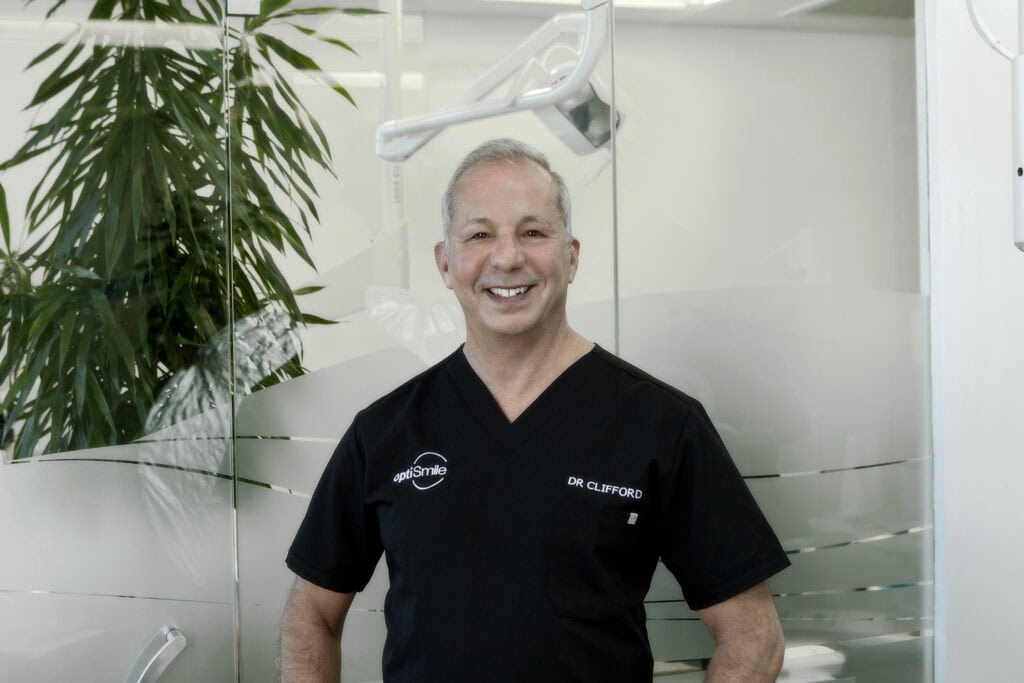
Hello and welcome again to Save Your Money, Save Your Teeth, the podcast where we help you make smarter, healthier and often more affordable decisions about your dental health. I’m Eon and, as always, I’m joined by Dr Clifford Yudelman from OptiSmile, and today we’re talking about something that many people have heard of in babies or children but very few realise can still affect adults in a big way, and that’s tongue ties, tongue posture and whether they could be linked to things like speech issues, swallowing problems, gum recession, headaches, jaw tension and even sleep apnoea.
So we’re also going to get into some of the online trends like mewing, what’s real, what’s hype, and what dentists and airway-focused professionals are actually seeing in practice. So if you ever wondered whether the way your tongue sits in your mouth could be affecting your health more than you realise, stay tuned. Dr Yudelman, welcome back.
[Dr Clifford Yudelman – OptiSmile] (1:06 – 1:24)
Thank you and yeah, it’s getting a bit chilly, getting into winter soon, and I was recently over by your side and hopefully you guys get lots of rain because I didn’t realise that there was a bit of a water shortage on that side, so hopefully by now you’ve had some rain, yeah.
[Eon Engelbrecht – E-Radio-SA] (1:24 – 1:42)
Yeah, let’s hope so, hey. I think it looks promising for the coming week or two, but we’ll see. So Dr Yudelman, what on earth is a tongue tie?
There’s also another name for it. I’ll leave that name to you. And how is it diagnosed in adults?
[Dr Clifford Yudelman – OptiSmile] (1:42 – 3:54)
They call it, the scientific term is ankyloglossia, ankylosis, like if you get ankylosis of your spine, it means that your spine is like getting fused together. So ankylose means something is fused and glossia, glossus is your tongue. So it’s a condition where there’s a band of tissue connecting your tongue to the floor of your mouth which is called the lingual frenulum or frenum, and it’s usually short, or it can be unusually short or thick or tight, and while it’s often discussed in babies, many adults live with undiagnosed tongue ties for decades.
In adults, we look at how the tongue works as well as how the frenulum looks, and we check this: how well the tongue elevates to the palate, moves side to side and protrudes without strain. Limited upward movement is often more significant than limited forward movement and symptoms in adults can include speech fatigue, difficulty swallowing, jaw tension, neck pain, headaches, gum recession behind the lower front teeth and sometimes chronic mouth breathing. And a lot of adults have got used to it, so it can be hard to spot. To diagnose it properly, we examine it and we also check how the tongue actually works. Just being able to see a frenulum doesn’t mean you need treatment.
I don’t want people who are listening to this podcast to start looking and then self-diagnose themselves and then go and get treatment when maybe they don’t need it. What matters is whether it’s stopping your tongue from working normally. So in adults, like I just said, it doesn’t really get diagnosed much, but there are people that are unaware when they stick their tongue out, say to lick an ice cream, the tip of the tongue goes really white and it looks almost like a forked tongue.
You know that old American Indian expression, “white man speaks with forked tongue”. I think that’s maybe where it came from. Have you ever heard that one or is it new to you?
[Eon Engelbrecht – E-Radio-SA] (3:54 – 3:57)
It’s new to me, but I can see it in my mind’s eye.
[Dr Clifford Yudelman – OptiSmile] (3:58 – 4:31)
I think it’s something like you’re lying through your teeth, but the American Indians were more polite. I think they meant that a forked tongue is normally, I think, related to, think about it like a snake has got a forked tongue, and what they mean when white men speak with forked tongue, it means that he’s a bit of a snake, you better watch out or he can bite you. But that’s a good digression very early on in this podcast and I won’t let my mind run away with me and we’ll stop with the jokes.
[Eon Engelbrecht – E-Radio-SA] (4:33 – 4:40)
OK, so Doctor, how can a tongue tie affect your speech and your swallowing and even neck tension?
[Dr Clifford Yudelman – OptiSmile] (4:40 – 6:36)
Your tongue is a very powerful muscle actually. Your tongue is purely muscle. It’s a muscular structure.
It’s very powerful and it plays a central role obviously in speech, in swallowing and actually in posture. And when movement is restricted, the other muscles are forced to compensate. So during swallowing, a normal tongue presses against the palate.
If someone’s tongue tied, that often goes wrong, so they swallow differently and the muscles around it have to work harder. And over time, this can be one of the things that causes jaw tension and neck discomfort. And I have mentioned Trish Lang in Bree Street a few times before, Cape Town Physio, and sometimes she’ll send a patient back to us and tell us, oh, this patient’s TMJ problems or headaches are caused by a tongue tie.
And we may even refer the patient for treatment, which we’ll get into shortly. But speech can also be affected, especially sounds that need tongue elevation, like the letters T or D or L, your tongue needs to come up, and N. So T, D, L and N. And adults often say their tongue gets tired or tight when they speak for a long time. It’s not usually an obvious speech problem.
I’m sure there’s a few people listening to this podcast that wish that their spouse had a bit of a tongue tie and would shut up on the odd occasion, but I’m full of jokes today. I had one too many coffees at lunchtime. But yeah, so look, when your mouth isn’t working properly, the jaw, the neck and the shoulders all try to make up for it, and over time that can cause problems. Your mouth is connected to the rest of your body.
[Eon Engelbrecht – E-Radio-SA] (6:36 – 6:50)
Interesting enough is tongue posture. I didn’t even know there was such a thing as tongue posture. So my question to you would be, where should your tongue actually be resting if you have a healthy mouth?
[Dr Clifford Yudelman – OptiSmile] (6:50 – 8:30)
So tongue posture is the resting position of your tongue when you’re not speaking or eating. So if you sit up nice and straight and you put your head on your shoulders, not leaning forward, then in an ideal scenario, you actually gently rest your tongue on the roof of your mouth with the tip just behind the upper front teeth and the back of the tongue lightly supported by the palate. So you put the tip of your tongue behind your upper front teeth, you know, on those little ridges, those rugae they’re called, and then you breathe through your nose.
So this posture supports normal jaw development in children and it helps to maintain airway space, which is basically the parts of your anatomy where the air comes through when you’re breathing. And it’s both in adults and in children. It also stabilises your bite and reduces strain on the jaw muscle because you’re not actually clenching your teeth together.
You’re breathing through your nose, your tongue is resting on the roof of your mouth, and your tongue is sealing off against your palate and your jaw is just sort of hanging slightly apart, teeth apart. And, you know, in many adults, especially those with tongue ties or airway issues, the tongue rests very low in the mouth and that contributes to mouth breathing, snoring and even altered facial muscle balance. And orthodontists and sleep doctors are paying more and more attention to tongue posture, for breathing and for how the face and jaw develop, although on its own it won’t fix complicated problems.
[Eon Engelbrecht – E-Radio-SA] (8:30 – 8:37)
And I wonder, can a tongue tie also contribute to gum recession or even gaps between your front teeth?
[Dr Clifford Yudelman – OptiSmile] (8:38 – 9:42)
Yes, it can. So we’ve spoken about these other, when we spoke about gum recession, when you pull on your lip and you get a lip frenulum where the lip is attached, it looks like a little piece of string from your lip to your gum, and that can cause recession there. But a very restricted tongue can compensate by pushing forward or downward during swallowing.
And over time, that can put pressure on your lower front teeth. And we’ve even seen some severe cases where you get recession on the inside of the lower incisors, especially in people with thin biotype or gum tissue. We’ve spoken about that when we spoke about recession.
And it can actually cause spacing or change in tooth position. You know, tongue tie is rarely the only cause of this problem. It’s also a contributing factor.
And treatment for that could be part of another whole bunch of treatment related to it. But you wouldn’t normally just get your tongue tie released and then everything gets better. It’s part of other treatment like grafting, etc.
[Eon Engelbrecht – E-Radio-SA] (9:42 – 9:50)
Now, you mentioned a frenectomy earlier. What on earth is a frenectomy? And also, is it painful to have it done as an adult?
[Dr Clifford Yudelman – OptiSmile] (9:50 – 11:47)
So frenectomy is a procedure that releases this restrictive frenulum basically to allow improved tongue mobility in adults. So basically they’re cutting that release, meaning they cut it. So in adults this is very commonly now performed using special lasers and in some cases a scalpel.
I’ve even heard of dentists doing it with a type of surgical scissors. You know, they numb it and they just literally snip it with modern techniques. Discomfort during the procedure is minimal because of the local anaesthetic.
And when you use a laser, there’s little or no bleeding and very little swelling afterwards. And most patients say it’s just pressure. It’s usually very mild or short-lived. The procedure is only part of the treatment. Then you need functional rehab. Frenectomies are safe and they work when there’s a good reason to do them.
And it’s combined with the other therapy. It’s more often done on very, very young kids because they can’t breastfeed and for other various reasons. But today we’re speaking mainly about adults.
We will talk a little bit about kids. But yeah, I don’t think getting it snipped with scissors or a scalpel and then some sutures, you know, there’s a lot of vascular supply. There are a lot of blood vessels in those areas.
You know, if someone says, oh, we’re just going to numb you up and cut this for you, I would ask questions like, what about sending me to someone with a fancy BioLase or Waterlase? So we have lasers. Yeah, we do various things with our laser. But if somebody needs a frenectomy, we often refer to Brian Sher in Green Point. If you’re in Cape Town, he’s a laser guru.
He’s got extra degrees in laser dentistry, especially soft tissue laser situations like tongue ties.
[Eon Engelbrecht – E-Radio-SA] (11:48 – 11:54)
And how does laser technology change the way tongue ties are treated?
[Dr Clifford Yudelman – OptiSmile] (11:54 – 12:46)
Yeah, so now that we’re on the lasers, you’re basically getting very precise cutting of the soft tissue, but with excellent control, and it seals the blood vessels as it works. So there’s hardly any bleeding and it improves visibility during the procedure. As I mentioned earlier, with the lasers there’s less inflammation and you recover faster at first, compared to the old surgical way.
And this can be particularly beneficial in the highly mobile tongue area. But a laser doesn’t replace a proper diagnosis or the exercises afterwards. It’s just a tool that makes the release more controlled and more comfortable, when you actually need it.
And, you know, there’s a lot written in oral surgery that shows laser frenectomy is safe, with results that are as good or even better.
[Eon Engelbrecht – E-Radio-SA] (12:47 – 12:55)
And now we get to mewing. What on earth is mewing and is there any scientific truth behind it?
[Dr Clifford Yudelman – OptiSmile] (12:55 – 15:36)
This is opening a can of worms right there. So mewing sounds like meowing like a cat, but it’s actually tongue posture training based on orthodontist John Mew. So it’s named after a particular orthodontist and Mike Mew.
And it focuses on keeping your tongue resting against the roof of your mouth and breathing through your nose. And so it’s often promoted on social media as a way to reshape your face as an adult.
But the scientific reality is a lot more nuanced. I mean, tongue posture does influence jaw development in growing children. But in adults, skeletal changes without any surgery or orthodontic intervention are very limited, if at all, depending on who you follow and where you get your evidence from.
If you go on AI or ChatGPT or you do a medical search, basically it says that claims about mewing have become overstated and there’s no strong scientific evidence that it can significantly change your jaw shape like what they claim on social media. There’s no evidence that it can widen the palate or move teeth. I mean, some dentists and other people that make a living from selling or promoting or teaching people how to mew are going to be a bit upset with this.
But, you know, just go on ChatGPT or Gemini or whatever, do your own research there. And it can’t replace orthodontic treatment. And the reason is the adult bones are no longer growing.
And to do significant changes, I mentioned you need braces or aligners or even surgery. What mewing can help with in adults is it encourages nasal breathing. It improves the posture of your tongue and lips.
It supports airway function. It can reduce habits like mouth breathing or low tongue posture. And these are all subtle things, but they’re important for sleep quality and for your oral health, because it leads to less dry mouth.
If you’re a mewer and you reckon it’s changed your face or you don’t agree with what I’m saying, then, you know, why don’t you send me an email or tell me your story? I’d be interested to hear about it.
[Eon Engelbrecht – E-Radio-SA] (15:36 – 15:43)
And I suppose your tongue posture is also related to sleep apnoea and your airway health, right?
[Dr Clifford Yudelman – OptiSmile] (15:43 – 17:18)
Yes. So, I mean, as you know, we’ve done, I think, four or five podcasts about lip taping, mouth taping, shall I say, CPAP machines, sleep apnoea tests, mandibular advancement devices, snoring, et cetera. And it’s all related to your tongue, your tongue posture during sleep.
If you’ve got a low tongue posture with restricted movement, then your tongue can fall back and obstruct your airway. So it’s got nothing to do with your uvula or your soft palate or that you’ve got a deviated septum. I think you should go back and listen to those podcasts where we covered all of this in detail.
If your tongue is floppy or sits in the wrong position, that can add to obstructive sleep apnoea. And this is one of the reasons why a mandibular advancement device, like an upper and lower plate that’s connected with a special connector, repositions your jaw forward so that your jaw doesn’t drop back and your tongue is actually connected to the front of your jaw. When we’re talking about someone with a tongue tie, it’s that connection or ligament that’s a bit too short.
But improving tongue posture can support airway health. But it’s not going to cure sleep apnoea. But yeah, look, we often check patients for sleep apnoea.
A lot of dentists are getting more aware of screening patients for tongue position and tongue ties, etc.
[Eon Engelbrecht – E-Radio-SA] (17:18 – 17:25)
And do patients need myofunctional therapy before or after a tongue tie release?
[Dr Clifford Yudelman – OptiSmile] (17:26 – 18:32)
You know, this is now we’re getting to podcast number 101, 102. So we get into things that are not that common. You know, at OptiSmile every month we see upwards of 100 new patients a month. It’s a big clinic. There are 25 of us working here, seven dentists. So we see a lot of people.
And with that kind of volume of people, we maybe only see two or three of these types of cases a year. So I don’t think people should get too worried about this if it doesn’t apply to them or one of their family members. But myofunctional therapy would involve exercises and training to improve tongue strength, coordination and posture.
And, you know, before a frenectomy, the therapy helps prepare the muscles and identify where the improved movement will actually be beneficial. And if you just get a frenectomy and you don’t actually get physio or myofunctional therapy with someone who knows what they’re doing, then, you know, it’s not going to work as well.
[Eon Engelbrecht – E-Radio-SA] (18:32 – 18:40)
And finally, can releasing a tongue tie really help with things like headaches and migraines?
[Dr Clifford Yudelman – OptiSmile] (18:40 – 20:21)
Only in very select cases, you know. Headaches and especially migraines are very complex. In individuals where there’s chronic jaw, neck or facial tension and it is linked to restricted tongue movement, releasing that and getting all kinds of myofunctional therapy, seeing Trish for some exercises, may help.
So more often than not, when we send Trish a TMJ patient, someone with jaw pain, we’ve spoken about that, we won’t make a bite plate or a mandibular advancement splint for someone unless they report snoring, they’ve got to have a sleep apnoea test. If they report grinding, often we send them for a sleep apnoea home test anyway. And before we make them a bite plate, we always send them for this myofunctional or physiotherapy assessment and evaluate the tongue, all of that. And a lot of the time they see Trish and she gets them to do these tongue posture exercises, like I just said, with resting your tongue on the roof of your mouth and then slowly opening and closing your mouth while keeping your tongue there.
There’s a lot of things that will help these headaches that most doctors or even dentists don’t know about. But you need to be able to put your tongue on the roof of your mouth. So a tongue tie release should never just be presented like, let’s snip your tongue because I happen to have bought a laser last month and I’m looking for things to do with it. You need a careful assessment, with the different specialists working together, and you have to be realistic about what it can do.
It can help your tongue work better, but it’s not a miracle cure.
[Eon Engelbrecht – E-Radio-SA] (20:21 – 20:43)
Dr Yudelman, as always, that was very, very fascinating. Thank you so much. And I think it’s amazing how something as small as a tongue tie or something as overlooked as tongue posture can actually have such a wide effect on your breathing, your comfort, your sleep, your jaw function and even the position of your teeth and gums. Thank you so much.
[Dr Clifford Yudelman – OptiSmile] (20:44 – 20:53)
Pleasure. Thank you. And very excited to speak to you next week where we will be talking about the magic wand or painless injections.
[Eon Engelbrecht – E-Radio-SA] (20:54 – 21:39)
Looking forward to that. I’m sure a lot of people are looking forward to that one when it comes to injections. We want them to be painless.
But yeah, thank you so much, Dr Yudelman. And also, if you’ve been dealing with any of the issues that we spoke about today, whether it’s tension, speech concerns or sleep-related problems, or you’ve simply been told you might have a tongue tie, it may be worth getting a proper assessment instead of just guessing from social media videos.
Thank you again to Dr Yudelman from OptiSmile for sharing his insights with us. And thanks to you for listening to Save Your Money, Save Your Teeth. Until next time, take care of your mouth and your mouth will take care of you.
[OptiSmile Announcer] (22:00 – 22:45)
Discover the world of dental excellence with OptiSmile. Join us for a weekly podcast featuring Dr Clifford Yudelman, a seasoned expert with 40 years of dental experience across four continents. Gain unique insights and expert dental advice by visiting OptiSmile.co.za for articles that illuminate the path to optimal oral health. If you’re seeking unparalleled dental care in Cape Town, get in touch with OptiSmile or book directly online on OptiSmile.co.za. OptiSmile, where global expertise meets local care.
Disclaimer: The content provided in this podcast, “Save Your Money Save Your Teeth” on Medical Mondays, is for informational and educational purposes only. It is not intended to serve as dental or medical advice. The insights and opinions expressed by Dr. Clifford Yudelman and any guests are designed to foster a better understanding of dental health, preventive measures, and general well-being, but should not be interpreted as professional dental or medical recommendations.Dr. Clifford Yudelman does not diagnose, treat, or offer prevention strategies for any health conditions directly through this podcast. This platform is not a substitute for the personalized care and advice provided by a licensed dental or healthcare professional. We strongly encourage our listeners to consult with their own dental care providers to address individual dental health needs and concerns.The information shared here aims to empower listeners with knowledge about dental health but must not be used as a basis for making health-related decisions without professional guidance. Your dental care provider is the best source of advice about your dental and overall health. Please always seek the advice of your dentist or other qualified health professionals regarding any questions or concerns about your dental health.