Chapters
What Is a Gummy Smile?
[00:00:05 – 00:03:37]
A gummy smile is a description rather than a diagnosis — it simply means that more gum tissue than usual is visible when smiling. The teeth themselves may be perfectly normal in size, but they appear shorter because part of the tooth surface remains hidden beneath excess gum tissue.
One of the most common underlying causes is a condition called altered passive eruption, where the gums fail to recede to their correct position after the teeth have fully emerged. Lip movement and jaw structure can also contribute to the appearance. Identifying the true cause is essential before any treatment is planned.
What Is Aesthetic Crown Lengthening?
[00:03:38 – 00:06:08]
Aesthetic crown lengthening — sometimes referred to as a gingivectomy or gum contouring — works by exposing the part of the tooth that already exists but is concealed beneath excess gum tissue. The goal is not to artificially lengthen teeth, but to reveal their true proportions.
In simple cases, a diode laser is used to precisely reshape the gumline with minimal discomfort. More complex situations may require bone reshaping as well. The procedure is grounded in periodontal biology, ensuring that the gums and bone remain at the correct distance from the tooth structure to stay healthy. When carefully planned, the aesthetic results are dramatic and stable.
Recovery and What to Expect
[00:06:09 – 00:08:14]
For minor laser gum contouring, recovery is straightforward. Patients are treated under local anaesthetic, may notice slight greyness along the treated gumline the following day, and typically see near-complete healing within a week.
True surgical crown lengthening — where a periodontist lifts the gums and reshapes the underlying bone — involves a longer recovery. Some swelling and mild discomfort are expected, though most patients return to normal activities relatively quickly. If bone reshaping has been performed, dentists generally wait six to twelve weeks before placing final restorations such as veneers, allowing the gums to fully stabilise.
Biological Width and Why It Matters
[00:08:15 – 00:11:09]
Biological width refers to the natural space between the margin of a restoration and the underlying bone — a zone the body requires to keep gum tissue healthy and attached. When a crown or filling is placed too deep and invades this space, the body responds with chronic inflammation, bleeding, and sometimes bone loss.
Crown lengthening corrects this by repositioning the gum and, where necessary, the bone before any restoration is placed. This creates the room needed for a crown or veneer to sit comfortably without irritating the surrounding tissues. It is worth noting that modern biomimetic dentistry also offers an alternative technique called deep margin elevation, which some practitioners use to achieve similar outcomes in select cases — a second opinion from a biomimetic dentist may be worthwhile in certain situations.
Saving Broken Teeth With Crown Lengthening
[00:11:10 – 00:12:40]
When a tooth fractures below the gumline, there may not be sufficient exposed structure to support a crown. Crown lengthening can expose more of the tooth by reshaping the surrounding bone, making it possible to place a stable restoration and potentially save the tooth from extraction.
Preserving a natural tooth is generally preferable to replacing it with a dental implant. That said, as implant outcomes have improved, crown lengthening for structural purposes has become less common, with many gum procedures today focused primarily on aesthetic refinement.
Laser Technology and How It Helps
[00:12:41 – 00:15:30]
Modern diode lasers allow for exceptionally precise reshaping of gum tissue. With a tip as fine as 0.3 millimetres, they enable targeted adjustments with minimal bleeding and faster healing compared to traditional scalpel techniques. In most cosmetic cases, this level of laser treatment is all that is required.
For more involved procedures, specialist lasers — including water lasers — can gently reshape bone as well, reducing the need for conventional drilling and potentially shortening recovery time. Once bone has been correctly reshaped and sufficient healing has occurred, the new position is stable and does not revert. Careful planning and correct execution at the outset are key to predictable, lasting results.
Cosmetic or Health Procedure? And How Does It Compare to Botox?
[00:16:20 – 00:19:20]
Crown lengthening serves both aesthetic and functional purposes. Cosmetically, it improves tooth proportions and creates a more balanced smile design. From a health perspective, it allows restorations to be placed in a biologically sound position, reducing plaque accumulation and supporting the long-term stability of crowns and veneers.
Botox is occasionally used to address a gummy smile by relaxing the muscles that elevate the upper lip — but it is only appropriate in specific cases, requires repeat treatments as the effect wears off, and must be administered with precision. Crown lengthening, by contrast, corrects the underlying structural cause. When properly performed, the result is typically permanent, making it the more durable solution for most patients.
Transcript
Eon Engelbrecht – E-Radio-SA (0:05 – 0:49)
Welcome back to another episode of Save Your Money, Save Your Teeth. I am Eon, and as
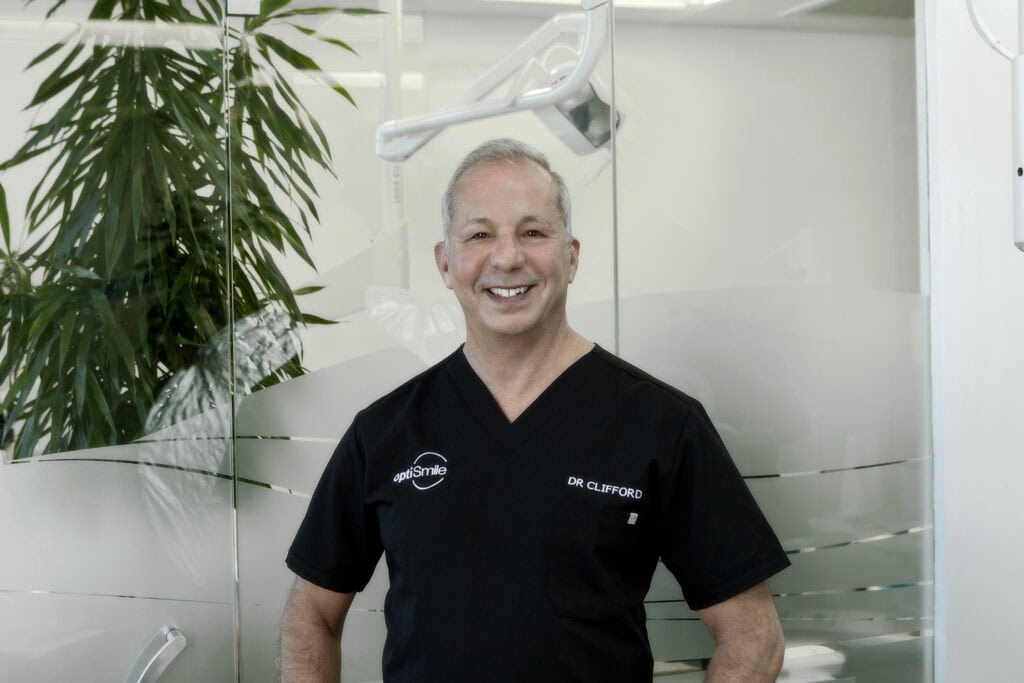
always we are joined by Dr Clifford Yudelman from OptiSmile to help you achieve a healthy,
beautiful smile without unnecessary costs.
Today we are discussing a procedure that sits right at the intersection of health and aesthetics.
Many people feel self conscious about what is often called a gummy smile. That is where the
teeth appear a little short and the gums take centre stage when someone smiles. But there is
actually a biological solution for this that does more than simply improve appearance. It can also
help protect the teeth themselves.
So today we are talking about crown lengthening.
Dr Yudelman, welcome back.
Dr Clifford Yudelman – OptiSmile (0:49 – 1:09)
Thank you, it is great to be back. Yes, we are changing things up a little today from cracked teeth
and some of the other episodes we have done. This is something we do quite often and we
receive many questions about it. The gummy smile is something we are going to discuss in detail
today.
Eon Engelbrecht – E-Radio-SA (1:10 – 1:33)
Sometimes if you ask someone why they do not smile in photographs they will say something
like, “No, I am all gums.” Then I always wonder what they mean exactly.
So what is a gummy smile and what causes it?
A gummy smile is more of a description than a diagnosis. It simply means that more gum tissue
than normal is visible when someone smiles.
Dr Clifford Yudelman – OptiSmile (1:34 – 3:31)
The important point is that there are different causes, and the treatment depends entirely on
which one is present.
In some people the teeth are actually normal in size, but the gums sit too low on the tooth
surface. We recently had a case like this. A few months ago we treated a patient who even made
a testimonial video on our YouTube channel.
She had Invisalign because her two front teeth were positioned slightly further back. We moved
them forward with aligners. But the gum line on those teeth was very low, so the teeth appeared
much smaller compared to the ones next to them.
This condition is called altered passive eruption, and it is actually quite common.
There are also other situations where the position of the upper lip or the jaw relationship can
contribute to the appearance of a gummy smile. So the key is to identify the underlying cause
before deciding on the treatment.
Eon Engelbrecht – E-Radio-SA (3:31 – 3:38)
What exactly is aesthetic crown lengthening, and how does it change the appearance of the
teeth?
Dr Clifford Yudelman – OptiSmile (3:38 – 6:08)
Aesthetic crown lengthening is sometimes called a gingivectomy or gum contouring, depending
on the situation. I will try to simplify it as we go.
Think of it a bit like a manicure. When someone has a manicure, the cuticle around the nail is
pushed back or trimmed slightly. In a similar way, we sometimes adjust the gum around the
tooth.
In the simplest cases this can be done with a scalpel, which is the traditional method. Today we
often use a diode laser. In more complex cases the procedure may involve reshaping some of the
bone as well.
The goal is not to artificially make the teeth longer, but to expose the part of the tooth that is
already there but hidden under excess gum tissue.
When it is done correctly it changes the proportions of the tooth.
For example, when we do injection moulded composite bonding, we sometimes contour the
gums slightly with a laser first. Then we place the bonding. The teeth that previously looked
short or square suddenly look well proportioned and natural.
From a scientific perspective, the procedure is based on periodontal biology. Periodontal simply
means the tissues around the teeth. “Peri” means around and “dontal” refers to teeth.
The gums and bone must sit at a specific distance from the tooth structure in order to remain
healthy.
Aesthetic crown lengthening respects these biological rules while improving the appearance of
the smile.
When properly planned and executed the results can be dramatic and very stable.
Eon Engelbrecht – E-Radio-SA (6:09 – 6:14)
Is this a major surgical procedure and what is the recovery like?
Dr Clifford Yudelman – OptiSmile (6:15 – 8:15)
If we are only doing a gingivectomy or gum contouring with a laser, it is actually very simple
and minimally invasive.
Patients usually have local anaesthetic and generally experience very little discomfort. The gum
may look slightly grey at the edge the following day where the laser was used. Within a day or
two it looks almost healed, and after about a week it is normally perfect.
However, true crown lengthening surgery is different.
In that case the periodontist lifts the gum and reshapes the underlying bone to the correct level.
That is proper surgery.
There can be some swelling and mild to moderate discomfort, but most patients return to normal
activities quite quickly.
The surface tissues heal in a week or two, but the gums continue to remodel and stabilise over
several weeks.
This is important because if bone reshaping has been done we normally wait about six to twelve
weeks before placing veneers or crowns.
When we only use a laser, however, we can often continue treatment immediately or within a
week.
Eon Engelbrecht – E-Radio-SA (8:15 – 8:28)
You mentioned something called biological width. What is that and why must dentists
respect it?
Dr Clifford Yudelman – OptiSmile (8:28 – 11:10)
Biological width refers to the natural space between the margin of a restoration and the
underlying bone.
That space allows the gums to attach and remain healthy.
If a crown or filling invades that space the body reacts with chronic inflammation. We see this
often when a crown is placed too deep under the gum line.
Patients may develop bleeding gums, discomfort and sometimes bone loss.
Crown lengthening creates the correct biological width before placing crowns or veneers.
By moving the gum and sometimes the bone we create space so that restorations can sit
comfortably without irritating the tissues.
This principle is fundamental and supported by many years of research. It directly affects the
longevity of both the natural teeth and the restorations.
However, modern biomimetic dentistry has introduced another concept called deep margin
elevation. In some cases we can place a filling under the gum line and then place the crown on
top of that.
Different dentists use different techniques. If a dentist tells you that you must have crown
lengthening surgery before a crown can be placed, it can sometimes be worthwhile seeking a
second opinion from someone who practises biomimetic dentistry.
Eon Engelbrecht – E-Radio-SA (11:10 – 11:16)
Can crown lengthening help if a tooth has broken under the gum line?
Dr Clifford Yudelman – OptiSmile (11:16 – 12:40)
Yes, in certain situations it can.
If a tooth breaks below the gum line there may not be enough exposed tooth structure to support
a crown. Crown lengthening can expose more of the tooth so that a stable restoration can be
placed.
In this procedure the bone around the tooth is reshaped to expose more tooth structure.
It is usually preferable to try to save a natural tooth rather than replace it with an implant or
bridge whenever possible.
That said, with modern implants we see fewer crown lengthening procedures done purely to
expose tooth structure. Today we often perform gum contouring simply to improve aesthetics
when enough tooth structure already exists.
Eon Engelbrecht – E-Radio-SA (12:41 – 12:52)
How does laser technology make the procedure less invasive?
Dr Clifford Yudelman – OptiSmile (12:52 – 14:44)
Laser technology is quite remarkable.
I use a diode laser called a Picasso laser. It has a very fine tip about 0.3 millimetres wide, which
allows extremely precise trimming of gum tissue.
Interestingly, these diode lasers have not changed much since I first bought one in 2004 when I
was practising in Perth.
They are very effective for small gum adjustments.
Some dentists also use specialised lasers that can reshape bone as well. These include water
lasers or bio lasers.
Instead of using a drill to reshape bone, the laser can gently remove small amounts of bone
tissue.
It sounds dramatic, but in skilled hands it can improve comfort and reduce recovery time.
Fortunately, in most cases we only need to use the diode laser to reshape the gum slightly.
Eon Engelbrecht – E-Radio-SA (14:44 – 14:49)
Does the bone grow back after the procedure?
Dr Clifford Yudelman – OptiSmile (14:49 – 15:30)
The bone does not grow back to exactly the same position.
Sometimes after laser gum contouring we may adjust the gum slightly again later if needed. But
when bone reshaping has been performed and sufficient healing time has passed, research shows
that the results are stable.
As with many dental procedures, success depends on careful planning and doing it correctly the
first time.
Eon Engelbrecht – E-Radio-SA (15:30 – 15:36)
How long should a patient wait after surgery before getting veneers or crowns?
Dr Clifford Yudelman – OptiSmile (15:36 – 16:19)
If bone has been reshaped, healing time is very important.
The gums continue to remodel for at least six to twelve weeks. For predictable aesthetic results
we prefer to wait before placing final restorations.
If it is only minor laser contouring, treatment can continue much sooner.
Eon Engelbrecht – E-Radio-SA (16:20 – 16:24)
Is this procedure purely cosmetic or does it offer health benefits as well?
Dr Clifford Yudelman – OptiSmile (16:25 – 16:57)
It is often performed for cosmetic reasons, but it also has important health benefits.
It allows crowns or restorations to be placed in a way that respects gum health. It can reduce
plaque accumulation and improve long term stability of restorations.
So although the improvement in the smile is obvious, the biological benefits are just as
important.
Eon Engelbrecht – E-Radio-SA (16:57 – 17:07)
Finally, how does the cost compare with other treatments such as Botox for a gummy
smile?
Dr Clifford Yudelman – OptiSmile (17:07 – 19:20)
Botox is sometimes used to reduce a gummy smile by relaxing the muscles that lift the upper lip.
However, it must be used very carefully and it is only suitable in specific cases.
In Cape Town there are only a few practitioners who do it appropriately for dental indications.
Botox also requires repeat treatments because the effect wears off.
Crown lengthening, on the other hand, is a structural and biological correction. Once it is done
properly, the result is usually stable and long lasting.
So while Botox may be appropriate in certain cases, crown lengthening often addresses the
underlying cause.
Eon Engelbrecht – E-Radio-SA (19:20 – 19:50)
You have been listening to Save Your Money, Save Your Teeth.
If you feel your teeth look too short or you have been told that a tooth has broken under the gum
line, it may be worth exploring crown lengthening.
You can learn more by doing a digital smile analysis at OptiSmile.co.za.
We will see you again next time.
Keep smiling.
Narrator (20:11 – 20:56)
Discover the world of dental excellence with OptiSmile.
Follow our weekly podcast with Dr Clifford Yudelman, a respected expert with over forty years
of dental experience across four continents.
Visit optismile.co.za for articles and expert dental advice to guide you toward optimal oral
health.
If you are looking for advanced dental care in Cape Town, visit OptiSmile or book directly
online at optismile.co.za.
Op Intro
OptiSmile, where global expertise meets local care.
Disclaimer: The content provided in this podcast, “Save Your Money Save Your Teeth” on Medical Mondays, is for informational and educational purposes only. It is not intended to serve as dental or medical advice. The insights and opinions expressed by Dr. Clifford Yudelman and any guests are designed to foster a better understanding of dental health, preventive measures, and general well-being, but should not be interpreted as professional dental or medical recommendations.Dr. Clifford Yudelman does not diagnose, treat, or offer prevention strategies for any health conditions directly through this podcast. This platform is not a substitute for the personalized care and advice provided by a licensed dental or healthcare professional. We strongly encourage our listeners to consult with their own dental care providers to address individual dental health needs and concerns.The information shared here aims to empower listeners with knowledge about dental health but must not be used as a basis for making health-related decisions without professional guidance. Your dental care provider is the best source of advice about your dental and overall health. Please always seek the advice of your dentist or other qualified health professionals regarding any questions or concerns about your dental health.