Chapters
What Is a Temporary Anchorage Device?
[00:00:05 – 00:02:15]
A temporary anchorage device, or TAD, is a small titanium mini screw placed into the jawbone to act as a fixed, stable anchor for orthodontic tooth movement. Because the screw is anchored in bone rather than attached to other teeth, it prevents unwanted reciprocal movement — a common limitation of conventional braces.
This absolute anchorage makes it possible to achieve sophisticated movements such as intruding a tooth vertically into the bone, or bodily translating a tooth along the arch without tilting or rotating it. These are movements that were previously very difficult, or only achievable through jaw surgery.
Is TAD Placement Painful?
[00:02:15 – 00:03:08]
Placement is carried out under local anaesthetic, so patients are numb throughout the procedure. Most describe feeling pressure rather than pain, comparable to having a small filling placed.
Discomfort afterwards is typically minimal and well managed with over-the-counter pain relief. Patients can return to normal activities immediately, and the anticipatory anxiety tends to be far worse than the experience itself.
Fixing Gummy Smiles Without Surgery
[00:03:08 – 00:04:07]
TADs offer a conservative solution for gummy smiles by allowing controlled vertical intrusion of the upper front teeth. As the teeth move upward into the bone, the gum line follows, reducing excess gum display without the need for aggressive surgical intervention.
In practice, small screws are placed between the tooth roots and in the palate, and an elastic is hooked between them. This applies more precise upward force than braces or aligners alone could generate, all while remaining anchored securely in bone.
Closing Long-Standing Gaps and Missing Tooth Spaces
[00:04:07 – 00:04:55]
Where a tooth has been missing for years, neighbouring teeth tend to tip into the space rather than move cleanly. TADs enable controlled, bodily movement of tipped teeth back into these gaps, which can in some cases eliminate the need for implants or bridges entirely.
A specially designed spring is bonded to the tooth and pulls at a precise angle, guided by the TAD anchor. Successful outcomes depend on careful assessment of available bone, space dimensions, and the overall bite.
Removal, Hygiene, and Day-to-Day Life
[00:04:55 – 00:06:02]
TADs are temporary by design. When treatment is complete, they can usually be removed without anaesthetic — a small screwdriver simply unscrews the device, and the site heals within days. Studies report no long-term adverse effects from their use.
Because TADs sit high up and are quite small, they integrate easily into a normal oral hygiene routine. Brushing around them is sufficient, and an antibacterial mouth rinse can be used if required. Plaque accumulation is minimal, particularly in patients who already maintain good oral hygiene.
TADs With Invisalign and Digital Planning
[00:06:02 – 00:07:06]
TADs are compatible with both fixed braces and clear aligners such as Invisalign, making hybrid treatment approaches possible. Combining the two allows for highly sophisticated tooth movements that neither system could achieve as effectively on its own.
Digital planning underpins these hybrid cases, improving precision and predictability. Success rates for TADs are generally high — between 80 and 95 per cent — though they can occasionally loosen or fall out. If this happens, a replacement is simply placed in an adjacent position.
How TADs Save Money Compared to Surgery
[00:07:06 – 00:08:53]
The most significant financial benefit of TADs is their potential to reduce or eliminate the need for orthognathic jaw surgery. Avoiding the operating theatre removes substantial costs as well as the associated risks and recovery time.
TADs also improve the efficiency and control of tooth movement, which can shorten overall treatment duration. For the right patient, a well-placed mini screw and a clear digital plan can achieve results that once required far more invasive — and expensive — interventions.
Transcript
Eon Engelbrecht – E-Radio-SA (0:05 – 0:50)
Welcome to Save Your Money, Save Your Teeth. In this week’s episode, we unpack one of
the quieter revolutions in modern orthodontics, the Temporary Anchorage Device, or TAD.
These tiny titanium mini screws sound intimidating, but they have transformed what is
possible without resorting to jaw surgery. So we look at how TADs work as a fixed anchor
point, the kinds of movements they make achievable, what patients actually experience
during placement and removal, and how they pair with both fixed braces and Invisalign.
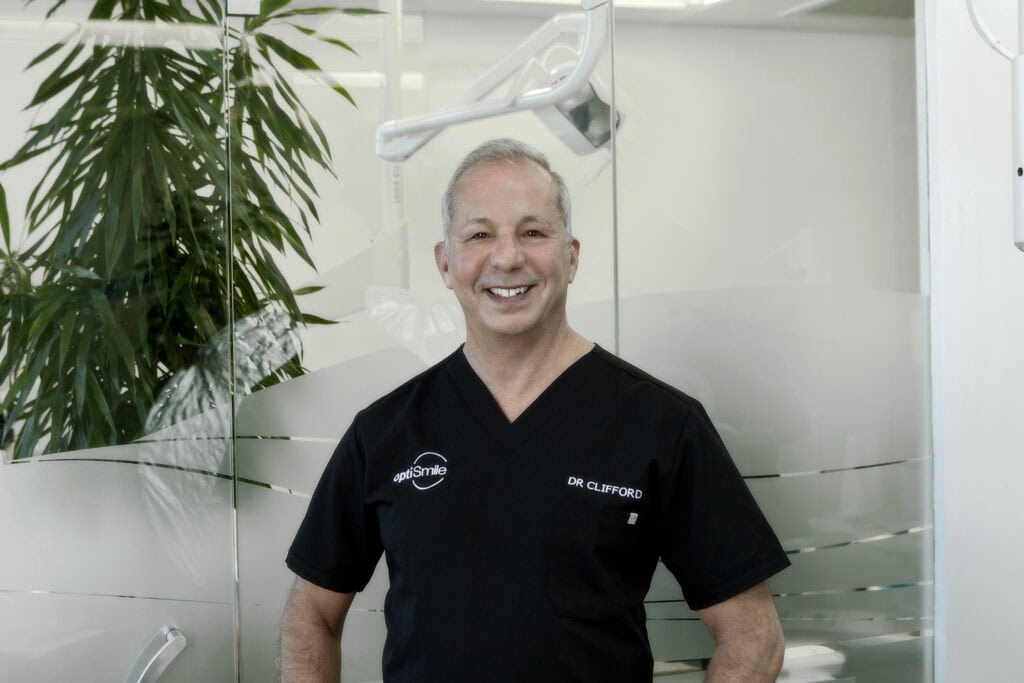
Here’s Dr Clifford Yudelman from OptiSmile. Welcome back, doctor.
Dr Clifford Yudelman – OptiSmile (0:51 – 0:59)
Thanks. Thanks for having me back. Looking forward to today’s episode, so fire away.
Eon Engelbrecht – E-Radio-SA (0:59 – 1:06)
Now, doctor, what on earth is a TAD, and why does it sound like a screw in the gum?
Dr Clifford Yudelman – OptiSmile (1:07 – 1:34)
So it’s a temporary anchorage device, and it’s a small temporary titanium screw placed in the
bone to act as a fixed and stable anchor for precise orthodontic movement. It prevents
unwanted opposite or reciprocal movement, and it allows sophisticated tooth movements
which were previously difficult or only possible with jaw surgery.
Eon Engelbrecht – E-Radio-SA (1:35 – 1:43)
And how do TADs allow orthodontists to do impossible movements without jaw surgery?
Dr Clifford Yudelman – OptiSmile (1:43 – 2:15)
So they provide what’s called absolute anchorage, allowing the teeth to be moved precisely
without causing other teeth to drift. And it enables difficult movements like intruding, which is
pulling upward into the bone, or bodily moving a tooth, which instead of tilting or rotating a
tooth, you’re physically walking it along backwards or forwards in the arch. And it also
significantly expands treatment options and, in many cases, reduces the need for jaw
surgery.
Eon Engelbrecht – E-Radio-SA (2:15 – 2:23)
Now, you know what I’m going to ask you next. Is the procedure to put them in painful?
That’s what patients usually want to know.
Dr Clifford Yudelman – OptiSmile (2:24 – 3:00)
So the answer is no. The procedure is easy. It’s done with local anaesthetic, so the patient’s
numb.
The patient typically feels pressure, not pain, similar to getting a small filling. And then
afterwards the discomfort is minimal, and usually some Nurofen and Panado is perfect. You
get back to your normal activities right away.
And obviously the anxiety is a lot worse before than after. Once people get it done, they’re
like, oh, that wasn’t anything to worry about.
Eon Engelbrecht – E-Radio-SA (3:01 – 3:08)
Just a few episodes ago we spoke about gummy smiles. How are TADs used to fix a gummy
smile?
Dr Clifford Yudelman – OptiSmile (3:08 – 4:00)
So it allows vertical intrusion of the upper front teeth into the bone, if that’s what’s called for.
As the teeth move up, the gums follow and it reduces gum display. And this is a conservative
and biologically sound approach.
It avoids aggressive gum or jaw surgery. Basically, a little screw is put between the roots up
above those teeth, that you can hook an elastic on, and the elastic goes over the top of the
teeth to a similar little screw that goes into the palate. And obviously that’s anchored in the
bone, a little titanium screw.
And that just puts more pressure on the teeth than braces on their own or aligners on their
own could do.
Eon Engelbrecht – E-Radio-SA (4:00 – 4:07)
And I’m also curious to know, can TADs help close spaces where teeth have been missing
for years?
Dr Clifford Yudelman – OptiSmile (4:07 – 4:50)
Yeah, so that can be quite difficult to do, because without TADs the teeth just tilt into those
spaces. With TADs it can allow controlled movement to pull an adjacent tipped tooth back
into a long-standing space, and sometimes eliminate the need for implants or bridges. And
the success depends on careful assessment of the bone, the size of the space, and the
overall bite.
Yeah, it’s pretty amazing. A little screw in the bone, and then a specially designed spring that
pulls on the tooth, it gets bonded to the tooth and it’s pulling at a specific angle, and the tooth
just moves like magic.
Eon Engelbrecht – E-Radio-SA (4:51 – 4:55)
Wow. Okay. And do they stay in permanently, or are they removed?
Dr Clifford Yudelman – OptiSmile (4:56 – 5:20)
So they can be removed, often even without anaesthetic. There’s a tiny little hole through the
gum into the bone, and it’s a little screwdriver, tiny little screw. You just turn it, it pops out,
and it heals naturally within a few days or a week.
And all the studies have shown no long-term side effects or adverse effects.
Eon Engelbrecht – E-Radio-SA (5:20 – 5:25)
And how do you keep them clean while they are in your mouth?
Dr Clifford Yudelman – OptiSmile (5:25 – 5:56)
So they’re very small, they’re titanium, they’re shiny, and they’re hidden because they’re
quite high up. Oral hygiene is just normal. You brush around them, and you can maybe use
antibacterial mouth rinses if needed.
The plaque doesn’t really collect on them. You won’t put them in someone’s mouth where
their whole mouth is not very clean. Most of the time, when people are getting Invisalign, the
patients we see have very good oral hygiene.
And just by having good oral hygiene, you don’t get all that inflammation.
Eon Engelbrecht – E-Radio-SA (5:56 – 6:02)
So they can be used with Invisalign, not just with metal braces?
Dr Clifford Yudelman – OptiSmile (6:02 – 6:21)
Yeah, they’re used with both fixed braces and clear aligners like Invisalign. And combining
TADs with aligners allows for very sophisticated and controlled different movements. It’s all
supported with digital planning, and it can make these hybrid approaches effective and
patient-friendly.
Eon Engelbrecht – E-Radio-SA (6:22 – 6:27)
And in terms of the success rates, can they fall out?
Dr Clifford Yudelman – OptiSmile (6:27 – 7:06)
So yeah, they can, and they do. Normally the success rate is high, it’s like 80 to 95 per cent.
But they can loosen, or they could unscrew or fall out, and they’re just easily replaced. You
just put another one, a brand new one, in a different spot and hope for the best, as they say.
But it’s more than that. I mean, basically, in the upper jaw the bone isn’t very, very tough,
and you’re putting these in there and putting an elastic onto it. Just like when you put a
screw in a piece of wood, every so often one might come a little bit looser or just pop out.
Eon Engelbrecht – E-Radio-SA (7:06 – 7:12)
And finally, how do TADs save money compared to surgical options?
Dr Clifford Yudelman – OptiSmile (7:12 – 7:50)
By reducing or eliminating the need for jaw surgery, they can dramatically lower cost and risk
and recovery time. They shorten the treatment duration by improving force efficiency and
control. And they shorten the treatment.
And you can do things that before TADs you couldn’t do. You know, it’s modern
orthodontics, using biologically intelligent solutions rather than something forceful, or
surgery, or anything more invasive.
Eon Engelbrecht – E-Radio-SA (7:50 – 8:18)
Doctor, what once required jaw surgery, headgear, or compromised results can now often be
solved with just a quietly placed mini screw and a clear plan. I think for the right patient the
shorter treatment is much better. It also reduces cost, and you avoid the operating theatre
altogether, which is always a win.
So, Dr Yudelman, thank you so much for yet another interesting discussion today.
Dr Clifford Yudelman – OptiSmile (8:18 – 8:39)
Thank you. Great to speak to you. And hopefully it was interesting today, and that people
continue to love these podcasts.
I had a look the other day on our YouTube. You know, we rebroadcast these on the
OptiSmile YouTube, and some of them have got 200 or 300 listens already. So that’s
amazing.
Eon Engelbrecht – E-Radio-SA (8:39 – 8:53)
Oh, that’s brilliant. Rising to stardom. Dr Yudelman, thank you so much. And until next time,
that’s it for this week’s Save Your Money, Save Your Teeth.
Dr Clifford Yudelman – OptiSmile (8:53 – 8:57)
Thank you. And great to chat to you again. Thank you.
Announcer – OptiSmile (9:16 – 10:00)
Discover the world of dental excellence with OptiSmile. Join us for a weekly podcast
featuring Dr Clifford Yudelman, a seasoned expert with 40 years of dental experience across
four continents. Gain unique insights and expert dental advice by visiting OptiSmile.co.za for
articles that illuminate the path to optimal oral health. If you’re seeking unparalleled dental
care in Cape Town, get in touch with OptiSmile or book directly online on OptiSmile.co.za.
OptiSmile, where global expertise meets local care.
Disclaimer: The content provided in this podcast, “Save Your Money Save Your Teeth” on Medical Mondays, is for informational and educational purposes only. It is not intended to serve as dental or medical advice. The insights and opinions expressed by Dr. Clifford Yudelman and any guests are designed to foster a better understanding of dental health, preventive measures, and general well-being, but should not be interpreted as professional dental or medical recommendations.Dr. Clifford Yudelman does not diagnose, treat, or offer prevention strategies for any health conditions directly through this podcast. This platform is not a substitute for the personalized care and advice provided by a licensed dental or healthcare professional. We strongly encourage our listeners to consult with their own dental care providers to address individual dental health needs and concerns.The information shared here aims to empower listeners with knowledge about dental health but must not be used as a basis for making health-related decisions without professional guidance. Your dental care provider is the best source of advice about your dental and overall health. Please always seek the advice of your dentist or other qualified health professionals regarding any questions or concerns about your dental health.