Chapters
Is String Floss Dead?
[00:01:49 – 00:05:42]
String floss is not dead, but it has long been oversold. The real goal was never flossing itself — it has always been removing plaque from between the teeth, and floss is simply one tool that may or may not achieve that effectively.
In many adult mouths, interdental brushes do a more reliable job. These small, reusable brushes are sized precisely to fit each gap, and when the right size is used, they sweep plaque away from tooth surfaces in a way that floss often cannot.
Patients who floss consistently can still develop cavities between their teeth because the floss slides past the plaque rather than lifting it. Switching to correctly sized interdental brushes often stops bleeding within days and can halt the progression of early decay — representing a significant long-term saving.
What Is a Waterpik, and Can It Replace Flossing?
[00:05:48 – 00:07:58]
A Waterpik is a brand of oral irrigator that uses pulsating bursts of water to disrupt bacteria below the gum line and flush out food debris. There are now many similar devices available from various manufacturers.
Oral irrigators can be genuinely helpful for people with braces, implants, bridges, or limited dexterity. They can reduce gum inflammation and calm bleeding. However, they do not reliably scrape sticky plaque from tooth surfaces, because plaque removal requires direct mechanical contact.
A Waterpik should be seen as a supplement, not a substitute. Anyone who relies on one alone can still develop inflammation around an implant or between teeth. Mechanical cleaning with floss or interdental brushes remains essential.
Why Do Gums Bleed, and Should You Stop Cleaning?
[00:07:58 – 00:10:32]
Bleeding gums are one of the most misunderstood warning signs in dentistry. Blood does not mean the gums are fragile — it means they are inflamed, almost always because plaque has been sitting at the gum line undisturbed.
A common mistake is to stop cleaning after seeing blood, which allows plaque to build further and inflammation to worsen. Gentle, consistent interdental cleaning typically reduces bleeding within a few days and resolves it entirely within one to two weeks.
If hardened tartar is present beneath the gum, a professional clean will be needed to remove it. However, thorough cleaning at home beforehand reduces inflammation significantly and makes the hygienist’s work considerably easier. Addressed early, bleeding gums are one of the cheapest dental problems to resolve; left untreated, they can progress to periodontal disease, bone loss, and costly surgical treatment.
Waxed Floss vs Tape: Which Is Better for Tight Teeth?
[00:10:33 – 00:13:46]
The choice between waxed floss and tape is less about which is superior and more about which is usable for a given mouth. Waxed floss slides through tight contacts more easily and shreds less readily. Tape is wider and suits broader contact points.
Studies show little meaningful difference between them in terms of cleaning effectiveness. Technique matters far more than brand or type. Slow, controlled movement and wrapping the floss in a C-shape around each tooth surface are what actually remove plaque.
If floss shreds repeatedly in the same spot, this is often a sign of rough fillings, tartar, or early decay — useful diagnostic information rather than a floss problem. A thick, quality waxed floss is generally preferable to the very thin, near-frictionless varieties that tend to glide over plaque rather than disturbing it.
How to Clean Under a Dental Bridge Without Damaging It
[00:13:47 – 00:16:07]
Bridges fail far more frequently from hygiene neglect than from structural weakness. Plaque accumulating beneath the false tooth, known as the pontic, is the most common cause of the supporting teeth eventually being lost.
For a Maryland bridge, cleaning is relatively straightforward — floss can be passed beneath it from the unwinged side. For a conventional three-unit bridge, superfloss or regular floss threaded through a floss threader must be used to clean beneath the pontic daily. Interdental brushes are also valuable at the point where the pontic meets the adjacent teeth, as this is a common site for decay.
A Waterpik can provide additional support for bridge hygiene, though it does not replace mechanical cleaning. With diligent care, a bridge can last well beyond the average seven years.
Are Floss Picks as Effective as Regular Floss?
[00:16:08 – 00:17:21]
Floss picks make interdental cleaning more accessible, but they are a compromise. They cannot wrap properly around the curved surface of a tooth, and the fixed angle often leads to the floss cutting into the gum rather than cleaning along it.
They are better than nothing for dislodging food, but should not be mistaken for effective plaque removal. Learning to use conventional floss correctly — ideally by watching detailed video demonstrations or asking a dentist or hygienist to demonstrate in person — is well worth the effort.
The Loop Method: Why Most People Floss Incorrectly
[00:17:22 – 00:19:30]
The loop method involves tying the floss into a small circle around the fingers rather than wrapping it in the conventional manner. This reduces pressure on the fingertips, improves control, and is particularly useful for beginners.
The critical principle of flossing is that cleaning only occurs when the floss is curved in a C-shape around each tooth surface and gently guided just below the gum line. Snapping floss in and out removes food but does little to disturb plaque. Each gap contains two tooth surfaces that both require attention.
Technique and consistency matter far more than speed. Done correctly, thorough flossing can be completed in under a minute.
Can a Waterpik on Too High a Setting Damage Your Gums?
[00:19:31 – 00:20:45]
Yes. Professionally dispensed oral irrigators are designed with controlled pressure settings that are safe for gum tissue. Consumer devices purchased from supermarkets or discount online retailers frequently deliver excessive pressure, and users often assume that higher pressure produces better results.
Directing a high-pressure stream at the gum line can cause trauma to the tissue and, in some cases, push bacteria beneath the gum — the opposite of the intended effect. This risk is particularly relevant around dental implants. The guidance for irrigators mirrors that for toothbrushing: gentle, consistent contact is far more effective and safer than forceful application.
Why Does Food Keep Getting Trapped in the Same Spot?
[00:20:46 – 00:22:58]
Recurrent food trapping in a specific location is rarely coincidental. It usually indicates a chipped tooth, a shifted tooth, an ill-fitting filling, or another structural change that has created an opening. Flossing and cleaning the area promptly after eating is important to prevent the gap widening over time.
In some cases, a newly placed restoration with an overly pointed cusp — known as a plunger cusp — may be driving food between two adjacent teeth. A dentist can smooth this cusp, which can resolve the food trap entirely without any drilling or restoration work.
Not every food trap requires a crown or a new filling, and patients should be aware of this before agreeing to more extensive treatment.
Brushing or Flossing: Which Saves More Money Long Term?
[00:23:00 – 00:26:13]
Brushing cleans approximately 60% of the tooth surface — the exposed faces and the areas along the gum line. The remaining 40%, the surfaces between the teeth, can only be reached with interdental cleaning. Most decay, gum disease, and bone loss begin precisely in those interproximal spaces that a toothbrush cannot access.
Brushing is essential for maintaining tooth function and preventing surface decay, but cleaning between the teeth is what prevents the most expensive problems over a lifetime: large fillings, root canal treatment, periodontal surgery, and tooth loss.
The honest answer is that both are necessary and neither should be sacrificed for the other. Done together, they address the full tooth surface and represent the most cost-effective investment available in long-term dental health.
Transcript
Eon Engelbrecht – E-Radio-SA (0:04 – 1:13)
Welcome back to Save Your Money, Save Your Teeth, the podcast where we take a look at
what actually protects your teeth and your wallet, and what is just marketing. So today we’re
going into the space between your teeth, which is where most of the expensive trouble
starts. Decay between teeth, gum disease, bone loss — almost none of it begins on the
surfaces that you can see in the mirror. It begins in the gaps.
So we are settling the argument today. Is string floss finished, and are the little brushes
genuinely better? Where does a Waterpik fit in, and can it replace flossing altogether? And
we’ll also get into why your gums bleed, whether that means you should stop, how to clean
under a bridge without wrecking it, and why food keeps getting stuck in the same spot every
single time.
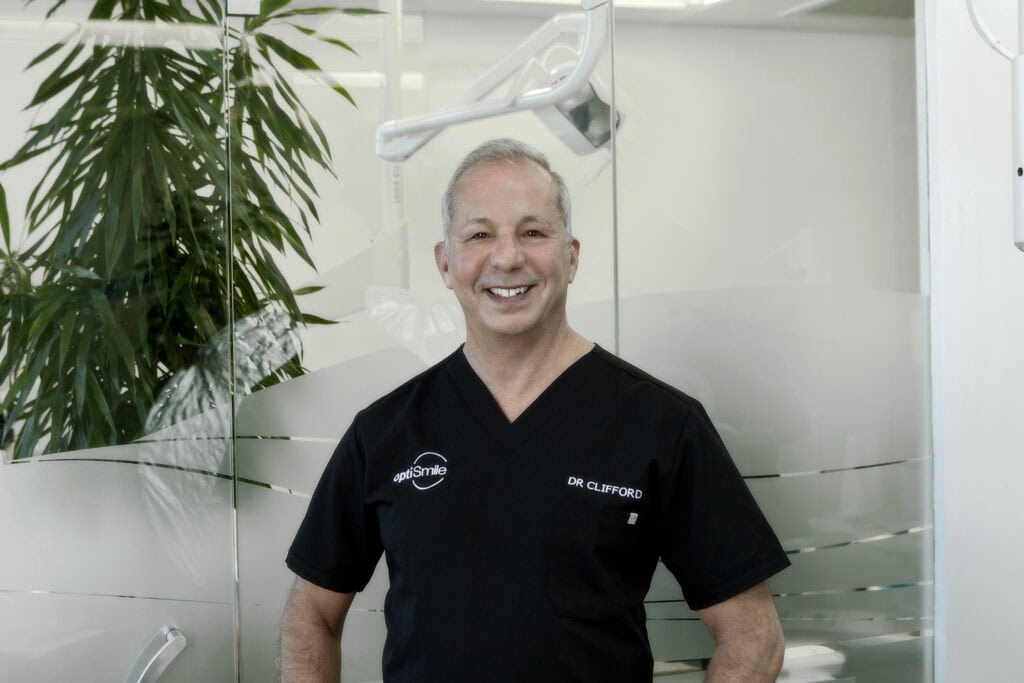
As always, I’m joined by Dr Clifford Yudelman from OptiSmile, and he’s been doing this for
over 40 years across four continents. Very impressive. Dr Yudelman, welcome back.
Dr Clifford Yudelman – OptiSmile (1:13 – 1:49)
Thank you. Thank you. Yes, I’ve actually been flossing for 66 years, but doing dentistry for
43, just to clear that up.
And it sounds like you just gave away the whole podcast there. Thank you for that wonderful
introduction. I think it’s great to let people know what they’re in for, to make it worthwhile.
Then if you wait till the end, there’ll be a big surprise. So make sure you listen to the very
end. I just made that up, but that’s the common one. We won’t be giving away free dental
floss at the end of this podcast.
Eon Engelbrecht – E-Radio-SA (1:49 – 2:00)
Okay. But anyway, so Dr Yudelman, let’s be honest. Is string floss dead? Do interdental
brushes actually work better?
Dr Clifford Yudelman – OptiSmile (2:01 – 5:21)
So I’m going to answer this honestly, because guilt has never improved anyone’s oral health.
String floss is not dead, but it has been a bit misunderstood and maybe even oversold for a
long time, because the real goal has never been flossing. The goal is actually removing
plaque between your teeth. And floss is just one possible tool to achieve that. And in many
adult mouths, it’s no longer the most effective one.
And when researchers compare floss to what we call interdental brushes — so I’ll stop for a
minute and explain. Inter means between and dental means your teeth. And these are these
tiny little brushes, not those little plastic toothpicks that have got little knobs on them, but
they actually are dispensed by a dentist or a hygienist. They can be reused. You rinse them
off. And if you’re careful with them, each little brush can last you several days or a week.
They can get quite expensive depending on the brand, etcetera.
In South Africa, we get one or two brands. You have to be careful of generic brands that look
like a high-end brand, because the wire can be too big, or it can be abrasive, or the bristles
can be too big for your gap and cause damage. But basically, they’re very good for cleaning
between teeth in people who’ve got a little bit of gum recession, or even early gum disease
or bleeding between the teeth.
And they consistently remove more plaque and reduce the inflammation more effectively.
And the plaque is very sticky and it clings to the tooth surfaces, especially between the teeth.
And if you’ve got one brush, a little interdental brush that’s exactly the right size, you pop it in
and you pull it out and it sweeps all of the plaque away from between the tooth in a way that
floss often doesn’t.
And we see patients that floss every night, but they still get cavities between their teeth.
They assume that they’re unlucky, but in fact, the floss has been sliding past the plaque
instead of removing it. And when we switch them to properly sized interdental brushes, the
bleeding goes away within a few days. And then we keep checking their cavities every year
or two on x-rays, and the x-rays show that the cavity is not progressing.
And from a money perspective, this means a lot — I want to say a hell of a lot, because
we’re in South Africa. You know, interproximal decay, or cavities between the teeth, and
gum disease are among the most expensive problems to fix later. And if you choose
something that actually works in your mouth, rather than the wrong one, this can not only
save your teeth, but thousands of rond over a lifetime. I wanted to say rond instead of rand,
so that’s, yeah.
Eon Engelbrecht – E-Radio-SA (5:21 – 5:21)
Okay.
Dr Clifford Yudelman – OptiSmile (5:22 – 5:24)
How do you say it? Is it rond or rand?
Eon Engelbrecht – E-Radio-SA (5:24 – 5:24)
Rand.
Dr Clifford Yudelman – OptiSmile (5:25 – 5:26)
If it’s many, then it’s rond.
Eon Engelbrecht – E-Radio-SA (5:26 – 5:26)
Yeah.
Dr Clifford Yudelman – OptiSmile (5:28 – 5:31)
Yeah. When you’re getting into thousands, it’s rond.
Eon Engelbrecht – E-Radio-SA (5:31 – 5:34)
Yeah. It’s quite posh saying it like that.
Dr Clifford Yudelman – OptiSmile (5:34 – 5:42)
So I know that was a long answer, but it sets you up for what’s coming now. So shoot away
with the next question.
Eon Engelbrecht – E-Radio-SA (5:42 – 5:48)
What exactly is a Waterpik, and can it replace manual flossing entirely, doctor?
Dr Clifford Yudelman – OptiSmile (5:48 – 7:58)
So yeah, we want to clear this one up. It’s not quite up there with all of those TikTok and
Instagram myths that we busted a few weeks ago on episode 116, one of my favourites.
Look, Waterpiks are not complete bullshit.
So just to go back to episode 116, a Waterpik is actually a brand of oral irrigator. There are
quite a few now. There’s hundreds on Temu and, you name it, TikTok. People are always
looking for an easy way out. But they all use basically a pulsating stream of water. So it
squirts like little short bursts of water, and it’s supposed to disrupt the bacteria below the
gum line and flush out food.
And it can be helpful for people with braces or implants or bridges, or elderly people, or
unfortunately a younger person with severe arthritis, or anyone who struggles with fine motor
control or being able to use their hands — dexterity. But they’re the only ones that we’re
going to make excuses for. Everyone else, there’s no excuse. So dental floss or a little brush
does a much better job.
And what happens is, a Waterpik they have shown can reduce inflammation. It can calm
bleeding gums. It can improve your gum health. But what it doesn’t do reliably is actually
scrape the sticky plaque off the tooth. The plaque is very clever. It makes a biofilm. Plaque
removal still requires good mechanical contact.
And someone who uses a Waterpik religiously can still get inflammation around an implant.
It’s not completely useless, and it’s better than nothing. But it doesn’t take the place of
flossing, or superfloss which we’ll talk about, or other things like that. Don’t rely on a
Waterpik if you’re one of those people that does use them. You do need to use other things
as well.
Eon Engelbrecht – E-Radio-SA (7:58 – 8:06)
Okay. And doctor, why would your gums bleed when you floss? And does it mean you
should stop or not?
Dr Clifford Yudelman – OptiSmile (8:07 – 10:32)
So we’ve spoken about the pink in the sink and bleeding gums. And they’re one of the most
misunderstood warning signs in dentistry. So bleeding doesn’t mean your gums are weak. It
means that they are inflamed. And inflammation is almost always caused by plaque sitting at
the gum line. And when inflamed gums are disturbed, even gently, they bleed easily.
A very common scenario is someone who flosses once, they see blood, they panic and they
stop. And then weeks or months later, the gums are bleeding even more. And that’s not
because the flossing caused the damage. It’s because the plaque was never removed.
And the evidence is very clear: when you do interdental cleaning gently and consistently, the
bleeding usually reduces in a matter of just a few days. You’ll see a very big difference. And
within one or two weeks, all the bleeding should go away. Unless you’ve got a lot of
hardened tartar or calculus under the gum — the floss or the interdental brushes won’t
remove the tartar.
But in fact, even with tartar under the gum, the tartar makes it easier for the plaque to hide.
But if you floss really well and use interdental brushes, you can actually reduce most or even
all of the bleeding. And then when you go to the dentist and you get a cleaning, or with a
hygienist, the calculus is much easier to remove. Your gums’ inflammation has gone away or
reduced. There’s much less bleeding. They can see what they’re doing.
If you’re going to start brushing between your teeth or flossing before you go to the dentist,
don’t start two days before, because we can see, and we know who you are. Make sure you
start a week or two before. And by the time you get to the dentist, you would already have
done half the job, making yourself much healthier, making your gums healthier, and in fact
your whole body healthier.
And from a cost perspective, bleeding gums are one of the cheapest warning signs you’ll
ever get. If you ignore it, they’ll turn into periodontal treatment, bone loss, maybe even gum
surgery. But if you address it early, then it often resolves just with flossing and using
interdental brushes.
Eon Engelbrecht – E-Radio-SA (10:33 – 10:39)
Okay. And doctor, for people with tight teeth, is waxed floss better than tape?
Dr Clifford Yudelman – OptiSmile (10:40 – 13:46)
So it’s less about which one’s better, but which is more usable. So waxed floss tends to slide
through the tight contacts between your teeth more easily and shred less. Tape is wider and
works better where contacts are broader. You know, the studies show there’s not much
difference between them. What matters is that the floss can be guided gently below the gum
line and wrapped around the tooth surface.
If the floss constantly shreds, that’s often not a floss problem. It can indicate rough fillings or
tartar or early defects like cavities. And that’s telling you something. It doesn’t mean there’s a
problem with the floss or what you’re doing.
And what people really make a mistake with is they think that the brand matters more than
the technique. But slow, controlled movement and consistency matter far more. And, you
know, my preference is actually the thickest waxed floss that you can find. What I hate is
they change the brands and the names, and they come out with these very thin little flosses
that are almost nonstick. I can’t remember what you call them. But they go between your
teeth really easily. They just slide over and under the plaque. I don’t think they do a great
job.
There’s a floss you can get that dentists, when it’s in stock, dentists love to supply. It’s not
very expensive. I think you get almost, like, 500… Could it be 500 metres, half a kilometre?
No. It must be 100 metres in a little… There might be some on the shelf. Yeah, I’m at the
practice. I’ll go have a look. But it’s called Champion Floss. And it looks like a very, very old
brand. Yeah, unfortunately, it sometimes goes out of stock for months. It’s in South Africa.
We love something called Man Floss from Australia, and Queen of Clean. It’s very similar to
Champion, but it’s super expensive. But, you know, like anything, it can save you from gum
disease and from cavities. And so the cost of the floss is really… you make up for it by
preventing problems. Yeah, you get 100 metres of floss and then the refills are not that
expensive.
But yeah, that’s one floss that we like in particular. But I think you only find that at a dental
practice. We generally don’t supply a lot of flosses at OptiSmile, because most of them are
available at any pharmacy.
And yeah, my favourite one, especially when you’ve got a teenager in the chair, when you
say, you know, when last did you floss? And they say, oh no, we ran out of floss. And you
say, when? They say, oh no, last month. It’s like, you know, can’t you just go and get some?
I love that. Yeah, let’s carry on.
Eon Engelbrecht – E-Radio-SA (13:47 – 13:56)
Dr Yudelman, how do you clean under a bridge — I mean, like a Maryland bridge — without
actually breaking it?
Dr Clifford Yudelman – OptiSmile (13:57 – 16:07)
So bridges fail far more often from hygiene problems than structural ones. Yeah, some
people still have bridges. We try to avoid doing bridges wherever possible, especially if it
means filing down two healthy teeth on either side of the gap. An implant is often a better
way to go long term.
Bridges, on average, only last about seven years. And then you’ve got to get another bridge,
or you end up losing one or other tooth on either side. And then you’ve got a much bigger
problem. And a lot of the time, it’s because the plaque actually accumulates underneath the
bridge.
The Maryland bridge that you mentioned — we did an episode on that. That’s where a
bridge is actually bonded to one or other tooth. Normally, it’s just got one wing. And yeah,
they’re much easier to keep clean, because you just pop the floss on the one side where
there’s no wing, and then you can floss underneath the Maryland. So they’re very easy to
keep clean.
You need to use something called superfloss if you’ve got one of those three-tooth bridges.
So a lot of people will have a bridge on a lower left or lower right, or both sides, where
they’ve lost the first molar. And then you’ve got to floss the front of the bridge and the back of
the bridge. But where the false tooth is, the pontic, you’ve got to pop some superfloss, or
you’ve got to put some regular floss on a little plastic nylon needle called a floss threader,
and thread the floss underneath the bridge. It’s a real hassle, but you’ve got to do it every
single day.
And also, that’s where those little interdental brushes are really good, where you can clean
at the gum line where that false or pontic tooth touches your own tooth. That’s where a lot of
people get cavities, and they end up losing those bridges. A Waterpik can also help in a
case like that.
But yeah, if you look after a bridge, it can last longer than seven years. But you really have
to clean underneath. It’s not optional.
Eon Engelbrecht – E-Radio-SA (16:08 – 16:12)
And doctor, are floss picks as good as regular floss, or are they cheating?
Dr Clifford Yudelman – OptiSmile (16:13 – 17:21)
Yeah, they’re cheating. They’re compromised, 100%. Yeah, look, floss picks sound like a
good idea. They do make cleaning a little bit more accessible, but they really don’t wrap
around the tooth. We see people cutting into their gums. The angle is wrong.
I mean, look, it’s better than nothing. It’s good to get a little bit of biltong out, maybe. I don’t
think people should, if they listen to this, go and buy floss picks and think that that’s going to
do the trick.
We need to learn how to use dental floss properly. I always recommend people go on
YouTube, and there’s literally thousands and thousands and thousands of videos on how to
floss your teeth properly. I also recommend that you get your hygienist or dentist to show
you. It only takes a few minutes. And every time you go, floss your teeth in front of the
dentist or hygienist so they can see that you’re doing it properly.
Eon Engelbrecht – E-Radio-SA (17:22 – 17:28)
What is the loop method for flossing? Why do most people do it wrong?
Dr Clifford Yudelman – OptiSmile (17:28 – 19:30)
That’s a great little trick. It involves tying the floss in a little circle, so you can move it around
with your fingers without actually cutting the circulation, without making your finger fall off. It
improves control and comfort. If you get this right, if you make that circle the right length for
your hands, you can really do a great job this way. It’s really a good way for beginners. You
can Google it or go on YouTube and there’s animations and videos close up. You can put in
‘loop method’.
You don’t want to snap the floss straight down and flick it out and flick some food on the
mirror. Your wife or husband will not be very happy. But snapping the floss in and out will get
food out, which is better than nothing.
The cleaning with floss only happens when the floss is curved around the tooth. We say in a
C shape, but someone really has to show you, or you’ve got to look at a video, and you
gently move it below the gum line. For every gap there’s actually two teeth that need to be
cleaned: the one in the front, or more towards the middle of your mouth, and the one
towards the back of the mouth. And you go up and down over the little bit of gum in between.
You make sure you’re not cutting into that. It is very technical, and that’s why those little
brushes sometimes are better for many people.
Flossing isn’t about force. It’s about the right contact and control. Once you know how to do
it, it actually really doesn’t take long. You’re supposed to brush for two minutes. Not that
many people do that. We did an episode recently about that. I think if you floss properly and
well, I think you can do it in under a minute.
Eon Engelbrecht – E-Radio-SA (19:31 – 19:40)
My next question to you, doctor, is: can using a Waterpik on too high a setting actually
damage your gums?
Dr Clifford Yudelman – OptiSmile (19:41 – 20:45)
That’s a great question, back on the Waterpiks. Because if you’re using a professionally
dispensed one — an actual Waterpik, or there’s some other better devices on the market
that a dentist or hygienist might dispense or sell to you and give you specific advice on how
to use it — those professional ones are especially designed to not damage your teeth.
But if you go and buy one in the supermarket or on Temu, it’s one of those things where they
think higher pressure is better. That can actually cause trauma and can push bacteria
underneath the gum.
It’s the same thing like with brushing. You want to be gentle with your brushing. You don’t
want to overdo it. If you blast the gums and you use the Waterpik aiming at the gum line,
which is how you’re supposed to do it — similar to brushing at 45 degrees — but the
pressure is too high, you can actually cause a lot of damage, especially around implants and
things like that.
Eon Engelbrecht – E-Radio-SA (20:46 – 20:53)
Why does food get stuck in the same spot every single time? Can flossing actually fix that?
Dr Clifford Yudelman – OptiSmile (20:54 – 22:58)
Yes and no. Recurrent food trapping is rarely random. It often means that a tooth, something
has chipped, or there’s been a shift with your teeth, or a filling wasn’t done properly, or
something has changed. And there’s always one spot or two spots that the food gets stuck,
every time you have lamb or chicken or celery, you name it.
Flossing is really good just to make sure you get it out as soon as possible afterwards.
Obviously not everyone walks around with floss, so if you use a toothpick, you want to be
gentle. You don’t want to force the toothpick between your teeth and open up the space
further.
If it’s a very new problem, you maybe got something stuck in there and you left it in because
you couldn’t get a toothpick or you couldn’t get some floss, and it opened up a little gap
because you left it in for a couple of hours. And then the next time you get something stuck a
day or two later, it pushes the gap bigger and bigger. That’s something that, if you avoid the
things that get stuck there and you keep it very clean, the gap can resolve on its own.
Sometimes it’s maybe you got a new crown on the lower, or something where the point on
the tooth was increased. It’s called a plunger cusp, and it’s now pushing the food between
two teeth that were otherwise not a problem before. A dentist can smooth off that pointy
cusp, called the plunger cusp, and that can make a food trap go away without having to redo
a filling or do an inlay or an onlay.
Not every food trap needs drilling. And a lot of dentists listening to this will be like, you got a
food trap, we need to do a crown. You know, crowns are not always the answer, so just be
aware.
Eon Engelbrecht – E-Radio-SA (~23:00)
And my final question to you today, doctor: if I only have time to do one — brushing or
flossing — which one saves the most money long term?
Dr Clifford Yudelman – OptiSmile (~23:05 – 26:13)
I was hoping you weren’t going to ask that. So just do them both quickly — better than
nothing if you don’t. But look, the brushing protects the surfaces of the teeth, the tops of the
teeth. If they’ve got deep grooves, they need sealants or they end up getting fillings no
matter how much you brush the tops of the teeth.
But when we’re brushing along the gum line, that’s cleaning altogether about 60% of the
tooth. The other 40% is between your teeth. And most decay, most gum disease, most bone
loss all start between the teeth just near the gum line, and brushing doesn’t actually reach
those effectively.
So, you know, the brushing will keep you functional, but the actual cleaning in between your
teeth with floss or brushes, as we’ve just discussed, will keep your teeth intact. And over a
lifetime, cleaning between the teeth prevents the most expensive problems. But I wouldn’t
choose just one. I would really do them both together.
You know, toothpicks were around many, many years ago — little metal ones. I used to
collect antique dental instruments, and even special little toothpicks that were much better
than the round wooden ones. I have a silver Chinese toothpick from the 15th century that I
once bought at an antique show. I don’t know, I haven’t looked up recently how much it
would be worth. But, you know, just from an interesting point of view, toothpicking was
around for a very long time.
And you used to be able to get these specially shaped toothpicks that didn’t damage your
gums. But these round toothpicks will cause a lot of gum recession, especially in the front.
And yeah, they even used to make these little toothpicks out of carved ivory, or even out of
bone, you know, back in the old days.
And I even visited a family many years ago out in the very rural areas of Tanzania, and after
having a big feast with the family, the hostess would actually break off a branch of a
particular tree and break off little bits of wood and hand out toothpicks. And it’s a communal
thing where everybody picked their teeth together. It was very interesting for me to see,
because it showed me what we were maybe doing a hundred years ago or two hundred
years ago, before dental floss. And with those little slivers of wood, it’s not as harmful as a
regular toothpick — it’s almost as good as an interdental brush, because you can really
polish your teeth. So maybe we have to bring those back, you know, if you found one in your
garden.
Eon Engelbrecht – E-Radio-SA (26:14 – 26:23)
Dr Yudelman, thank you so much. That was another great edition of Save Your Money, Save
Your Teeth. We appreciate your time, thank you so much.
Dr Clifford Yudelman – OptiSmile (26:23 – 26:24)
Thank you.
Announcer (26:44 – 27:28)
Discover the world of dental excellence with OptiSmile. Join us for a weekly podcast
featuring Dr Clifford Yudelman, a seasoned expert with 40 years of dental experience across
four continents. Gain unique insights and expert dental advice by visiting OptiSmile.co.za for
articles that illuminate the path to optimal oral health. If you’re seeking unparalleled dental
care in Cape Town, get in touch with OptiSmile or book directly online on OptiSmile.co.za.
OptiSmile — where global expertise meets local care.
Disclaimer: The content provided in this podcast, “Save Your Money Save Your Teeth” on Medical Mondays, is for informational and educational purposes only. It is not intended to serve as dental or medical advice. The insights and opinions expressed by Dr. Clifford Yudelman and any guests are designed to foster a better understanding of dental health, preventive measures, and general well-being, but should not be interpreted as professional dental or medical recommendations.Dr. Clifford Yudelman does not diagnose, treat, or offer prevention strategies for any health conditions directly through this podcast. This platform is not a substitute for the personalized care and advice provided by a licensed dental or healthcare professional. We strongly encourage our listeners to consult with their own dental care providers to address individual dental health needs and concerns.The information shared here aims to empower listeners with knowledge about dental health but must not be used as a basis for making health-related decisions without professional guidance. Your dental care provider is the best source of advice about your dental and overall health. Please always seek the advice of your dentist or other qualified health professionals regarding any questions or concerns about your dental health.