
Wisdom teeth are often the last teeth to arrive and the most troublesome. With regular checkups, we track them on routine X-rays over time so we can act before you experience pain.
OptiSmile helps you with wisdom tooth removal with a focus on your comfort and long-term oral health. If you’re managing an impacted wisdom tooth, a painful flare-up, or one your dentist has flagged on a routine scan, we’ll assess your situation and deliver a solution tailored to you.
From your first consultation in our Sea Point practice through to aftercare, our goal is to provide the right treatment, with as little disruption to your life as possible.


Wisdom tooth removal is a surgical procedure to extract one or more of the four permanent adult teeth at the back corners of your mouth, known as third molars. These teeth often lack sufficient space to grow properly, leading to impaction, pain, infection, or damage to nearby teeth.
Even if they aren’t causing immediate problems, dentists may recommend removing wisdom teeth to prevent future complications.
Wisdom teeth are the last set of permanent teeth to emerge, typically between the ages of 17 and 25. While some people experience no issues as their wisdom teeth come through, many others face complications due to insufficient space in the mouth, leading to impacted wisdom teeth.
Impacted wisdom teeth fail to erupt properly due to inadequate arch length behind your second molar. They can grow at various angles, including towards the next tooth (the second molar) or towards the back of the mouth.
They can also grow at a right angle to other teeth (lying down within the jawbone), or they may grow straight but remain trapped within the jawbone. These irregular growth patterns can cause pain, infection, and damage to adjacent teeth, so removal may be necessary.
While impaction is the most common reason, a wisdom tooth may also need removal if it’s affected by:
At OptiSmile, we evaluate each case thoroughly to determine if a wisdom tooth removal is the most suitable solution, ensuring optimal oral health for our patients.

Jaw or cheek swelling, fever, trouble swallowing or opening your mouth, or escalating pain are emergencies. Contact us straight away.
We do our best to see patients with painful or urgent wisdom-tooth problems promptly. Acting early almost always means a simpler procedure and a smoother recovery. We offer emergency dental care and attend to urgent cases as soon as possible.
1
Before anything else, you’ll sit down with an OptiSmile dentist to go through your medical history, current medications, and any questions you have about the procedure. At OptiSmile, we generally recommend that a patient see an oral surgeon and have their wisdom teeth extracted in a hospital under general anaesthesia.
There are cases where we remove one or more wisdom teeth under local anaesthetic, with or without sedation, in the practice; however, for a younger patient with four impacted wisdom teeth, we consider hospital extraction under general anaesthesia to be far the best option.
2
Arrange a lift home if you’re having sedation or general anaesthesia, and set aside a few days for recovery. Stock up on soft foods beforehand, such as soup, pasta, and yoghurt, so you’re not scrambling after the procedure.
3
4
5
| Why it’s done | Typically, impaction, recurring infection, or removing a potential cause of dental issues preventively. |
| Timing | We book the procedure at a time that suits you, whether it’s a current problem or acting pre-emptively on one flagged during monitoring. |
| Treatments involved | Ranges from a simple extraction to minor oral surgery. Teeth trapped below the gumline or angled against a neighbour need a surgical approach. |
| Replacement | Wisdom teeth serve no functional role, hence no replacement is required. |
| Aftercare | Simply healing and aftercare. There’s no replacement to fit, so once the socket has healed, recovery should be complete. |
Erupted wisdom teeth have broken through the gumline and, while they can contribute to hygiene issues, are often manageable with monitoring or a straightforward removal. Impacted wisdom teeth are trapped beneath the gum or locked within the jawbone. They can’t emerge properly and frequently cause pain, swelling, infection, and pressure on neighbouring teeth.
Partially impacted teeth are often the source of major problems, such as pericoronitis and recurrent infections.
Fully impacted wisdom teeth are not visible to the naked eye; diagnosis relies on X-rays or a digital scan. The deeper and more awkwardly positioned an impacted tooth is, the more involved the removal procedure tends to be, which is why earlier assessment and intervention lead to a smoother outcome.
Every wisdom tooth removal is carried out with your comfort and long-term oral health in mind. We use digital planning to assess each case precisely before we begin, and, where possible, we focus on preserving as much natural bone as possible.
For straightforward removals, we can manage comfort in-house. Still, wisdom teeth, particularly impacted teeth or full clearances, are referred to an oral surgeon for removal under general anaesthetic in hospital, which is the safest and most comfortable option.
What is the recovery period from wisdom teeth removal?
Most patients feel back to normal within a few days, though full socket healing typically takes one to two weeks. To ensure a smooth recovery:
Contact your dentist if you experience prolonged pain, fever, or signs of infection, such as pus or drainage from the socket.
When should I call my dentist or surgeon after a wisdom tooth removal?
Contact your dentist or oral surgeon if you experience:
How do you manage pain after wisdom tooth removal?
Pain and swelling can be managed by:
What day is wisdom tooth pain the worst?
Pain is usually most intense on days two and three after the procedure. If pain, bleeding, or oozing increases significantly between days three and five, contact your dentist, as this may indicate a dry socket.
How do you sleep after a wisdom tooth removal?
Do I need a referral to book at OptiSmile?
No referral needed. You can book directly with us, and we’ll handle everything from initial assessment through to aftercare in-house.
Can all four wisdom teeth be removed at once?
In many cases, yes. Removing all four in a single session means one round of general anaesthesia and one recovery period, which most patients prefer. An OptiSmile dentist will assess your specific situation and recommend the approach that makes the most sense for you.
Why is earlier removal better?
Wisdom teeth are easier to remove in younger patients because the roots aren’t fully formed and the bone is less dense. Waiting until problems such as impaction, infection, or damage to neighbouring teeth develop typically means a more complex procedure and a longer recovery.
How do I know if my wisdom tooth is infected or just sore?
General soreness as a wisdom tooth emerges isn’t unusual. Infection tends to present differently. It could be persistent throbbing pain, swelling in the jaw or cheek, a bad taste in the mouth, difficulty opening your jaw, or a fever. If you’re experiencing any of these, book an appointment rather than waiting it out.
How long does wisdom tooth removal take?
Most wisdom tooth removals take 45 minutes or less. The time varies depending on how many teeth are being removed and whether any are impacted. Your OptiSmile dentists will give you a clearer estimate once they’ve reviewed your scans.
What is dry socket, and how do I avoid it?
Dry socket occurs when the blood clot that forms over the wisdom tooth area is dislodged before the area has healed, exposing the underlying bone and nerves. It’s uncomfortable but manageable. To reduce the risk, avoid straws, smoking, and vigorous rinsing in the days following your procedure, and follow your aftercare instructions closely. Smoking is the biggest danger and often causes dry socket.
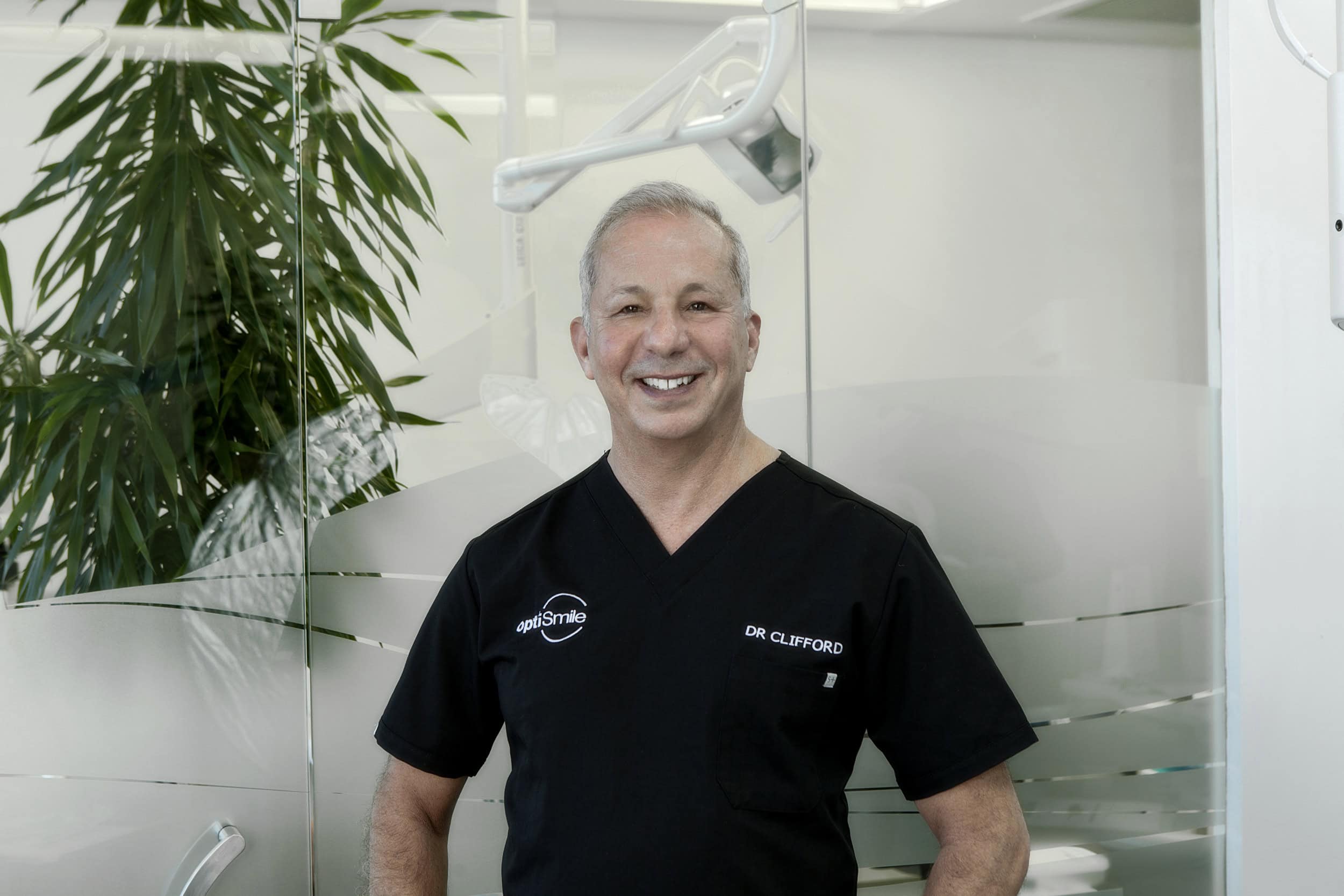
Dr. Clifford Yudelman
Founder & Principal Dentist, OptiSmile
As a globally recognised restorative and cosmetic dentistry expert, Dr Yudelman brings over 40 years of experience across four continents. A 1983 Bachelor of Dental Science graduate from the University of the Witwatersrand, his career has spanned private practices in London, San Diego, Perth, and Cape Town. Currently the founder and principal dentist at OptiSmile, he is celebrated for transforming dental visits into positive experiences and fostering patient confidence through superior dental health, with a commitment to the latest dental technology for improved patient outcomes.
🍪 Cookies for a Better Visit, Not Cavities! 🍪
Our website uses cookies to enhance your user experience. These cookies won’t harm your teeth—promise! By continuing to browse, you agree to our Privacy Policy.