Chapters
What Is the Difference Between a General Dentist and a Specialist?
[00:01:25 – 00:04:10]
A general dentist diagnoses, prevents, and manages most dental conditions across all age groups, covering everything from fillings and crowns to basic extractions and preventive care. Many also take on additional training in areas such as orthodontics.
A dental specialist, by contrast, has completed several more years of full-time postgraduate university training. Their scope is narrower but far deeper — a periodontist, for instance, attends periodontal conferences, reads periodontal journals, and focuses exclusively on gums and bone.
The two roles are complementary rather than competitive. Specialists are brought in when there is added complexity or risk, while the general dentist manages the broader picture. Understanding this distinction helps patients avoid both undertreatment and unnecessary referrals.
When Should You See an Endodontist for a Root Canal?
[00:04:11 – 00:09:08]
Endodontists specialise in diseases of the dental pulp and the root canal system. While many general dentists perform competent root canals, certain cases call for specialist involvement — particularly complex root anatomy, calcified canals, or retreatments where a previous root canal has developed an infection.
A common misconception is that a failed root canal means the tooth must be extracted. In most cases, a failed root canal was simply not performed well the first time and can often be redone successfully by an experienced dentist with a microscope and 3D imaging, or by an endodontist.
Endodontists also assist when persistent swelling or pain remains after treatment, or when a patient has vague, unlocated tooth pain. Higher success rates in complex cases are well supported by research, largely due to specialist training, consistent use of microscopes, and access to advanced technology such as electronic apex locators and canal lasers.
What Does a Periodontist Do Beyond Treating Gum Disease?
[00:09:09 – 00:12:08]
Periodontists specialise in the supporting structures of the teeth — the gums and the underlying bone. While managing gum disease is a significant part of their work, their scope extends considerably further.
They treat gum recession through procedures such as gum grafting, and they reshape gum and bone tissue to create adequate space for restorations. They are also highly skilled in implant placement, including advanced techniques such as partial extraction therapy, where part of the root is retained to preserve the surrounding bone and gum during implant placement.
Stable foundations are essential before any major restorative work can succeed. Patients requiring multiple crowns, bridges, or implants will often begin their treatment journey with a periodontist to ensure everything is healthy and stable before further work proceeds.
Why Would You Need a Prosthodontist for Crowns or Implants?
[00:12:09 – 00:15:25]
Prosthodontists complete at least four additional years of specialist training beyond dental school, focusing on the restoration and replacement of teeth. They are the go-to specialists for full-mouth rehabilitation — cases involving crowns on every tooth, extensive implant work, or complex reconstruction.
Where a general dentist might handle more straightforward crown and implant cases, a prosthodontist is better placed for high-stakes treatment involving significant investment. An experienced prosthodontist can comfortably complete 20 or more crowns in a single extended session, and their depth of experience makes a measurable difference to how long restorations last.
Experience matters as much as the qualification itself. A prosthodontist who has been practising for decades brings a level of clinical judgement that a recently qualified specialist is still developing. For complex or costly treatment, that experience can be the difference between restorations that last 15 to 20 years and those that fail within five.
What Is the Difference Between an Orthodontist and a Dentist Who Offers Invisalign?
[00:15:25 – 00:17:36]
Orthodontists are registered specialists who have completed postgraduate university training in tooth and jaw movement. They manage complex bite problems, skeletal discrepancies, and growth-related issues that go beyond what aligners alone can address.
Many general dentists offer Invisalign for mild to moderate alignment cases, having completed Invisalign’s certification programme and ongoing case support modules. A general dentist who has spent decades focused almost exclusively on aligners can bring considerable real-world experience, even without a specialist qualification.
It is worth noting that there is no such thing as a specialist cosmetic dentist — cosmetic dentistry is not a recognised specialty. A dentist may have a strong interest or extensive experience in cosmetic work, but the title of specialist carries a specific regulated meaning that this does not meet.
Oral Surgeons, Maxillofacial Surgeons, and Paediatric Dentists
[00:17:36 – 00:21:24]
In South Africa, oral and maxillofacial surgery is a single specialty. These surgeons handle extractions, wisdom teeth, biopsies, and minor surgical procedures, with some practitioners having additional expertise in facial trauma, reconstruction, or cancer treatment. Not all oral and maxillofacial surgeons have the same scope, and it is worth seeking the right practitioner for the specific procedure needed.
Paediatric dentists, sometimes called paedodontists, specialise in treating children — including those who are anxious, have special needs, or present with developmental conditions affecting tooth formation. Their training covers child psychology, behaviour management, and developing dentitions.
Young children requiring multiple fillings will often need treatment under general anaesthetic in a hospital setting. Paediatric dentists typically have regular sessions in hospital environments for exactly this purpose. In Cape Town, the Red Cross Children’s Hospital offers specialist paediatric dental services for children with more severe needs.
Do You Need a Referral, and How Does Coordinated Care Work?
[00:21:24 – 00:26:34]
Patients are legally able to self-refer to a specialist without going through their general dentist first. However, uncoordinated specialist visits carry risks — an implant placed without input from the restoring dentist, for example, may not be ideally positioned for the final crown.
Research consistently shows that multidisciplinary, coordinated care produces better outcomes than isolated specialist visits. Complex cases require careful sequencing: gum treatment first, then alignment if needed, then final restorations. The general dentist typically coordinates this process, with each specialist contributing their expertise at the right stage.
Strong communication between practitioners lowers the lifetime cost of treatment and improves how long results last. When roles are clearly defined and the team works together, it is patients who benefit most.
Transcript
Eon Engelbrecht – E-Radio-SA (0:04 – 0:55)
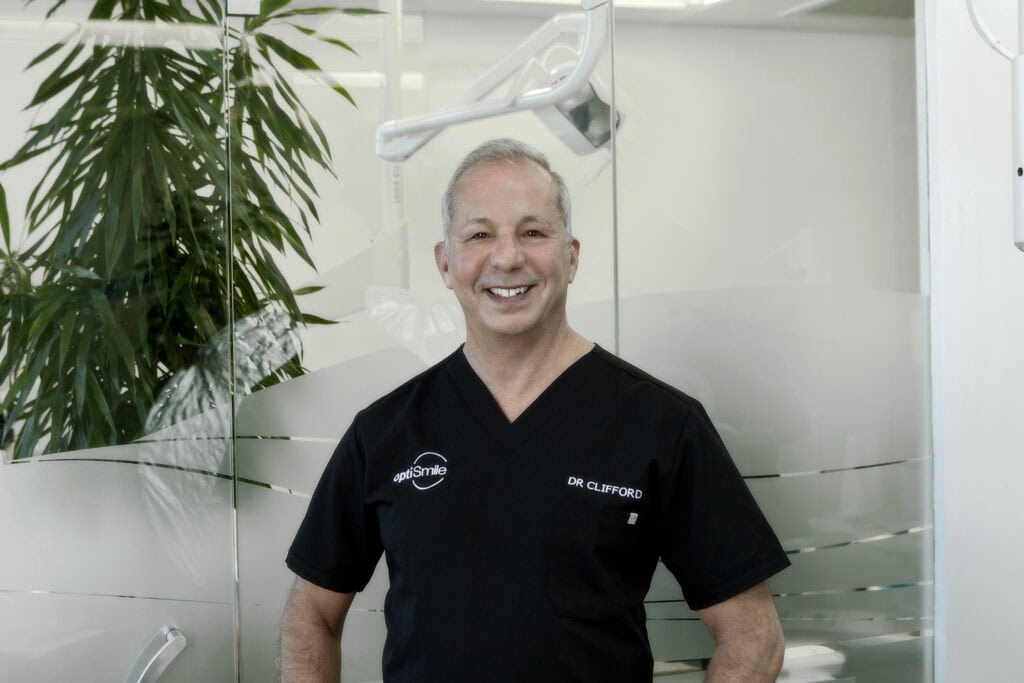
Welcome back to Save Your Money, Save Your Teeth. I’m Eon, and I’m joined as always by Dr Clifford Yudelman of OptiSmile. Now, today we’re tackling something almost every patient gets wrong at some point: the difference between a general dentist and all the specialists you can be referred to.
You get a periodontist and an endodontist and all of those. I won’t even try to say all the names, because it sometimes feels like alphabet soup.
Today Dr Yudelman is going to walk us through all of it: who does what, when you actually need a specialist versus a general dentist, and why getting this right can save you both money and unnecessary treatment. Dr Yudelman, welcome back.
Dr Clifford Yudelman – OptiSmile (0:55 – 1:24)
Hi Eon, lovely to be back, thank you, and I’ve really been looking forward to today’s episode. You know, I’m a big believer in specialising in different things, and we use a lot of specialists in our daily work, where we refer particular things to particular doctors. I don’t want to jump the gun, I’ll wait for the questions, but I think today is going to help a lot of people.
Eon Engelbrecht – E-Radio-SA (1:25 – 1:32)
I want to start at the beginning: what is the difference between a general dentist and a specialist?
Dr Clifford Yudelman – OptiSmile (1:32 – 4:10)
A general dentist is trained to diagnose, prevent and manage most dental conditions for all age groups. So that’s your exams and x-rays, your fillings, your crowns, basic extractions, and preventive care like cleanings and teaching you how to look after your teeth. And these days many general dentists do extra training and can even do orthodontics.
But a dental specialist, on the other hand, has done several more years of full-time postgraduate training, so they go back to university for another three, four, five years, depending on the specialty. And they specialise in things like orthodontics, which is straightening teeth, or periodontics. “Perio” means around, like a perimeter, so periodontics is your gums and your bone, and many periodontists also do implants.
“Endo” means inside: endodontics. Their scope is narrower, but deeper. So where I read a few different dental journals every month, or listen to podcasts, mostly in the fields I work in every day, a periodontist attends periodontal conferences, reads periodontal journals and does periodontal continuing education. Everything they focus on, that’s what they do all day. If it’s root canals, they’re doing root canals, and we’ll get to that shortly. So they go much deeper than a general dentist on their particular subject. And you know, evidence-based healthcare, which is what this podcast is all about, works best when a general dentist manages most of the care, but specialists are brought in when there’s extra complexity, or risk, or when something unexpected happens despite an experienced dentist being involved. It’s not that one is better than the other, it’s just that they’re complementary. And, you know, understanding the difference helps patients avoid undertreatment, which can sometimes be worse than the wrong treatment, putting off or missing treatment that needs to be done, or having it not handled well. And then it also helps patients avoid unnecessary escalation, like being sent to a specialist you might not need, when you might just need a more experienced general dentist.
Eon Engelbrecht – E-Radio-SA (4:11 – 4:18)
Okay, and when should I see an endodontist, instead of my regular dentist, for a root canal?
Dr Clifford Yudelman – OptiSmile (4:18 – 9:08)
An endodontist specialises in diseases of the dental pulp, that’s the soft part inside your tooth, and the root canal system. And while many general dentists can carry out competent root canals, there are a number of cases that call for an endodontist. Things like complex root anatomy or calcified canals. In other words, if your root canal makes a U-turn halfway down. It’s never perfectly straight, there’s always a little bit of a curve, but certain root canals are very complex, and if you’re older, you can have calcified canals.
Then retreatments, if you’ve already had a root canal and that root canal now has an infection. That’s a pet peeve of mine. A lot of dentists say, oh, your root canal didn’t work, we have to take the tooth out and do an implant. And that’s a shame, because most root canals that supposedly failed probably weren’t done well in the first place. So you’ve got a failed root canal, and it can often be redone. And an experienced general dentist with a microscope and a CBCT, a 3D x-ray machine, who has done extra training, even though they’re not a specialist, can do the retreatment. In my practice I’ve got two of those experienced general dentists. They’re not endodontists, they do other things on top of root canals. But the average general dentist should refer you to that type of dentist, or, in a case like that, to an endodontist, a root canal specialist.
Then teeth with persistent infections, where your dentist has attempted the root canal and you’ve still got swelling or pain. And sometimes we also send people to the endodontist when a patient has vague pain and we can’t find which tooth it is, or there’s just nothing to see. And every so often, you know, you simply need a second or a third opinion, until someone with more experience than you figures it out.
And, you know, there’s a lot of research showing much higher success rates, especially in complex cases, when a root canal specialist, an endodontist, does the treatment. And that’s mainly because of all the extra training, everything we’ve just spoken about, and especially magnification. They will always use a microscope. At OptiSmile we have three microscopes; we couldn’t practise without them. At the very least, the dentist should be wearing magnifying loupes, those binoculars they wear on their glasses, with a headlamp that’s really bright, and ideally even higher-magnification loupes if you don’t have a microscope. And then they have all the extra technology. Some of them use a laser inside the canal for persistent infections. There are all sorts of machines. We’ve just bought two more of these root canal treatment machines that electronically tell the dentist when they’re near the end of the root, so he knows where to stop, which is something even an x-ray might not show you. You’re working away and it goes beep, beep, beep, beep, and then it tells you you’re at the end.
So you know there’s all sorts of advanced technology that a general dentist might not have. And you know, if a general dentist recommends a specialist, it’s not a failure. It means the general dentist is looking out for you, and he wants to protect your tooth, even though he gets no kind of kickback or commission. You know, it’s not ethical or legal for the dentist to get, you know, a twenty percent kickback or whatever it might be from the specialist. They’re doing it purely as a favour to you. And you build good relationships with your specialists, and maybe you get a box of chocolates or a small gift at Christmas, just as a token of appreciation, but that’s it, it’s very much frowned upon. You know, in America it was different. If you sent a lot of braces cases, the orthodontist would take you heli-skiing with them, or something along those lines. But that’s frowned upon, you know, it’s a sort of indirect payment, treating you with gifts, or things like that. So the important thing is your long-term success. Oh, you can tell I love this subject. This isn’t going to be half an hour; I think we’re going for a full hour. It’s really important, it’s a whole book. Yes, okay.
Eon Engelbrecht – E-Radio-SA (9:09 – 9:16)
And while we’re talking about specialists, what does a periodontist do, besides treating gum disease?
Dr Clifford Yudelman – OptiSmile (9:17 – 12:08)
So yes, periodontists specialise in the supporting structures of the teeth, which is the gums and bone, and although gum disease is a major part of it, their scope goes further. You know, in a practice like ours, where you’ve mostly got people with a middle or higher income and good habits, like they’re not smokers, if they have diabetes it’s generally well controlled, and they come for cleanings every six months, or maybe they haven’t been for a year or two, but it’s not like we often get someone who hasn’t been to the dentist for ten years, or whose gums are far gone. So we don’t see a lot of severe gum disease in the practice, but we refer a lot of patients to the periodontist, funnily enough, and it’s not just for severe gums and bone loss, although we refer them for particular procedures as well.
They also manage gum recession, things like gum grafting, which we’ve spoken about before, and if someone needs bone removed around a tooth and the gum lowered, so that there’s more room to place something on the tooth. They are very, very good at implant placement, especially specialised techniques, something called partial extraction therapy, or PET, where, if it’s a front tooth, instead of taking your whole tooth out when a tooth is broken or has to come out, they prepare it but they leave the front part of the root of the tooth in place, so that your bone and your gum don’t shrink away. And then they place an implant with special planning and some bone grafting material behind it, and then they can often even put a temporary crown on, and you leave your appointment with a tooth in place where you came in with your own tooth. And it’s very specialised, brilliant. I can’t handle blood, I don’t do surgery, so I’ve been referring to various specialists for years. And in our practice we do place implants and do things like that, but for that type of very specialised implant placement we refer to a periodontist, sometimes an oral surgeon, but the periodontists are really excellent at this.
Yes, and we love the periodontists we refer to. And they do the groundwork, you know, they protect the foundations. Without stable foundations, everything else fails. So if someone needs a lot of crowns and bridges and implants and so on, they’ll often start at the periodontist, and they come back nice and healthy, and everything is stable, and there’s no recession, and then you can put something on the teeth.
Eon Engelbrecht – E-Radio-SA (12:09 – 12:16)
Okay, and why would I need a prosthodontist for crowns or, let’s say, implants?
Dr Clifford Yudelman – OptiSmile (12:16 – 15:25)
So yes, at OptiSmile I have a prosthodontist. And I’ll give away a secret: I turn 66 in August, and Dr Steyn is older. Let’s say older than 70. The reason I say older than 70 is I think he’s just turned 70 or 71, but he mountain-bikes and he flies [unclear: planes?]. He’s a very young old man. I hope he doesn’t hear this podcast. He’s a young man. Maybe we should cut that out, or maybe we’ll just leave it in.
But where I qualified at Wits in ’83, he qualified many years earlier in Pretoria, and then he went to Boston, and he qualified as a prosthodontist in Boston in 1983, and that’s right when implants were just beginning. And he’s a very good surgeon. He places his own implants and he restores them. So we’ve got, you know, my general dentists who do a lot of implants, and they do the more modern, straightforward cases. But we had a farmer from [unclear: Ireland?] who needed all his teeth done, and he needed 13, I think 6 on the bottom and 7 on the top, 13 implants, and his whole mouth rebuilt, and he came out maybe four or five times. And you know, those sorts of cases, you’re spending a lot of money, it’s a lot of treatment, and that’s exactly the kind of thing prosthodontists do, especially today. He also gets a lot of his own referrals and patients, because he’s been in Sea Point for a long time.
So if we get a patient who needs a full-mouth rehabilitation, crowns on every single tooth, and they’ve all failed, because maybe they have a dry mouth and they’re getting cavities everywhere, and all their crowns have worn out and they need all new crowns, sometimes they do it under sedation, but the prosthodontist won’t hesitate to do 20 crowns in a four-hour session, or 20, 26, 28 crowns. That’s what they do. They’re highly specialised, they’ve had a lot of training, and they’ve been doing it for years and years. Personally, I would always go to an experienced prosthodontist. I think if you go to a prosthodontist, it’s at least an extra four years of training, and we have a few of them in Cape Town who qualified maybe three or four years ago. They won’t have the depth of, say, someone like Dr Jurie in our practice, or some of the other experienced prosthodontists. So it’s also about the experience. But yes, look, it can mean the difference between something that lasts 10 or 15 years, maybe 20 if you’re lucky, but you know, things don’t always last, and something that fails in five years or less. And if you went to Turkey and they crowned all your teeth, and now two years later you have to replace them, you need someone like a prosthodontist, because the general dentist, well, you know, you don’t want to go there.
Eon Engelbrecht – E-Radio-SA (15:25 – 15:33)
Okay, and now I want to ask you: what is the difference between an orthodontist and a dentist who does Invisalign?
Dr Clifford Yudelman – OptiSmile (15:33 – 17:36)
So orthodontists also go back to university, and they get specialist training, mostly in tooth and jaw movement. They manage the complex bite problems and skeletal discrepancies, meaning your jaws, like if your lower jaw is too big, or your upper jaw is too small, and growth-related problems. Many general dentists offer Invisalign, or in some cases generic aligners, for mild to moderate alignment. If they do Invisalign, they have to do a certification course with Invisalign, and then a number of online modules, and they get support on their actual cases, and that helps them.
Some of the other generic brands that are available in South Africa, and we’ve done about six podcasts on this, they’ve never studied orthodontics, they don’t know what they’re doing with aligners. If you’re one of those listening to this, you know, sorry if I offend you, but don’t put people’s teeth at risk if you haven’t done the proper training. And a dentist like Dr Harris in my practice, he’s a general dentist, he never studied orthodontics at university, but he has done a number of courses, going back twenty years now, one with Skip Truitt, like a one-year residency, you know, and in those days nothing was online. And then he attended conferences and he limited his practice to orthodontics. So although he’s not a specialist orthodontist, he brings the experience of 20 years of aligners as a very good general dentist who limits his practice to it, or specialises in it, but he’s not a specialist. So a lot of people say they specialise in cosmetic dentistry, but there is no specialty in cosmetic dentistry. You can say you have an interest, or a special interest, or you’ve done a lot of courses, or you do a lot of it every day, but there’s no such thing as a specialist cosmetic dentist.
Eon Engelbrecht – E-Radio-SA (17:36 – 17:43)
Good, and when do I need an oral surgeon versus a maxillofacial surgeon?
Dr Clifford Yudelman – OptiSmile (17:43 – 18:50)
In South Africa they both do the same thing, though some of them have done further training. So oral surgeons do mainly extractions, wisdom teeth, minor surgical procedures. In South Africa they’re called oral and maxillofacial surgeons, so it’s one and the same. In some countries, you know, the maxillofacial part means they’ve done extra surgical and medical training, where they do things like facial trauma and reconstruction and cancer treatment and all sorts, and also cosmetic surgery, where they move your jaw forward or upward, that type of thing. You know, they do impacted wisdom teeth, simple extractions, biopsies. Yes, in South Africa they do the same thing. There can be one oral and maxillofacial surgeon who is more specialised than another, when it comes to trauma or cancer treatment or something of that sort, but you know, it’s always good to go to the right specialist, if you know you need a specialist. They’re not all the same.
Eon Engelbrecht – E-Radio-SA (18:51 – 18:59)
Yes, that’s true. And what is a paedodontist, and do they only see children?
Dr Clifford Yudelman – OptiSmile (18:59 – 21:24)
So yeah, look, a paedodontist or paediatric dentist, they specialise in treating children, including those that are anxious or special needs, or in complex developmental conditions, if they got bad enamel, something called MIH, or they swallowed a lot of fluoride toothpaste, or they grew up somewhere where there was a lot of fluoride and the teeth didn’t form properly from overdosing of fluoride. That’s not to be confused with getting the right amount of fluoride, which doesn’t harm your teeth at all. You know, their training focuses on child psychology, growth, behaviour management, and developing dentitions or child development. And you know, early positive dental experiences make a really big difference long term.
And while, you know, like I saw a little kiddie the other day, and it was fantastic, by the end of the appointment they were jumping in the chair and opening their mouth. I even did a 3D scan on the little kid. I couldn’t see in his mouth, but he was, he was basically almost scanning his own teeth. We put the scanner in his mouth and I helped him move it around, he was watching the screen, you know, so they could have a good time at the dentist. But if this kiddie needed 10 fillings, I’d probably be sending him to the paediatric dentist, because you can’t do long sedations on little kids. If a three or four year old needs a lot of fillings, they usually get a general anaesthetic in the hospital, and these paediatric dentists, that’s what they do. You know, every week they have a session at the hospital, and they’re dealing with kids that need multiple extractions.
Again, like, similar to what I said with gum disease, at OptiSmile, we really don’t see that a lot of the time. It’s in a, like, a lower economic level and a lower education level, and I’m sure in many small towns around South Africa, there’s a lot of kids with severe dental problems. There’s just not enough paediatric specialists a lot of the time. Like, in Cape Town, if someone’s listening to this and you’ve got a child with severe cavities, I believe you can go to the Red Cross Children’s Hospital, and they have specialists, especially if the kid needs extractions and so on. And there’s also programmes around Cape Town to help people out, especially for children.
Eon Engelbrecht – E-Radio-SA (21:24 – 21:30)
Okay, and then I also want to ask you, do you always need a referral to see a specialist or not?
Dr Clifford Yudelman – OptiSmile (21:31 – 22:55)
In some countries, maybe you do, but legally, no, a patient can self-refer. It’s always better if the referral is coordinated, so the primary dentist understands the full picture. When I first opened my practice here, I had someone come in, they had four implants. They went and got it done in hospital under medical aid, under anaesthetic, because then the medical aid paid for it. They were in the insurance business, so they knew how to sort of, you know, tweak it so that they could get free implants. But the oral surgeon, you know, he had these even before I moved back to South Africa, and they were healed. So he came to me, oh, can you put crowns on my implants? And if it’s not planned with the general dentist or the prosthodontist, the oral surgeon, you know, can do that, but they don’t know exactly where you want the teeth placed or how you want the angle of the implant. So they’re going to just do their best or whatever they normally do. But it’s always better when the, you know, when the patient and the regular treating dentist are working together. And, you know, research has shown that when you’ve got multidisciplinary health care as opposed to uncoordinated specialist visits, you know, you get much better outcomes when dentistry is played as a team sport.
Eon Engelbrecht – E-Radio-SA (22:58 – 23:00)
A team sport, you say, eh?
Dr Clifford Yudelman – OptiSmile (23:01 – 23:07)
Or a steam port. Sorry, that’s just the brain damage at this time of the day.
Eon Engelbrecht – E-Radio-SA (23:09 – 23:15)
I love it. That’s brilliant. Okay, and then were you finished or were you still talking?
Dr Clifford Yudelman – OptiSmile (23:16 – 23:19)
Yeah, I was done. Dentistry is a steam port.
Eon Engelbrecht – E-Radio-SA (23:19 – 23:26)
Okay, then I want to ask you, why does OptiSmile have specialists in-house?
Dr Clifford Yudelman – OptiSmile (23:27 – 24:54)
You know, we’ve got the prosthodontist and then we don’t have any other. So Dr Harris specialises in, or has a special interest and a lot of experience in Invisalign, but he’s not actually a registered specialist orthodontist. And then Dr Ruan teaches root canals. He taught root canals at Wits and now on a Monday, he’s not in the practice, he’s teaching root canals to other dentists, and he practises root canals to a specialist level, but he’s not an endodontist that is only registered to do root canals and nothing more.
We also work with, like I mentioned, the periodontists and the oral surgeons that are not in-house. So you have to be careful when a practice like OptiSmile or other practices around Cape Town talk about all the specialties under one roof. It doesn’t mean to say that everybody is a specialist. And yeah, we have meetings every Tuesday.
We have a special structure where we discuss complicated cases and we’re always sitting at a computer shoulder to shoulder, sometimes three of us or four of us, you know, coming together to make the best decisions for a particular patient. So when you come here, you don’t only just get one opinion, you’re getting multiple people thinking about your treatment and trying to come up with the best plan.
Eon Engelbrecht – E-Radio-SA (24:55 – 25:03)
And then finally, how do general dentists and specialists work together on complex cases?
Dr Clifford Yudelman – OptiSmile (25:03 – 26:34)
So complex cases always require proper sequencing. So for example, you know, you get the gums treated properly by the periodontist and you align the teeth, you know, that’s with the orthodontist or aligners like with Dr Harris. And then at the end, you got your injection moulded composite or your crowns, your implants, and everything needs to be planned together.
The general dentist will usually coordinate the care and the specialists contribute their expertise. And this type of thing always improves the treatment longevity and lowers the lifetime cost. And you know, when the roles are clear and communication is strong, it’s the patients that come out on top.
You know, one thing I found, especially with some of the younger dentists that are qualifying these days, they go to a few courses or they do a one-year course on digital dentistry and they really, you know, you don’t know what you don’t know. And they think they’re a jack of all trades and they’re doing very complicated cases that, you know, might require two or three different types of specialists to work on. And they are doing these, and I don’t want to say they think they can do it. They’re actually doing these big cases and we’ve seen disasters or treatment not going well when you go to one of these so-called, you know, self-proclaimed experts.
Eon Engelbrecht – E-Radio-SA (26:35 – 26:39)
Yeah, I think if you call yourself an expert, it’s probably already a red flag.
Dr Clifford Yudelman – OptiSmile (26:44 – 27:05)
Yeah, they chose red on purpose. Speaking of red and red flags, your new website looks fantastic. What colour red is that that you guys are using? It looks like fire engine red or lifeguard red, screaming red. What is it?
Eon Engelbrecht – E-Radio-SA (27:05 – 27:09)
It’s vivid red, actually. It’s called vivid red. Vivid. Yes.
Dr Clifford Yudelman – OptiSmile (27:10 – 27:14)
Yeah, I love the word vivid. It is. It says vivid. It feels good when you say it.
Eon Engelbrecht – E-Radio-SA (27:14 – 27:20)
Yeah, vivid. It’s vivid red. But I thank you. I’m glad you like it, Dr Yudelman.
Dr Clifford Yudelman – OptiSmile (27:21 – 27:48)
My pleasure. Thanks for your beautiful new website where you showcase our podcasts. And if anyone’s listening to this and they want to advertise on E-Radio or they want to do a podcast, you know, we’re now on, what is this, number 115 over the last two years. And we haven’t missed, other than over Christmas, both years, we haven’t missed a single week. And as you can tell, you’re doing a great job.
Eon Engelbrecht – E-Radio-SA (27:49 – 27:53)
You’re doing a great job. I’m just pushing the buttons and talking in between.
Dr Clifford Yudelman – OptiSmile (27:53 – 27:55)
Someone has to push the buttons.
Eon Engelbrecht – E-Radio-SA (27:56 – 28:05)
But yes, it’s great. And I’m enjoying it. But you can ask me anything about dentistry now. Anything. I think I qualified.
Dr Clifford Yudelman – OptiSmile (28:05 – 28:06)
All your friends are coming to you.
Eon Engelbrecht – E-Radio-SA (28:06 – 28:11)
Yeah, I’m going to graduate eventually after this series. I’m going to graduate.
Dr Clifford Yudelman – OptiSmile (28:12 – 28:30)
Well, now they just, this week there was news they’ve developed a self-drilling drill. You just clamp it on. So I’m going to be the clamper. I’m going to be the oke that clamps the drill. And then it’s all self, it’s all controlled by computers. So we’ll definitely have to get one of those.
Eon Engelbrecht – E-Radio-SA (28:30 – 28:30)
Yeah.
Dr Clifford Yudelman – OptiSmile (28:31 – 28:39)
Yeah. It’s amazing. I’ve been predicting that for about 20 years. So finally someone put some money into it.
Eon Engelbrecht – E-Radio-SA (28:39 – 29:08)
Fantastic. Dr Yudelman, thank you so much. That’s it for this episode of Save Your Money, Save Your Teeth. And if you’ve got questions about specialist referrals or any other dental topic, get in touch. We might just answer it here on the show. But until next time, when we’ll be talking about social media and dentistry, until then, look after your teeth and also your wallet. Where’s my wallet?
Announcer – OptiSmile (29:32 – 30:16)
Discover the world of dental excellence with OptiSmile. Join us for a weekly podcast featuring Dr Clifford Yudelman, a seasoned expert with 40 years of dental experience across four continents. Gain unique insights and expert dental advice by visiting OptiSmile.co.za for articles that illuminate the path to optimal oral health. If you’re seeking unparalleled dental care in Cape Town, get in touch with OptiSmile or book directly online on OptiSmile.co.za. OptiSmile, where global expertise meets local care.
Disclaimer: The content provided in this podcast, “Save Your Money Save Your Teeth” on Medical Mondays, is for informational and educational purposes only. It is not intended to serve as dental or medical advice. The insights and opinions expressed by Dr. Clifford Yudelman and any guests are designed to foster a better understanding of dental health, preventive measures, and general well-being, but should not be interpreted as professional dental or medical recommendations.Dr. Clifford Yudelman does not diagnose, treat, or offer prevention strategies for any health conditions directly through this podcast. This platform is not a substitute for the personalized care and advice provided by a licensed dental or healthcare professional. We strongly encourage our listeners to consult with their own dental care providers to address individual dental health needs and concerns.The information shared here aims to empower listeners with knowledge about dental health but must not be used as a basis for making health-related decisions without professional guidance. Your dental care provider is the best source of advice about your dental and overall health. Please always seek the advice of your dentist or other qualified health professionals regarding any questions or concerns about your dental health.