Chapters
Will a robot replace your dentist?
[00:00:04 – 00:06:08]
Dental robots already exist, and each one still needs a dentist. They hold the drill and reshape a tooth for a veneer or crown, with a dentist planning the preparation and operating the machine. Deciding who and what to treat, and when to wait and watch, stays with the dentist.
One system in development is built for minimally invasive dental veneers. Working from a digital scan, it can remove as little as 0.2 of a millimetre of tooth, a level of control that is very hard to achieve by hand. Dentists generally cut away too much tooth when preparing veneers, which is one of the main reasons OptiSmile is cautious about recommending them.
Because the veneers can be made ahead of time, the robot prepares the teeth and the veneers are bonded the same day. These systems are not yet for sale, and a version for crowns is being discussed.
AI on x-rays and chatbot second opinions
[00:06:08 – 00:10:45]
AI x-ray software has been trained on hundreds of thousands of images and does not get tired at four in the afternoon. It flags early decay and early bone loss that a dentist could skip past in error. The software only flags, and the dentist still decides what gets treated.
Seeing an early lesion on screen helps you adjust your diet and clean between your teeth before it grows. Prevention is the cheapest dentistry there is. A radiation-free 3D imaging technology shown in a recent webinar colour-codes cracks, cavities, old fillings and plaque, though it has not reached the market yet.
A chatbot is a useful starting point for understanding a treatment plan in plain language and preparing questions to take to a dentist. It cannot see your mouth or feel whether a tooth is loose, and it can be confident about a wrong answer. General AI tools can now spot a large cavity on an x-ray and simulate your smile after veneers or bonding, yet they cannot say how much tooth each option removes or which one suits you.
Tracking aligners from your phone
[00:10:45 – 00:12:55]
Remote monitoring means taking photos of your teeth at home with your phone, usually once a week. With Invisalign, the software checks that the aligners are fitting properly and notifies the dentist, who compares the photos to the treatment plan. The dentist can then tell you to wear an aligner for another week or confirm you are on track.
It suits people who travel, such as yacht crew and seafarers away for three months at a time, and patients elsewhere in South Africa or the rest of Africa. Catching a poorly fitting aligner early beats discovering it at a six-week check. There is little AI in the monitoring apps available now, and they do not take the place of a dentist.
Robot-guided implant surgery
[00:12:55 – 00:14:19]
Guided surgery works like a GPS. A 3D scan is used to plan where the implant goes before treatment begins, and in most practices a 3D-printed guide clips over the neighbouring teeth to direct the drill.
A robotic arm can now do that job, and at least one is reported to be in use in Cape Town. It guides the dentist’s hand to the right angle and signals when to stop, with the dentist still holding the instrument. The more accurately dental implants are placed, the better the crown on top and the better the result five to ten years later.
Who owns your dental data?
[00:14:19 – 00:16:47]
A modern dental record includes scans, photos, x-rays and sometimes recordings, and in South Africa it is protected under POPIA, the Protection of Personal Information Act. You are entitled to know how it is stored and who it is shared with. You can also ask for a copy.
A copy of your own scans and x-rays belongs to you. A practice cannot withhold an x-ray you paid for because you owe money on a different treatment. The same may apply even where the x-ray itself is unpaid, although that point was raised with less certainty.
Copying film x-rays once meant darkroom work, which justified an admin charge. Digital records take a few clicks to send, so you should be able to get your x-rays and a copy of your chart.
Will we ever regrow teeth?
[00:16:47 – 00:19:09]
Regrowing teeth is likely to happen eventually, though probably not within the next five years. Research in Japan is prompting new tooth growth, starting with people born without some of their teeth, and gene editing with CRISPR is advancing. Stem cell regrowth for someone who has lost a tooth is further off again.
The real danger is neglecting the teeth you have while waiting for a miracle. An implant and crown in South Africa can cost anywhere from R20,000 to R50,000. At the lower end, someone with 23 teeth left is carrying R460,000 worth of teeth, and natural teeth are better than implants.
Even when regrowth arrives, nobody knows what it will cost or whether the tooth will come in straight.
VR glasses and smart toothbrushes
[00:19:09 – 00:24:10]
Virtual reality glasses can put an anxious patient’s mind on a beach or under the ocean during treatment. OptiSmile has not used them on patients, partly because the headsets tried so far stick out too far and would block the view needed for microscope work. Slimmer glasses that sit flush like sunglasses are now appearing.
Smart toothbrushes measure how hard you press and sense the angle of the brush. A connected app shows which areas you miss. Some warn you out loud when you brush too hard, and with the higher-range models a lot of the price is branding.
Dyson’s new toothbrush costs about $500, or R8,185 at the time of recording. It uses a 100,000-pixel camera taking 28 images a second to spot gaps between teeth and fire a jet of mouthrinse into them, and it needs its own non-foaming toothpaste. First reports mention a number of issues, so it is worth waiting before buying one.
The takeaway: technology that helps you keep your teeth
[00:24:10 – 00:29:02]
The most exciting change is how the tools work together: digital scans, AI on x-rays, monitoring from home and better materials. Injection-moulded composite bonding placed around six years ago still looks good on patients today.
SmileCloud merges studio photos with a 3D scan to simulate how bonding or orthodontics would look on your teeth, and veneers in some cases. It also creates an AI video of you speaking with the new smile, including a side view. This has largely replaced the physical mock-up, where tooth-coloured material was moulded onto the teeth and had to be removed before it set.
The common thread is better decisions and less treatment, which is the point of saving your money by saving your teeth. Future episodes may bring in outside experts from universities to share the latest research.
Transcript
Eon Engelbrecht, E-Radio-SA [00:00:04 – 00:01:05]
Welcome back to Save Your Money, Save Your Teeth, where we look at what genuinely protects your teeth and also your wallet. Now last time we spoke about special care dentistry, adapting the visit to fit the person, and today we’re looking at the tools that are changing what a dental visit even looks like. Robots, artificial intelligence, AI, apps that watch your teeth move from home, and toothbrushes that report back on you.
Some of it is genuinely useful right now, some of it is hype, and some of it is still a decade away. So today, will a robot replace your dentist? Can AI spot a cavity that a human misses? And should you trust a chatbot’s dental advice who actually owns your dental data? And then also, are we really going to regrow teeth? Goodness gracious.
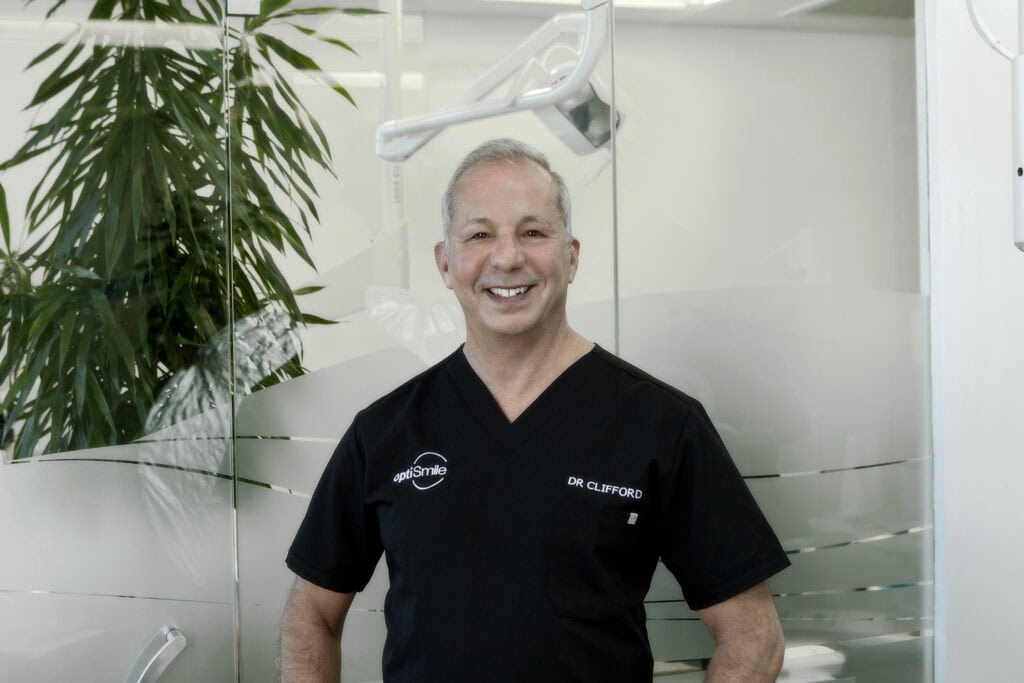
Joining me as always is Dr Clifford Yudelman from OptiSmile in Sea Point, Cape Town. Dr Yudelman, welcome back.
Dr Clifford Yudelman, OptiSmile [00:01:05 – 00:01:19]
Thanks, Eon. Great to be back, and yeah, very much looking forward to today’s episode. After the last one, which was quite serious, now we’ve got one which is a bit more future-looking and upbeat.
Eon Engelbrecht, E-Radio-SA [00:01:19 – 00:02:03]
I’m also looking forward to it because we both like AI and watching what’s happening with AI and how it’s advancing very, very rapidly, and some people even say it could be a threat to humans. I don’t know if you saw on the news, but some AI people quit at a company from the technicians because they saw what AI can do, and they got so scared that they actually left. They left the company.
So yes, I personally don’t feel that AI is going to take my job, but it’s definitely helping me in my field and assisting me. It’s working with me, not against me. So how do you feel? Do you think a robot will ever replace a dentist?
Dr Clifford Yudelman, OptiSmile [00:02:04 – 00:06:04]
So I want to just clarify between AI and robots. Actually, in dentistry now, especially in the last few years, there’s been quite a bit of development on actual robots that hold the drill and will actually reshape a tooth so that you can, say, get a veneer or a crown on the tooth, but it’s still operated by a dentist and the preparation and everything needs to be planned with the help of a dentist. It’s not at the point where you go in, you sit down, and the robot finds the problem, decides on the solution, and then fixes your tooth.
So these robots are just things that are brilliant at precision and repetition, but the judgment on who to treat and what to treat and when to wait and watch and the particular patient’s situation, that will always, I think, be a dentist that’s going to be in charge of that. But these are special tools that I’m sure when they are launched, none of these are for sale just yet. There’s a very top dentist that came and gave a lecture in South Africa about the work that he’s doing on this particular one that’s made especially for preparing veneers.
They’ve got it to a point now where they can, based on a digital scan, decide on how the veneer is going to look and how it should sit on your own tooth. These are very minimally invasive veneers where you do have to file a little bit of tooth, but in some cases, you’re only taking off 0.2 of a millimetre or even less than half a millimetre, which is very difficult. They’ve been comparing it to a dentist that’s trying to do one of these very minimally invasive preps, and dentists generally will overprepare, cut away too much tooth when doing veneers, which is one of the main reasons why I don’t like to recommend them or do them because they’re not as conservative as people say or think they are, but these robots, I think, will change all of that.
They can actually make the veneers ahead of time. The robot prepares the teeth, and then they can glue the veneer on the same day. That is amazing.
Now, they’re talking about a new one that’s doing crowns. In fact, there’s a robot that helps dentists to place implants, and there’s even one available in Cape Town. I heard a dentist a few weeks ago got one of these robots that instead of using a 3D-printed guide when you’re getting an implant placed, it superimposes where your jaw is with an x-ray, and then the robot helps to guide because the angulation and the precision has to be very precise.
It’s apparently amazing, obviously very expensive, but the dentist still keeps his hand on it. The robot just guides the dentist’s hand. It’s very much like robotic surgery for prostate cancer where there’s still somebody operating it.
We’ll talk more about AI also, I think, coming up later, but these are actual robots, physical robots. That’s right. Actually, I had a patient the other day. She’s sold a number of high-tech businesses, and she’s actually involved now with a company in California that’s building robots that fixes fighter jets. These are huge robots that’ll put a new wing on a fighter jet, so that’s a big time.
Eon Engelbrecht, E-Radio-SA [00:06:08 – 00:06:15]
Back now to dentistry, how is AI helping dentists find cavities that humans miss?
Dr Clifford Yudelman, OptiSmile [00:06:16 – 00:07:47]
I mean, the AI doesn’t get tired at four in the afternoon. It doesn’t have any bias, what it saw yesterday. We’ve spoken about AI with x-rays.
There’s a lot of other AIs now, but finding cavities on x-ray, they’ve been trained on hundreds of thousands of x-rays, so they’re very good at finding early shadows and early decay, early bone loss, things that a dentist can maybe skip past in error. They’re not actually diagnosing. They’re just flagging it, but I still decide what should get treated and what shouldn’t.
Also, we’re able to show these patients where these early lesions or cavities are, so they can do a better job with their diet or cleaning between their teeth and preventing these cavities from going further. That’s the cheapest dentistry there is, is prevention.
And then the other day, I was on another webinar where his name is Zuckerberg from Facebook. The father is a dentist, and he’s involved in a lot of these new technologies. They have a venture capital fund, and he was showing some new things instead of x-rays that give you a 3D picture of your tooth, and it shows cracks, cavities, old fillings, plaque. It’s all colour coded and with no radiation.
I can assure you when that comes in the market, I’ll be the first one to get it. It looks amazing.
Eon Engelbrecht, E-Radio-SA [00:07:47 – 00:07:50]
Yeah, because there’s no radiation also. That’s fantastic.
Dr Clifford Yudelman, OptiSmile [00:07:50 – 00:07:54]
Yes, and just so much more accurate. Oh, really? Yes. It looks amazing.
Eon Engelbrecht, E-Radio-SA [00:07:55 – 00:08:10]
Now, the next one, I’m guilty of this, and I think a lot of people are. We ask AI chatbots like ChatGPT about our teeth. We even use it as a second opinion on a treatment plan. Is this a good idea, doctor?
Dr Clifford Yudelman, OptiSmile [00:08:11 – 00:10:44]
I think it is useful and it’s a good starting point, but it’s not really a final word. A chatbot, just like Google, can explain what a root canal involves. It can help you write down some questions and maybe even take something that doesn’t make sense in plain English.
It can explain what if the dentist hasn’t already explained your treatment plan to you in a way that you understand. It can help translate it into layman’s terms, but it can’t see your mouth. It can’t feel if a tooth is loose.
It can’t necessarily read your x-ray, although I think that’s coming soon, just regular AI. I have put some x-rays in normal in Gemini and a couple of the others, and it can actually see a cavity, but we’re talking about a big cavity. If you put an x-ray with a big cavity and you say, is this tooth healthy? It will say, no, there’s a cavity on this and that surface. But so that’s getting really, really good.
There’s special apps. If you think you might have melanoma, it’ll use AI to tell you, yes, you should go to the dermatologist or don’t worry, but still you’re talking about cancer there. You would definitely want to go and see a doctor, but at least you’re getting some extra information. I would say, use it to get informed and then take those questions to a real dentist for a second opinion if you’re unsure.
You don’t want to be confident about a wrong answer. We get patients all the time that have, even now, I did a no-charge video consult with a patient that she’s a PA for a very, very wealthy person in France. They come to and from South Africa.
She did a before and after. I think it was on ChatGPT. ChatGPT, it didn’t just make up, give her a nice smile. It actually did some simulations of what her teeth would look like with veneers and what it would look like with bonding and what it would look like with orthodontics. I have to say it did a pretty good job, but it didn’t explain to her how much tooth would actually have to be drilled away if you were going to do a veneer versus, say, bonding, or it couldn’t actually pick which one was right for her. She could just get an idea of what it would look like with each one, but I was blown away. It was pretty good.
Eon Engelbrecht, E-Radio-SA [00:10:45 – 00:10:55]
That’s amazing. Doctor, what is remote monitoring for aligners like Invisalign, and can I really track my teeth with my phone now?
Dr Clifford Yudelman, OptiSmile [00:10:56 – 00:12:54]
Yes. You take photos of your teeth at home, usually once a week with your phone. The software checks that teeth are moving the way the plan should, but in fact, in the case of Invisalign, the software just checks that your aligners are fitting properly, and then the dentist gets a notification, and then the dentist is up to the dentist to then look at that and to compare it to the plan.
We do that a lot for yachties, people that work on, or seafarers, people that come and go maybe every three months, or people that live in other parts of Africa or South Africa, and it works very, very well. There is another one called remote monitoring that if it’s not Invisalign, it’s meant for other types of aligners. I don’t think it’s available in South Africa, but a lot of people overseas use it.
And it doesn’t take the place of a dentist, but it’s better than discovering at a six-week check that an aligner hasn’t been fitting properly. On the app, when we look at it and it looks like the aligner isn’t fitting properly or things are not tracking, the dentist can pick a message to send to the patient like, wear that aligner for another week before you change to your next one, or good job, you’re doing well. So basically, for people who travel a lot, those remote monitoring things work well.
There’s not a lot of AI in them. It’s basically just a way to take your pictures and to send it. Yeah, there’s not a huge amount of AI, at least in the ones that are available now.
But like I said, even ChatGPT or Gemini, they’re all getting very good at recognising different things. If you take a picture of your lower teeth and they’re all crooked and you say, oh, my teeth are straight or crooked, it’s going to tell you they’re crooked. It knows what normal looks like. Yeah.
Eon Engelbrecht, E-Radio-SA [00:12:55 – 00:13:00]
Okay. And just getting back to guided surgery, are robots actually placing implants now?
Dr Clifford Yudelman, OptiSmile [00:13:01 – 00:14:18]
Yeah. So as I was saying a little bit earlier, I jumped the gun with that, but it’s basically like a GPS. So you do a 3D scan and you plan exactly where the implant should go before you even begin.
And then in most cases where someone doesn’t have a robot, you make a 3D printed guide that clips over the adjacent teeth. And then you use that to plan where the implant goes. You actually use it as a guide to guide the drill.
But this particular system that I mentioned earlier, it’s a robotic arm and you use it to, it guides your hand where to go, the right angle basically, and then also when to stop. It’s still a human that’s doing it. And also, the accuracy is very good with these robots now.
And the more accurately an implant is placed, the better the crown that goes on it will be. And everything else, five, 10 years later is better when the implant is placed properly and at the right angle, et cetera.
Eon Engelbrecht, E-Radio-SA [00:14:19 – 00:14:31]
Now with all this AI and the digital scanning, who actually owns my dental data? Should I worry about privacy? I know we’ve got the POPI Act in South Africa as well.
Dr Clifford Yudelman, OptiSmile [00:14:32 – 00:16:46]
Yeah, I was going to talk about that now. So that’s a good question because a modern dental record is far more than just notes. It’s scans, it’s photos, it’s x-rays, sometimes even recordings.
And in South Africa, that information is protected under POPIA, the Protection of Personal Information Act, I believe is what it stands for. And you’re entitled to know how it’s stored, who it’s shared with, and to ask for a copy. The one thing about copies, your own scans belong to you, at least a copy of them.
So that’s something that people don’t understand. Say you go to a dentist and you get an x-ray done, and you’ve paid for that x-ray, and then you go back and you have a filling done, and for some reason or another, you didn’t pay for the filling when you left, and now you’re not happy with the filling, and then you still need to go back to that dentist, or maybe you don’t like them, and you owe them some money on the filling, and then you go to another dentist and you want to get your x-ray transferred, they can’t withhold that x-ray from you because you owe money on the filling. Or I believe, and I might be incorrect, that even if you haven’t paid for the x-ray in the first place, that that x-ray belongs to you, the information on that x-ray belongs to you.
In the old days when it was film x-rays, there used to be an admin charge or a charge to copy because you had to go in the darkroom and physically take one x-ray and put it in a special machine to expose it on another piece of film and then develop it, and there was quite a lot of labour involved, and then mount the x-ray, and then the patient could come in and pick it up, it would be in an envelope waiting for them. So, they used to charge for copying x-rays, but these days with everything digital, and it takes a few clicks to email or transfer something through, everybody should be able to have access to their records, and you should be able to ask for a copy of your chart as well.
Eon Engelbrecht, E-Radio-SA [00:16:47 – 00:17:01]
Now, doctor, that’s very interesting. I never knew that, to be honest, about the data and the x-rays actually belonging to you, but do you think we’ll ever be able to regrow teeth?
Dr Clifford Yudelman, OptiSmile [00:17:01 – 00:19:08]
So, I do think so, especially now with AI, but not tomorrow, not the way the headlines make it sound. There’s genuinely exciting work, including some work going on in Japan where they’re prompting new growth. They’ll do it initially for people born without some of their teeth, and also there’s a lot of things now with genetic engineering and CRISPR, spelt a bit differently to how you would think. I think it’s just C-R-I-S-P-R, if I’m not mistaken, where they’re actually splicing genes and putting in genes or taking out genes.
You know, stem cell regrowth for someone who’s lost the tooth is further off again, but the real danger here is people neglecting teeth that they’ve got while they’re waiting for some miracle, and that’s one of the most expensive bets you can make. Look after your teeth.
If an implant, to put in an implant and put on a crown, in South Africa it can be anywhere from R20,000 to R40,000 or R50,000, and I see someone who’s maybe lost four or five teeth and they have, say, 23 teeth left in their mouth, and then even at the lower end, R20,000 a tooth, I tell them, you know, you’ve got R460,000 worth of implants there in your mouth, and they’re better than implants. What nature gave you, you know, you would look after them better. Don’t think, oh, if I lose a few more teeth, I’ll just get an implant. You’ve already got something better than an implant there.
Also, you know, this regrowing teeth, even when we can do it, who knows what it will cost or whether the tooth will come in straight. I’m not sure that will happen anytime in the next five years, but I’m sure with the way things are going that we will have that, and also with AI now, there’s so much stuff going so quickly.
Eon Engelbrecht, E-Radio-SA [00:19:09 – 00:19:18]
Yeah, and now let’s talk about virtual reality or VR. How does virtual reality help anxious patients during treatment, doctor?
Dr Clifford Yudelman, OptiSmile [00:19:20 – 00:21:01]
So, personally, I’ve never used it on a patient, but I did have a look at them when I was recently in America. I think they were the Meta ones, and they were amazing, but for me, they were still a bit bulky. They stuck out from the patient’s face too much, you know, with all the correct projection and the lenses, and they would have obstructed, you know, we work with a microscope, and they would sort of cover up the mouth because a lot of the time the dentist is looking over the top of your head sort of past your nose, and if you have something that’s sticking out, you know, a few inches or a centimetre or two further, it’s not going to let the dentist see inside your mouth, but I did see something popped up because I’m interested in these things, and something, a VR glasses popped up on my feed a few days ago that look a lot more flush.
They just look like a nice pair of, like, Oakley sunglasses, and apparently they work quite well, but wearing something like that will, you know, put your mind somewhere else. You can feel like you’re on the beach or under the ocean, and also the sound on those things is really good, and it could be a good distraction.
I believe that they use them now in, like, burns units, and in medicine, maybe when someone’s getting a CAT scan or something done. I don’t think they can actually put your head in a, what do you call those, an MRI with these glasses on, but maybe soon they’ll be projecting stuff inside those. Have you ever had an MRI? You know what I’m talking about.
Eon Engelbrecht, E-Radio-SA [00:21:01 – 00:21:01]
No, thank goodness.
Dr Clifford Yudelman, OptiSmile [00:21:02 – 00:21:13]
Anyway, you know, it’s, I think it’s an interesting concept. I haven’t used it myself, but everything’s going that way these days, I guess.
Eon Engelbrecht, E-Radio-SA [00:21:15 – 00:21:21]
And then, smart toothbrushes, what are they, and is the data actually useful?
Dr Clifford Yudelman, OptiSmile [00:21:21 – 00:21:47]
So, funny, you know, this came up now rather than a few weeks ago because Dyson, who makes fancy vacuum cleaners and hair dryers, just launched one overseas, and it’s going all viral, and it’s actually about $500. So, what would that be in South Africa? A lot more. How much would that be? It’s like 10,000 rand?
Eon Engelbrecht, E-Radio-SA [00:21:47 – 00:21:54]
$500 at the moment. That’s US dollars. It’s 8,185 rand.
Dr Clifford Yudelman, OptiSmile [00:21:55 – 00:24:10]
It’s just over 8K. Yeah. We sell some very fancy toothbrushes at OptiSmile that I’ll talk about in a second, and they’re pretty expensive at 3,000 rand, and the others, some of these higher-range Sonicares and that, a lot of that’s branding.
There’s an Oral-B IQ series. We have one called Oclean at OptiSmile. I actually have one of these things. I think I mentioned this in a previous podcast. In fact, we did. It has like that little voice that says, you’re brushing too hard. You’re brushing too hard.
So, these are these fancy toothbrushes that measure how much you press on your teeth, and the one that I have connects with the app. I did set it up when I first got it, but I’ve never looked at it since. It can show you which areas you’re missing. It’s got sensors that will actually sense what angle your brush is at where you are, but this Dyson one, I think we have to mention it.
It’s got a 100,000-pixel macro camera, and it’s got artificial intelligence, and it takes 28 images a second. When it sees a gap between your teeth, it shoots a little bit of mouthrinse in a jet. It’s like a water flosser, which we spoke about before. I’m not big on water flossing. In fact, we see patients who have problems from using water flossers at the wrong angle. This might actually fix that because this is shooting from the correct angle, I guess.
Then, also, this Dyson, apparently, you have to use it with special non-foaming, not shampoo, toothpaste, so then you’re going to pay a fortune for the special toothpaste that comes with it. Apparently, there’s a number of issues with this device just in the last few days, so stay tuned. I hope you didn’t buy one of these, did you get one?
Eon Engelbrecht, E-Radio-SA [00:24:10 – 00:24:27]
Thank goodness, no. Okay, so this is so interesting, but now that we wrap up of everything we’ve discussed today, doctor, what excites you the most about where dentistry is heading?
Dr Clifford Yudelman, OptiSmile [00:24:28 – 00:27:11]
I mean, it’s not just one gadget. It’s the way everything works together, the digital scans, the AI on the x-ray, the monitoring from home, some of the amazing materials. Five, six years ago, this injectable composite came out that is just so amazing. Even six years later, these injection moulded composite bondings that we made with these types of materials, they’re still looking good on patients. There’s so many advances in dental materials and in all kinds of AI.
I did mention earlier about that alternative to x-rays. X-rays were invented, I don’t know the exact date, but I remember when I was learning French, I had to give a talk about Marie Curie in French. I think she invented the x-ray, her and her husband, I believe. I can’t remember now, but x-rays are pretty old. They’ve been around, I want to say, since the 1800s, so not quite 200 years, but they’ve been around for a while.
The AI, we use something called SmileCloud. If I take a photo, a couple of photos of you in the studio with a nice camera and then upload your 3D scan that we take with our 3D scanner, it merges everything, your photo and your scan. Then we can do simulations to see what bonding or orthodontics would look like on your teeth or even veneers in some cases. Then it will create an AI video of you speaking and even a side view so you can see what the new smile would look like.
In this case, it’s replaced what we used to do a lot of, which is get a mould made and then fill it with tooth-coloured material and then put the stuff in your mouth and then let it sit and then take it out. Then you could have a look at it. We could take a video of you. Then we had to quickly take it out before it sits and sticks to your teeth. There is the odd time that we will do something like that, but now with this AI version on SmileCloud, it’s very rare that we would do that. We show it to you all in 3D and it’s pretty amazing. That’s very exciting right now.
The big thing is a lot of these things are saving people’s teeth. It’s about not getting more treatment. It’s about better decisions. That’s the whole philosophy of the show, saving your money by saving your teeth. The technology really helps us to do that.
Eon Engelbrecht, E-Radio-SA [00:27:11 – 00:27:17]
Absolutely. Who knows what a dentist visit will look like on this day in 2036?
Dr Clifford Yudelman, OptiSmile [00:27:20 – 00:27:21]
Only 10 years from now.
Eon Engelbrecht, E-Radio-SA [00:27:21 – 00:27:22]
You never know.
Dr Clifford Yudelman, OptiSmile [00:27:22 – 00:27:42]
I should still be practising. I’ll be 76 and my late dad practised till he was 80. I’m hoping the robots are doing most of the work then. I’m not sure. As long as I can get to and from work, I’ll be controlling a robot. That’s only in 10 years’ time. It’s around the corner.
Eon Engelbrecht, E-Radio-SA [00:27:42 – 00:27:45]
Do you think this podcast will still be going then?
Dr Clifford Yudelman, OptiSmile [00:27:49 – 00:27:52]
There’s always new things to talk about.
Eon Engelbrecht, E-Radio-SA [00:27:53 – 00:27:56]
Imagine. Oh my gosh. That’s hilarious.
Dr Clifford Yudelman, OptiSmile [00:27:59 – 00:28:37]
There’s always going to be new treatments and new things. One concept for continuing the podcast is rather than people just listening to me and my opinions would be to start inviting other world experts because we do it on the radio like this where we have spoken about preventing cavities. We can maybe get a professor from a university in Europe or Australia or even here in South Africa that could give even more in-depth information and tell us what the very, very latest research is.
Eon Engelbrecht, E-Radio-SA [00:28:37 – 00:28:52]
That’s a very good idea actually, Dr Yudelman. We should definitely explore that. That’s it for another edition of Save Your Money, Save Your Teeth. We say thank you to you, Dr Yudelman. It was great as always. Thank you.
Dr Clifford Yudelman, OptiSmile [00:28:53 – 00:28:57]
Thank you very much and looking forward to speaking to you next time.
Eon Engelbrecht, E-Radio-SA [00:28:57 – 00:29:00]
Absolutely. Into the future we go. Until next time.
Dr Clifford Yudelman, OptiSmile [00:29:01 – 00:29:02]
Cheers. Thank you.
OptiSmile Announcer [00:29:22 – 00:30:07]
Discover the world of dental excellence with OptiSmile. Join us for a weekly podcast featuring Dr Clifford Yudelman, a seasoned expert with 40 years of dental experience across four continents. Gain unique insights and expert dental advice by visiting optismile.co.za for articles that illuminate the path to optimal oral health. If you’re seeking unparalleled dental care in Cape Town, get in touch with OptiSmile or book directly online on optismile.co.za. OptiSmile, where global expertise meets local care.
Disclaimer: The content provided in this podcast, “Save Your Money Save Your Teeth” on Medical Mondays, is for informational and educational purposes only. It is not intended to serve as dental or medical advice. The insights and opinions expressed by Dr. Clifford Yudelman and any guests are designed to foster a better understanding of dental health, preventive measures, and general well-being, but should not be interpreted as professional dental or medical recommendations.Dr. Clifford Yudelman does not diagnose, treat, or offer prevention strategies for any health conditions directly through this podcast. This platform is not a substitute for the personalized care and advice provided by a licensed dental or healthcare professional. We strongly encourage our listeners to consult with their own dental care providers to address individual dental health needs and concerns.The information shared here aims to empower listeners with knowledge about dental health but must not be used as a basis for making health-related decisions without professional guidance. Your dental care provider is the best source of advice about your dental and overall health. Please always seek the advice of your dentist or other qualified health professionals regarding any questions or concerns about your dental health.