Chapters
What a stressed mouth looks like
[00:00:04 – 00:04:47]
Stress leaves marks a dentist can often spot before the patient says a word. Worn-down front teeth are one. A white line along the inside of the cheek shows where clenching presses the tissue against the teeth, and the side of the tongue can carry scalloped indentations from the same habit.
No single sign proves much on its own, since teeth chip for all sorts of reasons. The pattern is what tells the story, and after 43 years in practice it becomes recognisable enough that the first question is often about something other than teeth.
Gums that look red and puffy right across the mouth, beyond the places where plaque usually collects, are another prompt to ask. The body is built for short bursts of stress, the kind that end when the threat does. Stress that runs for weeks and months is what it handles badly.
Cortisol, bleeding gums and box breathing
[00:04:47 – 00:08:01]
Long-running stress leaves a biological footprint in the gums. Cortisol climbs with stress and with broken sleep, dampening the immune response and changing blood flow to the tissues. Bacteria get the upper hand and healing slows, so gums start bleeding even though the brushing has not changed.
The clinical word for those gums is friable, meaning weak and quick to tear. Bleeding that tracks with heavy plaque points to ordinary gum disease. Bleeding from a puff of air, with little plaque to explain it, suggests something going on deeper in the body.
Box breathing is one thing patients get taught in the chair. Breathe in for a count of four or six, hold for a similar count, breathe out, then hold again before the next breath in. Three or four minutes of it can be enough to feel the pressure lift.
Grinding and clenching you do not notice
[00:08:01 – 00:10:03]
Most people who grind hear about it from a partner, because the noise carries at night. Others wake with a tight jaw or a dull ache around the temples and never connect it to sleep. The teeth show it too, in flattened or chipped front edges and fillings that keep cracking.
Daytime clenching is quieter and easier to miss. Sitting at a red robot is a good moment to check. Either the teeth are pressed together, or they are slightly apart with the tongue resting gently on the roof of the mouth.
A night guard protects the teeth and leaves the stress untouched. It is also a different appliance from a sports mouthguard, and wearing a boil-and-bite sports guard overnight can make matters worse. Patients chew on it like a toy, which builds the jaw muscles up and leaves the joint worse off.
Ulcers, dry mouth and sudden cavities
[00:10:03 – 00:13:38]
Ulcers are one of the most visible signs of stress in the body, and they cluster around exam season and big deadlines, and around a boss someone has had enough of. The painful round ones sit in the sulcus, where the cheek meets the soft part of the gum. A straight or oval one is usually a toothbrush scratch.
Any ulcer still there after two or three weeks needs a proper look, and sometimes a biopsy. A nasty-looking ulcer that does not hurt is more urgent still, especially on the side of the tongue or the floor of the mouth, because oral cancer can present that way. Heavy drinking combined with smoking raises that concern further.
Fight or flight also turns saliva production down, and saliva is the mouth’s main defence against acid. A dry mouth goes acidic faster after eating and stays acidic longer, so someone with twenty clear years can start getting cavities during a divorce. Sugar in the coffee and a diet drifting towards processed carbohydrates push it along, which is why a dental check-up matters most in the months nobody feels like booking one.
Burning mouth syndrome
[00:13:38 – 00:15:50]
Burning mouth syndrome shows up as a burning or tingling feeling, usually in the tongue. Stress is recognised as a contributor in a good number of cases, though it does not explain every one. The frustrating part for patients is that the mouth looks completely normal on examination, with no redness to point at.
Many people go from one doctor to the next, collect tests and come away without an answer, which feeds the anxiety and makes everything worse. It is seen most often in women from their early fifties into their sixties, where menopause and hormone change sit alongside whatever else life is doing. Referral to an oral medicine specialist or a psychiatrist is sometimes the right step, and certain medications help.
Once sleep improves and the stress eases, the burning can ease along with it. The condition is complex enough to warrant proper investigation before anyone settles on stress as the cause.
Trench mouth is still around
[00:15:50 – 00:18:31]
Trench mouth takes its name from the First World War, where poor nutrition and vitamin C deficiency met the conditions in the trenches. It was a common sight in California in the 1980s, in the early years of HIV when immune systems were failing and there were no drugs to offer. It has not gone away.
The expected patient is someone living on the streets or managing a psychiatric illness. The practice has also seen it recently in entrepreneurs running two or three companies, flying between meetings and going weeks without proper sleep. Good nutrition does not cancel out vaping and a body pushed past its limit.
It comes on fast, and it hurts. The gum between the lower front teeth starts falling away, and treatment means antibiotics and mouthwashes, followed by several thorough professional cleanings. Left too long, a patient can lose a great deal of gum and bone.
Anaesthetic, healing and elective treatment
[00:18:31 – 00:23:10]
Patients who have felt treatment through the anaesthetic before arrive at the next appointment frightened, with cortisol already high, and that makes numbing harder again. A gene linked to red hair also raises the amount of local anaesthetic or sedation a person needs. Plenty of freckled adults were redheads as babies, which is worth mentioning to a dentist who keeps injecting while the patient keeps feeling it.
When someone is very stressed, elective work usually waits. For treatment that cannot wait, a tranquilliser taken before the appointment often does the job, where the medical history allows it. Sedation dentistry covers the heavier options, from a tablet the night before to intravenous sedation with an anaesthetist present, and a relaxed patient numbs up far more readily.
Healing is the other cost. Stress changes blood flow and affects collagen formation, both of which the body needs to repair itself, so an implant can take longer to integrate. Complete failures are rare, and they often involve someone who vapes or goes back to smoking while the implant is healing.
When brushing falls off the list
[00:23:10 – 00:27:18]
Oral hygiene disappearing altogether is a danger sign that goes beyond stress. A patient who normally looks after themselves turning up with plaque everywhere, and visibly not caring for the rest of themselves either, says a lot within seconds. Dentists are not psychiatrists, so the advice is always to speak to your own doctor first.
What a dental practice does have is regular contact. Someone seen every three or six months can be caught on the way down, before the meals stop and the exercise goes. People in that position often cancel appointments instead, and the results turn up months later.
The response is practical. A mouthwash and a soft toothbrush help a person get through a bad patch, and acknowledging what they are dealing with matters more than a lecture about brushing. There is usually someone to point them towards, whether a psychologist down the hall or a person they trust.
The takeaway
[00:27:18 – 00:28:40]
The mouth is part of the body, and it often reports trouble first. Gums that bleed for no clear reason and ulcers that keep coming back are messages worth reading. So is an anaesthetic that suddenly will not take.
Support is there for people who need it, including free helplines such as Lifeline and government clinics that cost nothing. Sometimes an hour at a coffee shop among other people is enough to break the loop for a while. Stress is a real health risk, and treating it as one protects a great deal more than teeth.
Transcript
Eon Engelbrecht, E-Radio-SA [00:00:04 – 00:01:12]
Welcome back to Save Your Money, Save Your Teeth, the podcast that looks at what genuinely protects your teeth and also your wallet. So last week we spoke about protecting teeth from the outside: mouthguards, knocks and sport. Today we’re looking at damage that comes from the inside, and it’s the kind almost nobody connects to their mouth.
Stress. Yes, we all know it grinds teeth at night, but the mouth is one of the first places in the body where stress leaves fingerprints. Bleeding gums, ulcers, a dry mouth, teeth that suddenly decay after 20 good years, wounds that won’t heal and, strangely, an anaesthetic that doesn’t seem to work.
So today: what cortisol actually does to your gums, why exam season means ulcers, whether trench mouth is still a thing, why you shouldn’t book an implant in the middle of a divorce, and what to do when you’re too overwhelmed to even brush properly. This sounds so interesting. I can’t wait.
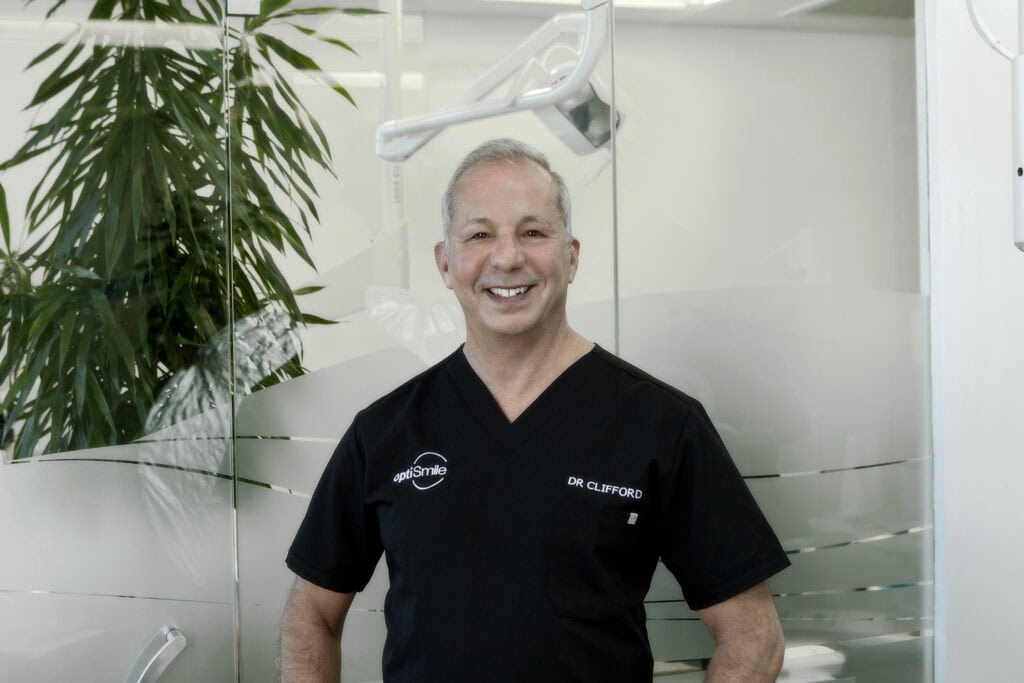
Joining me is Dr Clifford Yudelman from OptiSmile. Welcome back, doctor.
Dr Clifford Yudelman, OptiSmile [00:01:13 – 00:01:40]
Thanks for having me back. After last week’s shorter episode, I think today will be a little bit longer, but I’ll try not to go on too much. For people overseas, and we’ve got a lot of overseas listeners, “going on” in English means to drag on, because it could cause a bit of stress.
And then the next thing you know, we don’t want them to grind.
Eon Engelbrecht, E-Radio-SA [00:01:43 – 00:01:53]
But you know, I want to ask you firstly, because it sounds like a really interesting podcast today: can you actually tell that a patient is stressed just by looking in their mouth?
Dr Clifford Yudelman, OptiSmile [00:01:54 – 00:04:43]
Well, sometimes before I even look in their mouth, before they’ve even said anything. When you’re speaking to people, you can see worn-down front teeth. When you do look in their mouth, you can see where they’ve been biting their cheeks, or when they’re clenching there’s this white line along their cheeks, like bite marks. The side of the tongue has got little scallops from where they’re pressing their tongue against their teeth.
Scallops meaning bumps on the tongue, or indentations from the tongue pushing against the teeth. They have bleeding gums, even though they’re brushing the same as they always do. And the combination itself tells the story.
So it’s not like one of these signs on its own means very much. People will chip a tooth for all sorts of reasons, but it’s the pattern that I now recognise after 43 years of doing this. You get a feel for it.
And so sometimes the first question I ask isn’t about their teeth at all. Sometimes I just see that their gums in general, their whole mouth, look reddish and inflamed, and not just near the teeth where the plaque normally causes gingivitis. Everything just looks a bit puffy.
And it might be a patient that I haven’t seen in a year. And then I’ll ask them: if 10 is severe stress, like let’s all run, there’s a tsunami coming, versus a one or a zero, where you’re sitting on the beach drinking a cocktail, how bad is the stress in your life in the last month?
And I’ve had patients who have burst into tears, and you know that it’s bad. Yeah. And they haven’t been sleeping, or their dog died, or the wife ran off with the gardener or something, or vice versa. The husband ran off with her. No, never mind. We won’t go there.
But with somebody else, with the gym instructor. So these things, I mean, it’s true, these things happen, and especially unexpected stress. And the other thing is stress that goes on. Your body is made to deal with stress when you’re in your cave a few thousand years ago and there’s a sabre-toothed tiger that’s trying to eat your child.
That stress lasts until you get eaten, or the child gets eaten, or until you kill it. But stress that goes on for days and weeks and months is what our body is not used to. So I don’t want to jump the gun. I think you’ve got more questions that we’ll probably get into there.
Eon Engelbrecht, E-Radio-SA [00:04:43 – 00:04:44]
Got nine more to go.
Dr Clifford Yudelman, OptiSmile [00:04:45 – 00:04:46]
Let’s go.
Eon Engelbrecht, E-Radio-SA [00:04:47 – 00:04:57]
I also want to ask you, biologically, what does chronic stress and cortisol do to the gums? I mean, why would gums bleed more when nothing about my brushing has actually changed?
Dr Clifford Yudelman, OptiSmile [00:04:57 – 00:07:33]
Yeah. So that’s just it. The word in the medical dictionary is friable, F-R-I-A-B-L-E. And I’m not talking about Cordon Bleu cooking school, like is that chicken wing friable? It means weak, it will tear easily, it’s like tissue paper. And when you’ve got a lot of stress, it’s not just in your head. There is actually a biological footprint in the gums, and the mouth in general is one of the first places that you’ll see it.
So when you’re very stressed, your body, especially your adrenal glands and other organs, creates all of this adrenaline, and then you get cortisol, which is a stress hormone. And also, if you’re not sleeping at night, you get a lot of cortisol. And what that does is it dampens your immune response.
It changes the blood flow. The bacteria can get the upper hand, or your healing slows down. And in a case like that, it’s not really much to do with brushing.
If we blow air on someone’s gums and there’s not a lot of plaque, and their gums bleed just from blowing air on them with a little air syringe, then you know there’s something bad going on inside the body. We’ve seen this with patients, and a lot of the time I ask them: is this something that you’re going to be able to deal with, or is it more long term?
I’ve even, over the years, referred patients to a psychiatrist, or given them advice on breathing. Not that I’m a breathing expert, but I’ve actually sat and breathed deeply with patients just to teach them some little breathing techniques, something called box breathing. If you’re listening to this and you’re feeling stressed just hearing me talk about it: breathe in for a count of four or six, then hold your breath for a count of four, six or eight, depending on your own pattern, then breathe out, then hold it, and then breathe in again. It’s like a little box: up, across, down, across and so on.
It’s called box breathing. You can Google it. Just doing that for three or four minutes, you’ll feel a lot of that cortisol leaving your body and you feel like you can breathe again.
So that’s just a little tip that’s on the subject, but off the subject. But I really think that we underestimate stress.
Eon Engelbrecht, E-Radio-SA [00:07:33 – 00:07:54]
Yeah, until it’s too late, usually. But nice to know that we don’t need a box for box breathing. I don’t know why, but I always pictured breathing into a box, like you would into a paper bag.
I thought you’re holding a box in front of your mouth. Oh, that was blonde, blonde, blonde. That’s not very clever.
Dr Clifford Yudelman, OptiSmile [00:07:54 – 00:08:00]
You don’t have to wait for Checkers Sixty60 to deliver and then get a paper bag to stick over your head.
Eon Engelbrecht, E-Radio-SA [00:08:01 – 00:08:15]
Oh, silly, silly me. OK, but just talking about grinding and clenching, most people have absolutely no idea that they’re doing it. How would someone know that they’re grinding and clenching, and what’s it doing to their teeth?
Dr Clifford Yudelman, OptiSmile [00:08:15 – 00:10:02]
So for some people, it’s usually their partner who tells them first, because they make a lot of noise at night. It sounds like a cricket or something, like rubbing two pieces of wood together, and people make different sounds. Other people don’t know. They wake up with a tight jaw or a dull headache around their temples, and they don’t know that it’s from clenching or grinding in their sleep.
And then they’ve got flattened or chipped edges on the front teeth. Their fillings keep cracking. We have done some podcasts about grinding and these bite plates and TMJ, etc.
But sometimes people clench during the day and there’s no sound to give it away. We always tell people to check themselves. If you’re sitting at a red robot, which is a traffic light for people listening from overseas, just check: are your teeth actually clenched together because you’re stressing out with the traffic, waiting for the robot to change to green, or are your teeth slightly separated with your tongue sitting gently on the roof of your mouth?
And a simple night guard won’t fix the underlying stress. A night guard is different to a sports guard, which we spoke about last week. You don’t want to wear a sports guard, or a boil and bite rubber mouthguard that’s meant to protect your teeth against a tennis racquet or a squash racquet or a cricket ball, at night, because that can make your jaw worse. You tend to chew on it like a little chew toy, you’ll make all those muscles stronger, and you’ll make your TMJ, your joint, worse off.
Eon Engelbrecht, E-Radio-SA [00:10:03 – 00:10:09]
And doctor, why do people get mouth ulcers when they’re stressed? Is it the same as other conditions also flaring up?
Dr Clifford Yudelman, OptiSmile [00:10:09 – 00:12:00]
Yes, ulcers are one of the most visible signs of stress in the body. A lot of people get them typically around exam time, or final year of medical school, when someone’s got a big deadline, or they’ve got a boss that they just want to strangle, which is quite common these days. They get a whole lot of ulcers in their mouth.
So we’re talking about an ulcer that’s quite painful, and it’s normally in what’s called the sulcus. It’s in the soft part of your mouth, more where the cheek meets the soft part of the gum, and they can be very sore and they’re normally round.
If you get a straight or oval one, that’s most commonly because you scratched it with a toothbrush. And then there’s something called lichen planus, which is very different. That’s an immune condition.
Stress can trigger flare-ups, but if you’ve got an ulcer that’s been there for two or three weeks, then you need someone to have a proper look at it. Sometimes it needs a biopsy. If you have a severe or nasty-looking ulcer that’s not painful and it’s been there for a while, that’s very urgent to look at, because sometimes nasty things like oral cancer can show up as a non-painful ulcer.
I’m talking about something that’s maybe been there for a few months, or if you’re a heavy drinker, or a combination of heavy drinking and smoking. And especially if it’s on the side of your tongue or the floor of your mouth, which is not the most common place to get the types of ulcers we’re talking about today. We have spoken about this type of thing in previous podcasts, so I won’t go on further.
Eon Engelbrecht, E-Radio-SA [00:12:01 – 00:12:11]
Doctor, how does stress dry out your mouth, and also why does it suddenly raise cavity risk in someone who’s, let’s say, never had a filling?
Dr Clifford Yudelman, OptiSmile [00:12:11 – 00:13:37]
So for people that haven’t heard some of our previous podcasts about cavities or dry mouth, there are quite a few that bring this up. Stress switches on your fight or flight system, the thing that tells you whether to get aggressive and fight back or to run away. And one of the first things it does is turn down your saliva production, and saliva is genuinely your mouth’s main line of defence against acid.
So when you have a dry mouth, your mouth goes acidic faster when you eat or drink, and it stays acidic for longer before it actually recovers. I’ve had patients that have gone 20 years with no fillings and then they start getting cavities because they’re going through a divorce, or there’s a death in the family, or there’s a change in management at their business and the new boss is not as nice as the previous one, but they can’t afford to leave the job. Some kind of stress that’s not going to go away in a hurry.
They start drinking a lot of coffee, and maybe put sugar in the coffee. The diet changes. They start craving more refined, processed foods and carbohydrates because of stress eating.
And these are things that nobody thinks of, these invisible things, until something happens. And by then it’s too late.
Eon Engelbrecht, E-Radio-SA [00:13:38 – 00:13:47]
And can you tell us about burning mouth syndrome? And also, can stress really cause a burning feeling when everything looks normal?
Dr Clifford Yudelman, OptiSmile [00:13:47 – 00:15:50]
So that’s quite a complex one. I wouldn’t say that every case is caused by stress, but stress is recognised as a contributor in a good number of them. It shows up as a burning or tingling feeling, usually in the tongue.
And the frustrating part for the patient is that everything looks completely normal when we look at it. There’s no redness. There’s no sign of it.
They often go from one doctor to another. They get tests done and they come away with no real answer. And that just adds further to the anxiety and makes everything worse.
But what we’ve seen more than once is that once sleep improves and the stress eases, the burning sensation can ease right along with it. I’ve seen this most commonly in female patients, usually in their early 50s and going into their 60s, sometimes related to menopause and other changes in the mouth and other parts of the body, if they don’t go on to hormone replacement and oestrogen therapy. Combine that with maybe a problem in their marriage or their relationship, or maybe the husband left them for another woman and they’re going through a divorce, and you can imagine it could be very, very stressful.
And that, combined with hormone changes, these patients feel as a burning mouth or burning tongue syndrome, and it can drive them completely nuts. In some cases, I will actually refer patients to a psychiatrist. There are medications, psychiatric medications, that can help cases like that, but it is quite complex.
We may also send the patient to an oral medicine specialist, who has further medical training that a general dentist like myself doesn’t have.
Eon Engelbrecht, E-Radio-SA [00:15:50 – 00:15:59]
And then, Dr Yudelman, is trench mouth still a thing in high-stress professionals, or is that just from the history books?
Dr Clifford Yudelman, OptiSmile [00:16:00 – 00:18:31]
So it’s funny you mention that, because that’s part of the questions to do with stress. Trench mouth gets its name from the First World War. Obviously, if you were in a trench and you hadn’t eaten for days and there were bombs going off around you, and people were losing their lives, or losing their limbs and still alive, it was a very stressful time for people in the trenches, with poor nutrition and a lack of vitamin C.
They would get a combination of trench mouth and maybe even scurvy, which was caused by vitamin C deficiency. I used to see a lot of it when I was in California in the 80s. And the first thing we would suspect, in the early days of HIV when there were no drugs, was poor nutrition and the whole immune system shutting down.
But just recently at the practice, we saw someone with trench mouth. Normally it would be maybe a lower socioeconomic person. I think if you were to examine people that have psychiatric problems, or people that live on the streets, you might see quite a lot of trench mouth, because it’s very stressful living in those conditions. But we have actually seen cases in entrepreneurs who have got two or three companies and are flying all over the world for meetings and not sleeping for weeks on end.
They generally have good nutrition, but in a lot of cases they’re not sleeping. They also might vape, even though they’re well educated, and the body can only handle so much. And trench mouth is very painful. It comes on very rapidly and they lose the gum between the lower front teeth.
It just starts falling away, like meat falling off a bone. Literally, the gums just rot, and they need antibiotics and mouthwashes and several good cleanings. And they can actually lose a lot of gum and bone if it’s not sorted out quickly. So that’s what stress can do to you.
It can make you look like you’ve been in the First World War.
Eon Engelbrecht, E-Radio-SA [00:18:31 – 00:18:45]
That’s insane. Yeah, very, very. Also, back in the chair, doctor, some patients swear that numbing never actually works on them. Can stress actually make the local anaesthetic less effective?
Dr Clifford Yudelman, OptiSmile [00:18:46 – 00:21:08]
Yeah. So look, it’s a double-edged sword. Patients that have had an issue with anaesthetic working on them in the past will generally be much more scared at the dentist the next time.
And so they arrive with a lot of cortisol in their system and they’re very nervous. Not to get off the subject, but a lot of the time it’s patients with red hair, or freckles and red hair, or who had red hair when they were a baby. Often if I see patients with freckles, I ask them if they had red hair when they were a baby, because they might dye it now, or maybe it’s changed colour and gone brown.
But there’s a gene related to red hair that causes you to need a lot more local anaesthetic, and also sedation or general anaesthetic. And they have a history of feeling the dental treatment, and the dentist says, “But I’ve already given you three injections, so let’s just keep going,” and the dentist hasn’t heard about this particular gene.
And so those patients are really nervous, and they’ve got the red hair. So with patients that are very scared of the dentist or stressed out: look, if someone’s already very stressed, we’d put off treatment until they’re doing better, unless it’s very urgent. But let’s just say someone is going through a divorce, they’re very stressed, they haven’t had a check-up in a while, and now they’ve got a cavity that’s gone into the nerve and they need a root canal.
I’ll often, if they’re not on other psychiatric medications and they’ve got a simple medical history, prescribe a type of tranquilliser for them to take before the appointment. And when they relax, the anaesthetic works really well. But if they’re very hyped up, you sometimes have to give a number of injections.
They might still not be comfortable. So it’s important to discuss it with your dentist. We have done several podcasts about what’s called oral sedation, which is taking a tablet before an appointment, and if you’re very stressed out, even the night before, but it’s up to the dentist to prescribe that. And also intravenous sedation, where an anaesthetist will come in and sedate the patient. We still have to numb them.
But obviously, when they’re sort of half awake, half asleep, the anaesthetic works really well.
Eon Engelbrecht, E-Radio-SA [00:21:08 – 00:21:10]
It’ll take you right to cloud number nine.
Dr Clifford Yudelman, OptiSmile [00:21:11 – 00:21:13]
Yeah, even number 10.
Eon Engelbrecht, E-Radio-SA [00:21:16 – 00:21:28]
OK, so stress is really doing a lot of bad things. Does it also slow down healing after an extraction or an implant? And should people delay big treatment during a stressful period, doctor?
Dr Clifford Yudelman, OptiSmile [00:21:28 – 00:23:09]
Yeah, so that’s a good point right there. Stress affects your blood flow, it affects your immune cells and how they move around the body, and it can affect collagen formation.
Collagen is your connective tissue, the things that help you to heal. And all of those things are essential to how your body heals. In patients that are very stressed out, we do see that an implant might take longer to integrate.
It’s very rare that an implant won’t integrate at all. In many of those cases, it’s a patient who says they don’t smoke, but they’re actually vaping. And we have done a podcast on that before.
Or they stop smoking while the implant is healing, and then because of stress, they start smoking again too soon. So these things are all interrelated.
But generally, patients who are under the type of severe stress we’re talking about won’t come along and say, “Can we do that implant now?” They normally put a lot of these types of things on hold. And we don’t push people to get treatment when they’re in these types of situations.
Obviously, an emergency won’t wait. But if you’ve had a tooth missing for three years and you decide to get an elective implant, you’re not generally going to do that when you’re going through a divorce, or you’ve just lost a pet or a family member, or something very stressful.
Eon Engelbrecht, E-Radio-SA [00:23:10 – 00:23:20]
And just finally, doctor, what do you say to someone who is so overwhelmed that oral hygiene has just fallen off the list entirely?
Dr Clifford Yudelman, OptiSmile [00:23:20 – 00:25:54]
Yeah, I would say that’s a big danger sign, because now you’re getting beyond stress and they’re going into depression. I’m not a psychiatrist, so like we always say after every podcast, speak to your own doctor first. But when I see a patient who generally looks after themselves, whose oral hygiene is reasonable, and they come in and there’s just plaque everywhere, and they look like they haven’t had a bath in a couple of days, or normally their hair is well looked after and now it’s tied up, or they’re wearing a hoodie or something, it doesn’t take more than a few seconds to see that this patient has gone beyond stress and is now hitting a depression. And I’ll always bring it up.
I’m the dentist, I’m not the doctor or the GP or the psychiatrist. But we tend to see people on a regular basis. People who are in that type of situation sometimes will cancel their appointments, and we might not see them until they’ve gone through all of that. And then they come in and we see the results of it.
But sometimes we’re lucky enough to catch it, because some patients are coming in every three or four or six months, and we might see them on the edge of that, where things haven’t slipped too far, but they’re not cooking proper meals or they’re not exercising. And we don’t just nag them about their oral hygiene. I might give them a mouthwash to use to help them along.
And maybe a soft toothbrush, and try to bring it up gently. We acknowledge that they’re going through a hard time, and sometimes they do just burst into tears and don’t know which way to turn, which is obviously tough, because we’re not trained as psychologists or psychiatrists. But it’s in a case like that that I can tell them: why not go and see the psychologist across the hall, or do you have anyone you can talk to about this?
Stress can kill you. They say it’s something to avoid, because you won’t live very long if you stress. So try to chill out a bit.
Eon Engelbrecht, E-Radio-SA [00:25:54 – 00:26:16]
Yeah, it’s so tough. It’s hard to just chill out, especially if you’re in a really difficult situation and you have no one to turn to.
I mean, it’s not easy for someone to then just chill. It’s hectic. We’re all dealing with things on different levels. So I guess the best we can do is just be there for each other and help as much as we can.
Dr Clifford Yudelman, OptiSmile [00:26:16 – 00:27:17]
Yes. And if someone’s listening to this and they are stressed, there are free services like Lifeline and different helplines. And if you don’t have the money, there’s government help and government clinics.
And there are also different religious organisations. If you haven’t been to church in a long time, maybe it’s a good time to go. Or if you’re a different religion, go and talk to the pastor or the rabbi, or go to the mosque.
Maybe there’ll be some sympathetic people there to talk to. If you’re not religious, there are other avenues as well. Or even if you just go out and get a cup of coffee and sit at the local coffee shop, sometimes just being out and about and seeing other people enjoying themselves, maybe someone will strike up a conversation and you just get your mind off things for a few minutes.
Eon Engelbrecht, E-Radio-SA [00:27:18 – 00:27:59]
Absolutely. And I think if there’s one thing that we take away from this podcast today, it’s that the mouth is not separate from the rest of your body. When the gums start bleeding for no reason, or the ulcers keep coming back, or the numbing doesn’t work, your mouth is telling you something and you need to listen.
So hopefully this podcast will help you to listen more to your body and see what’s actually happening. Sometimes you don’t even realise how stressed you are until somebody asks you, what happened to you? Why are your teeth like that?
So, Dr Yudelman, thank you so much once again. That was another great, insightful podcast.
Dr Clifford Yudelman, OptiSmile [00:28:00 – 00:28:03]
Yeah, we got a bit serious for a change.
Eon Engelbrecht, E-Radio-SA [00:28:03 – 00:28:03]
Yeah, we did.
Dr Clifford Yudelman, OptiSmile [00:28:03 – 00:28:13]
I didn’t think it was going there, but it’s a serious topic, and stress is not funny. Stress is a killer.
Eon Engelbrecht, E-Radio-SA [00:28:13 – 00:28:23]
In all ways, it destroys the entire body, piece by piece. And that’s the end of it. Dr Yudelman, thank you so much. Until next time, and don’t stress.
Dr Clifford Yudelman, OptiSmile [00:28:24 – 00:28:27]
Yeah, you too. Christmas is coming.
Eon Engelbrecht, E-Radio-SA [00:28:28 – 00:28:40]
Yes. And as they say, your mouth keeps the score. It knows what’s happening in your life. So look after your teeth, look after yourself, and save your money and save your teeth. Until next time. Goodbye.
OptiSmile Announcer [00:28:59 – 00:29:43]
Discover the world of dental excellence with OptiSmile. Join us for a weekly podcast featuring Dr Clifford Yudelman, a seasoned expert with 40 years of dental experience across four continents. Gain unique insights and expert dental advice by visiting OptiSmile.co.za for articles that illuminate the path to optimal oral health. If you’re seeking unparalleled dental care in Cape Town, get in touch with OptiSmile or book directly online on OptiSmile.co.za. OptiSmile, where global expertise meets local care.
Disclaimer: The content provided in this podcast, “Save Your Money Save Your Teeth” on Medical Mondays, is for informational and educational purposes only. It is not intended to serve as dental or medical advice. The insights and opinions expressed by Dr. Clifford Yudelman and any guests are designed to foster a better understanding of dental health, preventive measures, and general well-being, but should not be interpreted as professional dental or medical recommendations.Dr. Clifford Yudelman does not diagnose, treat, or offer prevention strategies for any health conditions directly through this podcast. This platform is not a substitute for the personalized care and advice provided by a licensed dental or healthcare professional. We strongly encourage our listeners to consult with their own dental care providers to address individual dental health needs and concerns.The information shared here aims to empower listeners with knowledge about dental health but must not be used as a basis for making health-related decisions without professional guidance. Your dental care provider is the best source of advice about your dental and overall health. Please always seek the advice of your dentist or other qualified health professionals regarding any questions or concerns about your dental health.