Chapters
What the Numbers Mean
[00:00:04 – 00:04:23]
If you have ever heard a hygienist calling out numbers over your head during a check-up, those numbers are pocket depth measurements — and they are far more useful than most patients realise. A thin, blunt periodontal probe is gently slipped into the space between each tooth and the surrounding gum, and the depth is read off in millimetres.
A healthy reading is one, two, or three millimetres, indicating that the gum is fitting snugly against the tooth like a tight sleeve. A full mouth produces around 180 readings — six per tooth — which is why the whole process can sound like a game of bingo.
What Is a Periodontal Pocket and How Does It Form?
[00:04:24 – 00:06:20]
A periodontal pocket forms when inflammation causes the gum to loosen and pull away from the tooth, creating a deeper space where bacteria can accumulate undisturbed. The brush cannot reach into these pockets, and they develop slowly — over months or years of unchecked inflammation.
Gum disease is largely painless in its early stages, which is how it goes unnoticed for so long. Bleeding gums that cause no discomfort can persist for years, all while bone is quietly being lost — and bone does not grow back on request.
Reading the Traffic Light: Fours, Sixes, and What They Mean
[00:06:21 – 00:09:17]
A pocket depth of four millimetres is a yellow light — a sign of inflammation that often responds well to improved home cleaning and a professional scale and polish. Most fours return to threes with consistent interdental cleaning and regular hygienist visits every three to six months.
A reading of six or more is a different matter. At that depth, bone support may already be compromised and professional treatment is essential. That said, a single six around a poorly contoured crown or filling is a localised plumbing problem, not a diagnosis of gum disease across the whole mouth.
Ignoring sixes can lead to significant expense — deep cleaning across all four quadrants can cost thousands of rands or dollars. Early, proportionate treatment is nearly always the more affordable path.
Does Probing Hurt, and What Does Bleeding Tell Us?
[00:09:17 – 00:13:56]
Healthy gums barely register the probe. Only around 20 grams of pressure is used — roughly the same as lightly touching an eyelid. When probing is uncomfortable, that discomfort comes from inflamed tissue, not from the instrument itself.
Bleeding during probing is equally telling. Healthy gums do not bleed when touched gently, and the belief that some people simply have “sensitive gums” is a myth. Bleeding is the earliest available warning sign — it appears long before pockets deepen and years before bone loss shows on an X-ray.
Rather than brushing more gently around areas that bleed, those areas need more thorough cleaning. Two to three weeks of correct technique is often enough for long-standing bleeding to resolve entirely.
Why Smokers and Vapers Can Have Misleadingly Good Numbers
[00:14:02 – 00:16:19]
Nicotine constricts blood vessels in the gum tissue, reducing blood flow and suppressing the visible signs of inflammation. Gums can look healthy, feel tight, and produce no bleeding — while significant bone loss is already visible on X-rays.
This means the standard warning system is effectively switched off in people who smoke or vape heavily. Probing is especially important in these patients, as clinical appearance alone is deeply unreliable. A probe that sinks six or seven millimetres into gum that shows no bleeding at all is a serious finding that appearances would never reveal.
Probing vs X-Rays: Two Different Pictures
[00:16:19 – 00:17:17]
Probing measures the soft tissue — how deep the pocket is. An X-ray measures the bone — how much support remains around the root. Both are necessary, and neither tells the full story on its own.
Think of the tooth as a fence post: the probe reveals how loose the soil is at the surface, while the X-ray shows how much soil is left holding the post upright. Deep pockets with a clean X-ray mean disease has not yet reached the bone — that is still a reversible situation. Waiting until the X-ray looks wrong means the window for simpler treatment has already passed.
Can Deep Pockets Shrink Without Surgery?
[00:17:17 – 00:19:09]
Yes — and this is what happens in many cases. Where bone has not yet been lost, removing the source of irritation (most often tartar, but sometimes an overhanging filling or a poorly fitted crown) allows the inflammation to settle and the gum to tighten back against the tooth. Fours reliably return to threes under these conditions.
Where significant bone loss has already occurred, the goal shifts from reversal to management. Surgical options such as bone grafts exist, but they are expensive and not always necessary if the condition is caught and treated early.
Deep Pockets Do Not Automatically Mean Lost Teeth
[00:19:09 – 00:22:00]
Pocket depth is just one component of a thorough periodontal examination. A full assessment also records bleeding points, any suppuration (pus), bone loss between roots (furcation involvement), tooth mobility, and gum recession.
Each of these factors adds important context. A three millimetre pocket accompanied by six millimetres of recession, for example, may leave very little bone holding the tooth in place — despite what the pocket number alone might suggest. A proper periodontal exam draws all of these findings together into a complete picture.
Why the Gum Map Is Your Best Financial Protection
[00:22:00 – 00:24:14]
A periodontal chart turns guesswork into a clear treatment strategy — and it is guesswork that costs patients money over the long term. Comparing today’s chart against one from a year ago shows immediately whether things are improving, stable, or worsening, allowing intervention to be targeted and timely.
Without that chart, dental care becomes reactive, and reactive dentistry almost always involves more extensive and more expensive treatment than would have been needed earlier. The chart also changes the dynamic for the patient: seeing your own map means you are making an informed decision rather than accepting a recommendation you cannot evaluate.
Over a lifetime, that means teeth still present in your seventies and surgical costs you never had to meet.
Transcript
Eon Engelbrecht – E-Radio-SA (0:04 – 0:54)
Welcome to another edition of Save Your Money, Save Your Teeth, and it is Eon with you as always, joined
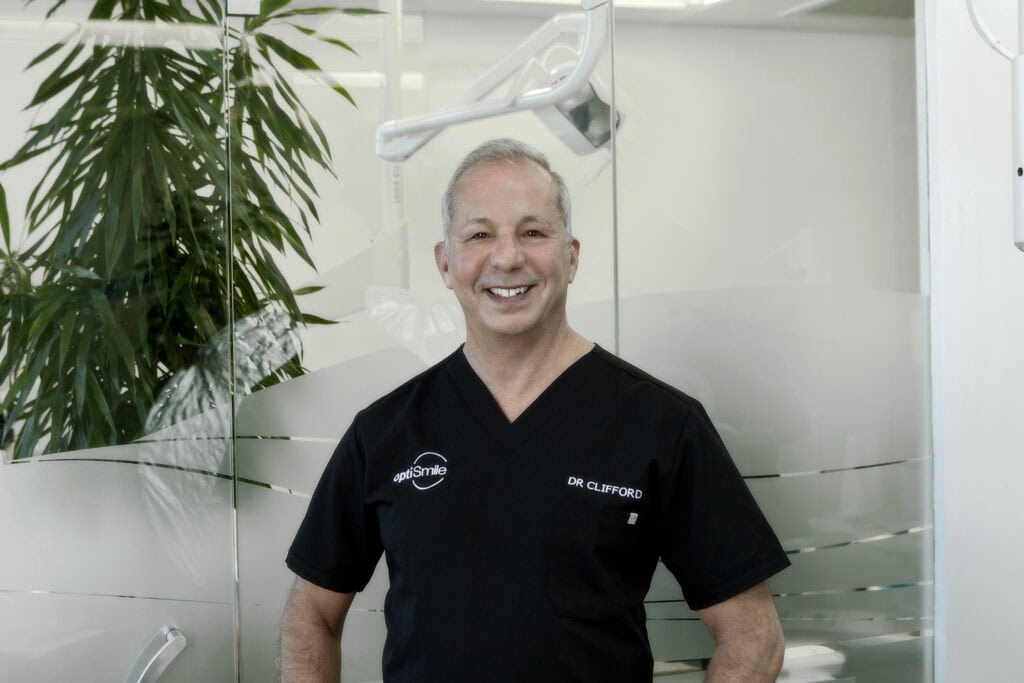
by Dr Clifford Yudelman from OptiSmile. If you have ever sat in a dental chair while somebody called out
numbers over your head, you will know the feeling. Three, two, three, five.
It sounds like a code, and nobody stops to tell you what it means. Those numbers are one of the most
useful pieces of information in dentistry, and they are almost never explained. So today we are going to
decode them. What they actually measure, which ones matter, and which ones can be reversed.
Now we will finally understand it after today’s episode. Another great insightful one awaiting us. Dr
Yudelman, welcome back.
Dr Clifford Yudelman – OptiSmile (0:54 – 1:19)
Thank you. Thanks for having me back, and really looking forward to today’s episode, because this is
something that should be done routinely if you are seeing a hygienist, and if it is not the hygienist then the
dentist. And we will not go too deep today. Excuse the pun. You know what I am talking about.
Eon Engelbrecht – E-Radio-SA (1:19 – 1:35)
Yeah, exactly. But Dr Yudelman, when the hygienist calls out the numbers, I thought it was something to do
with maybe the bill or something. So they go three, two, three, five.
What exactly does it mean? Are they actually measuring something?
Dr Clifford Yudelman – OptiSmile (1:35 – 4:10)
Yeah, so we are measuring the depth. If you imagine your sleeve is your gum, if you have a jacket on or a
long sleeve shirt, and your wrist or your arm is your tooth. If you put your finger between your sleeve and
your arm, and imagine the first little joint on your finger is one millimetre, and the next joint is two
millimetres, and then if your finger is going all the way into your jacket or your shirt, that is three
millimetres.
That is how a periodontal probe works. So the probe is a thin little probe. It is not a pointy one, it is blunt. In
fact, some probes have even got a little balletjie on the end, or a little ball if you are not from South Africa,
and then it has got different millimetre markings.
Sometimes the first three millimetres is marked off, and then the next two millimetres, and so on.
Sometimes it is a yellow plastic probe and it is colour coded with red and blue and green. But this basically
goes gently into the space between the tooth and the gum, which scientifically, or in the medical
terminology, we call the sulcus. The sulcus, or gingival crevice, is another word for it. We push it in until it
stops, and it can be a little bit uncomfortable, but basically it stops at a certain point and then we read off.
So healthy is one, two or three millimetres, which tells me or your hygienist that the cuff of gum, or your
sleeve, is tight against your hand. Your gum is tight against your tooth, it is very snug, and it is sealing. That
is not all that we do when we are measuring, but that is the main thing. I do not want to jump the gun like I
normally do, but basically there are six readings per tooth, around 180 readings in a full mouth, and that is
why it sounds like someone is playing bingo, calling it out above your head.
Eon Engelbrecht – E-Radio-SA (4:10 – 4:12)
It does, it does.
Dr Clifford Yudelman – OptiSmile (4:12 – 4:23)
And those numbers are a map, and the map actually tells the dentist where there are pockets. If you have
got a four or a five, which we will get into, that is completely reversible. So as I said, I do not want to jump
the gun. We have got lots of questions and I think you are going to be asking them now, so let us go ahead.
Eon Engelbrecht – E-Radio-SA (4:24 – 4:30)
Yeah, I want to ask you, what is a periodontal pocket and how does it form?
Dr Clifford Yudelman – OptiSmile (4:30 – 6:14)
Yeah, so peri, or perio, like a perimeter, means around, and dental means the tooth. Gums. We talk about a
gum specialist, and that is a periodontist. And then a pocket is when the gum loses its grip and you get
inflammation that makes your gums a little bit swollen and they loosen up from the tooth. Imagine you
have got a knitted sweater on now, and the sleeve has gone all loose and it is kind of baggy and you can
stick your whole hand into your sleeve. When it starts detaching it leaves a deeper space where the
bacteria can live and be undisturbed.
The brush cannot reach into those pockets, and these pockets do not appear overnight. Nobody wakes up
with a six millimetre pocket. It takes months and years of inflammation that has gone uninterrupted, which
means that there is a long window where this is still reversible. And gum disease is quiet. That is its whole
trick, that is how it sneaks up on you, and by the time your gum hurts you would have usually lost bone,
and bone does not grow back on request.
If you have got a patient who has got bleeding gums but no pain, and every time they brush they get the
pink in the sink, or the pink in the basin as we call it, for about two years, there is no pain, they see
bleeding, they spit out, they think well nothing is going on, it is not hurting, and they think it is normal. That
is the kind of patient who will eventually get a six or seven millimetre pocket, which means that the bone is
now being eaten away.
Eon Engelbrecht – E-Radio-SA (6:14 – 6:20)
And in the measurements, would four be a warning sign and six a disaster?
Dr Clifford Yudelman – OptiSmile (6:21 – 9:17)
I like the way you put it. So let us look at it like a robot, as we call it in South Africa, a traffic light. So a four
is a yellow light. If you are in South Africa you just gun it and run it before it turns red. But I am not kidding,
I was just in the States recently, and in the States people are a lot more cautious about their gum health,
and they start getting paranoid when they have got a four. Sometimes it gets over diagnosed in America,
where they tell you that you need deep cleaning and scaling and root planing even if you have got fours or
bleeding.
But basically a four is a yellow light, not a red one. It is inflammation, and a good cleaning, and cleaning that
area where the bleeding is coming from. We spoke about interdental cleaning using floss and little brushes
and water picks, and which ones work best. I think that was two episodes ago. Most of the fours come back
down to threes. Also, last time we spoke about plaque disclosing agents, or dyes, those pink or purple
tablets. That is a very good way to get fully healthy. You just brush where the plaque is.
But now six is a different conversation. The bone support may already be compromised and it needs
attention. You need to see the dentist. If a dentist tells you that you have got five or six areas that are six or
more, that is actually something to worry about. If you have got a single six, maybe you have got a food
trap there, or the filling has got an overhang that is catching food. Often it is restorative. If it is an individual
one, it is something like what I just mentioned. You just have to get that problem treated and then keep it
clean, and it will actually help you out.
So from a cost point of view, because we are about saving your money and saving your teeth, treating fours
with good oral hygiene and cleaning every four to six months. If you are going every six months and you still
have bleeding, then maybe you need to ask your hygienist whether you should come every three or four
months, if you are not doing a great job with your own cleaning at home. That will save thousands. But if
you ignore sixes it is going to cost you thousands, either thousands of rands or thousands of dollars. I was
just in the US, as I said, and a quadrant of root planing, a deep cleaning, they charge a thousand dollars, and
you usually need all four quadrants done. So that is a lot of money.
So the response is proportionate. You must not panic. Like I said, one six around a badly contoured crown,
and everything else is a two or three, that is a plumbing problem on one tooth. That is not gum disease.
Eon Engelbrecht – E-Radio-SA (9:17 – 9:28)
Exactly. But when you say probing, probing sounds like it hurts. Does probing actually hurt, and if it does,
what does it tell us?
Dr Clifford Yudelman – OptiSmile (9:28 – 12:29)
Yeah, look, it can. Healthy gums barely feel it. So if your gums are healthy and the hygienist or myself or
another dentist is poking around your gums, and if we do something called a BPE, which is more like a
periodontal screening, we poke around six places on each tooth but we do not record all of them, we just
record the deepest one, and we see if there is bleeding or pus. If your gums are healthy that probing does
not take very long. You are just sort of checking under the cuff, just checking whether the shirt is tight or
not tight. You are not actually jabbing anything deep down.
If your gum does hurt a bit, that is actually your inflammation. That is your own gums telling you that there
is an issue. Inflamed gums are tender and they bleed because they are quite swollen and they have gone
fragile. We only use about 20 grams of force, which is the same amount of pressure as if you just touch
your eyelid. You are not going to handle too much pressure there.
And the answer is not to avoid the appointment. Afterwards, ask the hygienist or dentist to point out the
areas where it hurts. You might even still see a little bit of bleeding in those areas. Ask to look in the mirror.
Pain during probing is a map of where your flossing and your little brushes and your cleaning technique are
not working properly. You can even ask the hygienist or dentist to make a little map for you and show you
where those areas are, or to give you a copy of your periodontal charting.
And when a patient jumps or flinches during a periodontal probing, they blame the dentist or the hygienist,
because the probe went in, the gum bled, and therefore the hygienist or dentist is being rough and made
your gum bleed. But in fact it was not because of that, because you cannot actually make a healthy gum
bleed at that pressure. The bleeding and the discomfort is because you are not cleaning there properly, or
you let it go too far.
I will give it to you that there are some hygienists or dentists who are somewhat sadistic, and they might
overdo that in a way to make you floss better before the next appointment. But we do not believe in that
type of negative reinforcement. I am sure I have heard lots of stories of that. Does that hurt? No. What
about that? I will clobber that person. Sorry, we should not laugh, but it does not happen at our practice.
When I hear about someone down the road, or someone who has moved down here from overseas or
Johannesburg, and they talk about the hygienist or dentist having a little glint in their eye when they were
probing their gums, you have got to believe what the patient tells you.
Eon Engelbrecht – E-Radio-SA (12:29 – 12:45)
Yeah, they should not try that with me, hey. I will pinch something. Exactly. Okay, so what does it mean if
there is actually bleeding during the probing?
Dr Clifford Yudelman – OptiSmile (12:45 – 13:20)
Yeah, so we covered that a little bit, but it means that there is inflammation, in a nutshell. Healthy gums do
not bleed when they are touched gently, as I said. There is a belief out there among some people that they
just have bleeding gums. No, I have got bleeding gums. But there is no such thing. Or sensitive gums. If your
hands bled every time you washed them, you would not conclude that you had sensitive hands, now would
you?
Eon Engelbrecht – E-Radio-SA (13:20 – 13:23)
Oh, that is hilarious. Imagine.
Dr Clifford Yudelman – OptiSmile (13:23 – 13:56)
And that is one of the strongest predictors that we have, and it is the earliest, long before the pockets
deepen, years before anything appears on an X-ray. So if there is blood in the basin, or pink in the sink, do
not brush around it and more gently. That area needs more cleaning. And it actually does not take long for
it to get better. Two or three weeks of cleaning properly, and people come back and we check, and their
gums that have been so called sensitive their whole life are now better, and they do not bleed.
Eon Engelbrecht – E-Radio-SA (13:56 – 14:02)
Now that is interesting. Okay, and why do smokers often have good numbers but they still have gum
disease, doctor?
Dr Clifford Yudelman – OptiSmile (14:02 – 16:11)
Yeah, you know, that one catches patients out, and it also catches dentists out too. Smoking, and also
vaping. The nicotine constricts the blood vessels in the gums, and there is less blood flow, less bleeding, less
visible swelling, and the gums look nice and tidy, and the warning system has been switched off. And the
smoking impairs healing. And then you take an X-ray and you see, oh, there is a lot of bone loss. That is why
you have to probe the patients. You cannot just go on looks alone, especially on smokers.
The upper molars, like the palate, can look nice and tight. There is no recession, there is no bleeding, and
the gum is tight against the tooth. And you gently poke underneath there. So you have seen bone loss on
an X-ray and there is nothing, nothing, nothing, and then the probe just sinks in.
This happened to me literally about a month ago. I had a patient, I could not smell cigarettes on her, she did
not look like a smoker, and she had all of this type of issue. She had been getting cleanings in the UK and
the dentist kept telling her that her gums were healthy and there was nothing wrong. And to me they
looked healthy. And then we poked around a little bit. It turns out she was a very, very heavy vaper, and
she was sort of holding that back, she was not telling me. When I said, do you smoke, she said no, I do not
smoke. I did not say, do you smoke or vape. So once you get caught out, then you know to ask it.
And you pop the probe in and it just sinks down. No pain. It goes in, I am not kidding, six or seven
millimetres. That is a long way. And when you take the probe out there is no bleeding. And then you poke
along there and then you see all this bone loss. So I think if you do smoke or you vape, you need to go back
and listen to the podcast about vaping and smoking, because that is where it is worst, for your gums. And
when you do not see bleeding like that, that is not healthy.
Eon Engelbrecht – E-Radio-SA (16:11 – 16:19)
So the warning system is suppressed. Dr Yudelman, how do these numbers relate to the bone loss that we
see on the X-rays?
Dr Clifford Yudelman – OptiSmile (16:19 – 17:11)
Probing tells me about soft tissue, and the X-ray tells me about the bone. So these are different things that
we need to look at, and you do need both. Think of the tooth as a fence post. The probe tells me how loose
the soil is at the top, but the X-ray tells me how much soil is left holding the post upright.
And the probing picks up things first. Deep pockets with an X-ray that still looks fine means the disease has
not gone into the bone yet, and that you are still in the reversible phase. If you wait until the X-ray looks
wrong, then you have waited too long. So basically you do need both, and like I said, with smokers,
sometimes the gums look perfect and all of the damage is underneath, and you only see that on the X-ray.
Eon Engelbrecht – E-Radio-SA (17:11 – 17:17)
Okay, and can a deep pocket actually shrink back down to a healthy number without surgery?
Dr Clifford Yudelman – OptiSmile (17:17 – 19:09)
Yes, one hundred percent, and actually that is what often happens. Pockets reduce, particularly where the
bone is not gone yet. So the first thing is, say you stop brushing one particular area as an experiment, or
you do not floss one particular area. As the plaque gets under the gum and the gum gets swollen, the bone
might stay where it is and your gum will swell up. So the gum is growing up above the tooth, and it can
swell up to where it is four or five millimetres, but the bottom of the pocket is where it always has been.
Whereas if the gum is firm against the tooth and the probe goes in, then that often will correlate with bone
loss, and then the gum will not shrink.
But basically the gum is a living tissue, and if you remove the irritation, which is often tartar but sometimes
it can be an overhanging filling or a bad crown, the inflammation settles and the tissue tightens back
against the tooth, and the fours become threes. And it is when the plaque actually keeps going and going.
Brushing alone will only get about three fifths of each tooth surface. The rest is in between the teeth, and
that is where most of the pockets happen.
And once there is a lot of bone loss, then we are just managing it, we are not curing it. There are surgeries,
and patients go for surgery and get bone grafts, and it gets very expensive and it means having surgery. We
will not get into the details of that now. This is mainly about the measuring.
Eon Engelbrecht – E-Radio-SA (19:09 – 19:14)
And doctor, let us say you have these deep pockets. Does it definitely mean that you will lose your teeth?
Dr Clifford Yudelman – OptiSmile (19:14 – 22:00)
Well, one thing when we do these pocket measurements, which we have not covered, is that we not only
measure the actual pocket, how deep the probe goes in. We also go back and look whether there was any
bleeding, and we record all of the bleeding points. And we also record what is called suppuration, where
we record all of the areas that have any pus coming out of them. So there are different degrees of severity.
We also record bone loss in between the roots, because that is not a good thing. On a molar you have got
what is called a furcation. So on a lower molar there are two roots, and if the probe goes in between those
two roots you get a grade one, grade two or grade three furcation lesion. And on the upper molars you
have got three roots, so there are three areas where there are different furcations that you can measure.
The other thing on a good periodontal exam, aside from pocket measurement, is that we measure mobility.
So there is grade one, grade two and grade three mobility. Grade one is where the tooth is a little bit jiggly,
just noticeable. Grade two is where it is quite noticeable. And grade three is where you feel like you can
almost pull it out with your fingers.
And sometimes a patient can have grade three mobility with a huge amount of recession. So recession is
another thing that we measure. So you can have a three millimetre pocket but six millimetres of recession,
and there is only two millimetres of bone holding the tooth in. So these are things I wanted to throw in at
the end, in case we missed out on it.
So your question was, if I have deep pockets will I definitely lose my teeth. Sometimes it is the other way
around. So you need a full periodontal exam, not just a quick little probing, if there are issues noticed,
because all of these things add up. A periodontal probing, if it is done properly, is a very good service, and a
lot of the time it is not charged for. In America, for a full periodontal probing, you can pay, and it can take
quite a long time, obviously. We have a voice programme. I programmed my own voice periodontal
charting programme, so the hygienist can record a whole chart and make diagrams and get a full chart like I
just mentioned in maybe five minutes, just with her voice. She just whips through and pulls all of that out.
So it is not just about the pockets. You need to be sure that the dentist or hygienist is doing a full
periodontal examination.
Eon Engelbrecht – E-Radio-SA (22:00 – 22:08)
And doctor, why is this gum map so important for saving money on future surgery? Just our last question
for today.
Dr Clifford Yudelman – OptiSmile (22:08 – 24:10)
Because it turns guesswork into a strategy, or a plan, and it is the guesswork that costs people money in the
long term. With a chart in front of us we can compare today against a year ago or two years ago, whether it
is improving, whether it is stable, whether it is worse. And if the numbers are coming down, then we give
you lots of encouragement. If one region has crept up, then we treat that region and nothing else.
And without a chart, everything else is reactive, and reactive dentistry is nearly always more dentistry than
what the patient needed in the first place. This is co-discovery. The moment somebody sees their own map
or chart, they stop being sold something and they start making a decision. And over a lifetime, that is teeth
that you still have in your seventies, and surgery that you never had to pay for.
My dad practised as a general dentist but specialised in periodontics, and he practised for 57 years. He used
to do a lot of this conservative scaling and root planing and periodontal probing. In fact he lectured at the
university for 27 years. He taught the postgraduates how to do all of this. He was actually a general dentist,
but he went to the US in 1968 and he learned all about it from a few universities that were doing it, and he
and another periodontist came back to South Africa. The other guy specialised in periodontics, but my dad
taught periodontics while still actually practising as a general dentist. So it does not take a specialist to
probe your teeth. Every hygienist on earth should know how to do it, as well as every dentist.
Eon Engelbrecht – E-Radio-SA (24:10 – 24:14)
And that is it for another edition of Save Your Money, Save Your Teeth. Dr Yudelman, thank you so much.
Dr Clifford Yudelman – OptiSmile (24:14 – 24:21)
Pleasure. Thank you for having me, and looking forward to speaking to you next week.
Eon Engelbrecht – E-Radio-SA (24:21 – 24:46)
Absolutely. And I think if there is one thing to take away today, it is that your gum numbers are a map, not
a verdict. Four is the yellow light, six needs attention, neither of them is a sentence. So the next time
somebody calls out numbers over your head, ask what they mean, and ask whether they are better or
worse than the last time. Until next time, look after your teeth and they will look after you.
OptiSmile Announcer (25:05 – 25:50)
Discover the world of dental excellence with OptiSmile. Join us for a weekly podcast featuring Dr Clifford
Yudelman, a seasoned expert with 40 years of dental experience across four continents. Gain unique
insights and expert dental advice by visiting optismile.co.za for articles that illuminate the path to optimal
oral health. If you are seeking unparalleled dental care in Cape Town, get in touch with OptiSmile or book
directly online at optismile.co.za. OptiSmile, where global expertise meets local care.
Disclaimer: The content provided in this podcast, “Save Your Money Save Your Teeth” on Medical Mondays, is for informational and educational purposes only. It is not intended to serve as dental or medical advice. The insights and opinions expressed by Dr. Clifford Yudelman and any guests are designed to foster a better understanding of dental health, preventive measures, and general well-being, but should not be interpreted as professional dental or medical recommendations.Dr. Clifford Yudelman does not diagnose, treat, or offer prevention strategies for any health conditions directly through this podcast. This platform is not a substitute for the personalized care and advice provided by a licensed dental or healthcare professional. We strongly encourage our listeners to consult with their own dental care providers to address individual dental health needs and concerns.The information shared here aims to empower listeners with knowledge about dental health but must not be used as a basis for making health-related decisions without professional guidance. Your dental care provider is the best source of advice about your dental and overall health. Please always seek the advice of your dentist or other qualified health professionals regarding any questions or concerns about your dental health.