Chapters
Introduction: TikTok Dentistry Under the Microscope
[00:00:04 – 00:02:12]
Social media is awash with dental hacks claiming to whiten, straighten, and reshape teeth at home. This episode examines the most popular trends — from nail file enamel filing and oil pulling to DIY elastic band braces and unlicensed veneer technicians — separating harmless nonsense from genuinely dangerous advice.
The core message is stated plainly from the outset: the fact that a hack is going viral does not make it safe. Some of these trends cause permanent, irreversible damage.
Nail File Enamel Filing
[00:02:13 – 00:03:48]
Filing teeth with a nail file for cosmetic purposes is one of the more alarming trends circulating online. Dentists do occasionally perform cosmetic contouring in a clinical setting, but only after examining the tooth structure carefully and with appropriate instruments.
Doing this at home means having no awareness of where the dentine begins beneath the enamel surface. Enamel does not regenerate, and any damage done is biologically irreversible. Social media consistently trivialises this risk.
Oil Pulling — Harmless Ritual or Dental Treatment?
[00:03:49 – 00:06:49]
Oil pulling — swishing coconut or sesame oil around the mouth for 15 to 30 minutes — falls into a different category from nail filing. Some small studies suggest it may reduce certain oral bacteria, but there is no high-quality evidence that it whitens teeth or reverses cavities.
Cavities result from acid causing mineral loss in enamel, a process oil cannot reverse. Oil pulling is unlikely to cause direct harm, but it is not a substitute for brushing with fluoride toothpaste and should not be promoted as a dental treatment.
Charcoal Toothpastes and Powders
[00:06:50 – 00:07:59]
Charcoal toothpastes are highly abrasive, particularly in powder form. They may remove some surface staining in the short term, but over time they wear away enamel, exposing the softer dentine layer beneath.
As dentine shows through, teeth become more sensitive and can appear darker — the opposite of the whitening effect being marketed. Laboratory studies have shown that many charcoal products exceed safe abrasivity thresholds for daily use. The whitening impression is a cosmetic illusion; the damage is cumulative and real.
Unlicensed Veneer Technicians
[00:08:02 – 00:09:36]
There is no such profession as a veneer technician. Dental technicians are licensed to manufacture prosthetics in a laboratory but are legally prohibited from working inside a patient’s mouth. Practising dentistry without a licence is a criminal offence in South Africa, regulated by the Health Professions Council of South Africa, and has resulted in arrests and custodial sentences.
Clinics advertising veneer services on TikTok and Instagram outside a regulated dental practice should be treated with serious caution. The risks of infection, permanent tooth damage, and legal recourse with no professional body to complain to are all significant.
Lemon Juice and Baking Soda Whitening
[00:09:37 – 00:12:09]
This combination ranks among the most damaging DIY whitening methods. Lemon juice is highly acidic and softens enamel; baking soda is abrasive. Used together, they strip enamel in a way comparable to using a household abrasive cleaner on your teeth.
Short-term use may produce a superficially brighter appearance, but regular application leads to severe sensitivity that can persist for months. A clinical case is described involving a patient whose excessive pineapple consumption, combined with abrasive toothpaste and vigorous brushing, produced strikingly similar patterns of erosion — illustrating how acid and abrasion compound one another regardless of the source.
DIY Elastic Band Braces
[00:12:10 – 00:13:39]
Placing elastic bands around teeth to close gaps is genuinely dangerous. Rather than moving teeth in a controlled direction, a looped elastic band can migrate below the gum line, destroying the supporting bone and causing tooth loss.
Orthodontic elastics are used in professional treatment, but under tightly controlled conditions — specific strengths, widths, attachment points, and sequencing. Without clinical oversight, the same force that might correct a gap can silently destroy the tooth’s foundation.
Why Some Veneers Look Like Chiclets
[00:13:40 – 00:16:58]
The oversized, flat, uniformly white appearance associated with heavily filtered influencer smiles results from prioritising aesthetics over anatomy. Natural teeth vary in shape, length, and translucency. Overly uniform veneers ignore facial harmony and age-appropriate proportion, producing a result that looks striking in a thumbnail but artificial in person.
Consumers are also warned about a more serious issue: some practitioners market veneers as a way to protect teeth, implying that patients need them to avoid tooth loss. This framing is misleading. The best tooth is one that has never been drilled. Veneers require tooth preparation and may need to be replaced multiple times over a lifetime.
How to Spot Fake Dental Advice Online
[00:16:58 – 00:19:13]
Several red flags signal dental misinformation: absolute claims with no caveats, miracle-cure testimonials, an absence of references, and — most tellingly — content that demonises mainstream dentistry while positioning the creator as the sole source of truth.
Credible dental advice acknowledges limitations, discusses risks, and references peer-reviewed research or recognised professional bodies such as the Health Professions Council of South Africa or the British Dental Association. Screenshotting a claim and asking an AI tool to evaluate it against recognised evidence is a practical starting point for critical scrutiny.
Purple colour-correcting toothpastes are briefly addressed in the same context — generally harmless but relying on a visual colour trick rather than any chemical whitening action, and not worth the expense.
Why Buying Professional Dental Tools Online Is a Bad Idea
[00:19:38 – 00:21:58]
Dental treatment is not simply a matter of having the right instrument. It depends on diagnosis, sequencing, and risk management — skills developed over years of clinical training. Evidence consistently shows that self-treatment leads to worse outcomes and higher eventual costs.
DIY veneer kits, online scaling hooks, abrasive toothpastes, and social media hacks all share the same flaw: they address appearance without understanding the underlying biology. Social media is entertainment. Listeners are encouraged to seek out evidence-based sources and to verify any dental claims before acting on them.
Transcript
Eon Engelbrecht – E-Radio-SA (0:04 – 1:02)
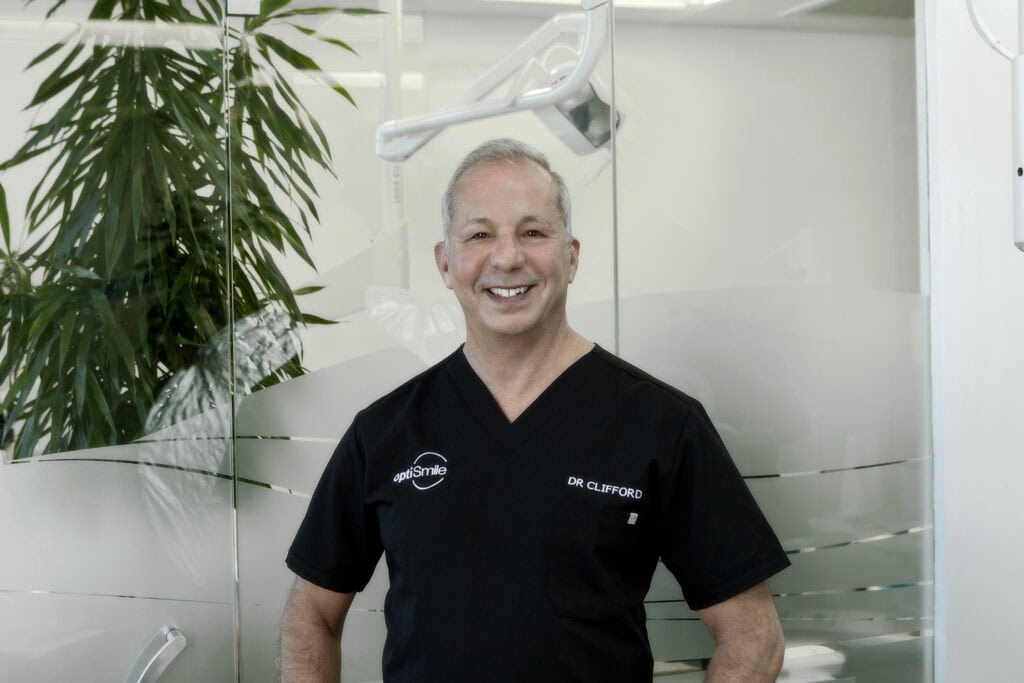
Welcome back to Save Your Money, Save Your Teeth. It’s Eon with you as always, also joined by Dr
Clifford Yudelman from OptiSmile. Today we’re taking on TikTok and Instagram dentistry.
Nail file enamel filing, also oil pulling, charcoal scrubs, goodness gracious, lemon and baking soda
whitening hacks, DIY elastic band braces, unlicensed veneer techs and more that we see so often on
social media. Some of these trends are harmless nonsense. Others cause permanent, irreversible
damage. So Dr Yudelman is going to separate the trends from the truth. This is going to be good, and
also explain what’s actually happening to your teeth when you try these hacks and give you the tools
to spot dental misinformation before it costs you your smile or your money. Dr Yudelman, welcome
back.
Dr Clifford Yudelman – OptiSmile (1:02 – 1:30)
Thanks for having me back. It’s great to be back. I’ve been really looking forward to this one, and in
case you’re in a hurry and you don’t have time to listen to all 10 questions, I just want to tell you that
whatever you see on TikTok, whether it’s a mom or a so-called dentist in America that’s getting
thousands of views saying any of these things that Eon just mentioned, I can tell you right now in one
word, it’s bullshit.
Eon Engelbrecht – E-Radio-SA (1:31 – 1:48)
Exactly. And then people, you know, the worst is people download these videos and then send them
to their friends and family who aren’t even on TikTok, and they then send it on and it becomes like
this whole chain, all these hacks, you know. And then I’ve seen some terrible things on TikTok.
Dr Clifford Yudelman – OptiSmile (1:48 – 1:49)
Granny’s got dentures.
Eon Engelbrecht – E-Radio-SA (1:51 – 2:05)
Yeah, I’ve seen some terrible things on TikTok of what happened to people’s teeth, especially when
they get turkey teeth, or people who had their teeth filed down and it didn’t work and now they look
like a shark. It’s disturbing.
Dr Clifford Yudelman – OptiSmile (2:05 – 2:08)
Yeah, you should try to work more rather than spending all that time on TikTok.
Eon Engelbrecht – E-Radio-SA (2:08 – 2:11)
No, that’s at night time when I can’t sleep.
Dr Clifford Yudelman – OptiSmile (2:12 – 2:13)
You need to sleep.
Eon Engelbrecht – E-Radio-SA (2:13 – 2:32)
Well, this TikTok thing here, it’s like you go down a rabbit hole. It’s actually very, very scary. So we
see people filing their teeth with nail files on TikTok. My word.
Why could this possibly be disastrous, doctor?
Dr Clifford Yudelman – OptiSmile (2:33 – 3:48)
Yeah, look, if you see people doing something on TikTok, it doesn’t mean to say that it’s a good thing.
Obviously, sometimes in the dental chair we will actually trim or polish or buff a tooth, but you know,
we’re doing it under a microscope. We know, you know, we studied this.
I’ve been doing it 43 years. I know that if a tooth is worn a little bit on one side and not on the other, I
can safely do what’s called cosmetic contouring. In fact, I do quite a lot of it. But I don’t recommend
that someone take a nail file and just start filing straight across, because you don’t know where your
dentine is.
You don’t know what’s going on underneath. If you’re stuck on a desert island somewhere, or you’re
on a yacht and six weeks away from anything, and there’s a sharp edge somewhere and you can get a
nail file to it and it ends up smoothing off and you don’t cut your tongue, that’s one thing. But filing
your front teeth for cosmetic purposes is just looking for trouble. You know, a lot of these things on
social media, they trivialise something that is basically biologically irreversible damage.
Don’t believe it. Bullshit.
Eon Engelbrecht – E-Radio-SA (3:49 – 3:59)
Now, does oil pulling actually whiten teeth or cure cavities? I know the answer, but I’m going to ask
you anyway.
Dr Clifford Yudelman – OptiSmile (4:00 – 6:06)
So actually, oil pulling, when you swish oil around your mouth, people use mainly, I think, coconut
oil or sesame oil. While some small studies suggest it may reduce certain oral bacteria, there is no
high quality evidence that it whitens your teeth or treats cavities. It’s a bit different to the filing
because maybe it’s a waste of time and money, but it might not necessarily be damaging your teeth.
So let’s put it in a different category. Cavities are caused, as we’ve spoken about many times before,
by acid that causes mineral loss from your enamel, and oil can’t reverse this process. There are other
things that you can swish with, like a fluoride toothpaste or tooth mousse.
We’ve done lots of podcasts about that. And like I said, oil pulling may just be harmless, but it’s
definitely not a replacement for brushing with fluoride toothpaste. And it just shouldn’t really be
promoted.
I get patients who tend to be quite into Eastern philosophies, and maybe I might be generalising now.
I’m trying to be a little bit, what is it, you’ve got someone who’s vegan and meditates every day and is
into ayurvedic medicine and so on, and they truly believe that the oil pulling helps all their chakras
and keeps all the toxins out of their mouth. It’s more of a belief system than a scientific thing.
And it does help them, because the one thing is, sometimes people believe in keeping the oil in your
mouth for long periods of time. I’m not sure what the recommended time is, but I think the person that
it benefits, if you are keeping your mouth closed and trying to keep this oil in your mouth for 15
minutes, at least your husband or wife is getting a bit of a break from you.
Eon Engelbrecht – E-Radio-SA (6:10 – 6:35)
Yes, that’s actually a very good idea. Okay. Yeah, that’s a good one.
Okay. I was picturing something completely different when I read oil pulling. Okay.
But now I know what oil pulling is. Okay. And then we come to DIY charcoal scrubbing.
I’ve seen that before as well. Any dangers when it comes to that?
Dr Clifford Yudelman – OptiSmile (6:35 – 6:49)
Yeah. So, I mean, just back to the oil pulling, I mean, it’s a minimum of 15 minutes and some people
say it only works if you do it for 30 minutes. So your husband or wife will love it if you just keep that
oil in your mouth and shut up.
Eon Engelbrecht – E-Radio-SA (6:50 – 6:55)
That’s a long time to keep your mouth closed. I don’t think I can do that. Yeah.
Dr Clifford Yudelman – OptiSmile (6:55 – 7:51)
And then there’s the charcoal toothpaste, and they are very abrasive, especially the powders. You
know, maybe they’ll remove some surface stain if you’ve been drinking your rooibos tea or smoking
cigars or cigarettes, but they actually scrape the enamel over time. That will cause your enamel to get
thinner, exposing your dentine, the softer part of your tooth, and then you get increased sensitivity and
eventually your teeth will get darker looking as your dentine shows through.
And, you know, there are lab studies showing how many of these charcoal products exceed safe
thresholds for daily use. It’s like putting Vim on your teeth, though it doesn’t smell like chlorine. And,
you know, this whitening effect is a cosmetic illusion, and the damage is real and it accumulates day
to day.
Eon Engelbrecht – E-Radio-SA (7:52 – 7:59)
Because you get all these charcoal toothpastes and I was always wondering, you know, is it actually
good for you? It just doesn’t look right.
Dr Clifford Yudelman – OptiSmile (8:00 – 8:01)
No, it’s not right.
Eon Engelbrecht – E-Radio-SA (8:02 – 8:11)
Okay. And then are veneer techs, unlicensed people doing veneers, operating in South Africa? Yeah.
Dr Clifford Yudelman – OptiSmile (8:11 – 9:36)
So, I mean, it’s very illegal. I have read of cases where people have been arrested. There’s no such
thing.
There’s no veneer technician. You get a nail technician that puts, you know, false fingernails on.
Somebody could be a dental technician which can manufacture things, but they are not allowed to
work in the mouth.
The police will knock on your door if you’re doing this. Someone reports you, because the HPCSA,
Health Practitioners Committee, South Africa, I forgot what HPCSA stood for for a second. The
Health Professions Council of South Africa is what it is.
And it’s very strictly restricted. And yeah, look, there have been cases of people going to jail. So, you
know, you’re playing with fire.
If you do that, you’ll see it on TikTok and Instagram. And maybe if you go to Bangkok or, you know,
if you go to Turkey, you’ll just get proper veneers. You don’t need all that. I won’t say proper veneers.
Yeah. If you go to Turkey, you’ll get what you think of as veneers, but they’ll file your teeth down and
give you crowns. And that’s, we’ve covered that a few times, but you might be better off going to a
veneer tech who’s unlicensed and can’t drill your teeth.
So, but yeah, don’t do it. No, it’s bullshit.
Eon Engelbrecht – E-Radio-SA (9:37 – 9:48)
Yes. Okay. And then I’ve got to ask you this lemon juice and baking soda whitening hack.
Is this also nonsense?
Dr Clifford Yudelman – OptiSmile (9:49 – 10:08)
Yeah. Look, that’s one of the most damaging things. You know, if you’ve listened to any of our
podcasts, you know lemon juice is highly acidic.
Baking soda is abrasive, and together it’s like using Vim. If you’re not from South Africa, Vim is like
a, what is it? It’s like something for scrubbing.
Eon Engelbrecht – E-Radio-SA (10:08 – 10:10)
Yeah. It’s like almost like Handy Andy.
Dr Clifford Yudelman – OptiSmile (10:10 – 12:10)
Yeah, Handy Andy. I don’t know what they call it in America, but basically it’s very toxic to your
teeth, and it won’t take long before all your teeth get sensitive.
You know, maybe you do it once or twice. Your teeth may look a bit whiter. If you do it every day,
you’ll be visiting the dentist and it will cost you a lot of money to sort out.
And we’ve had patients who’ve done things like this, and it can take months for the sensitivity to
improve. I recently had a patient come from Uganda. We did a video consult and he came, stayed with
a friend in Somerset West, and he got an Uber to Sea Point every day. I think the Uber might’ve cost
him more than the treatment, but he came to see me because all of his teeth were very sensitive.
It wasn’t from lemon juice and baking soda, but I got to know him quite well. He came to see me
about four or five times to fix some of the issues he had. And it was similar, because where he lives,
there are lots of pineapples and he just loves pineapple.
And his name’s Roger, and Roger was eating a lot of pineapple every day. Then he’d go and brush his
teeth and he used very abrasive toothpaste and would brush his teeth. He’d come before an
appointment and he’d go in the bathroom, and 10 minutes later, he’d come out. He came early,
especially.
And I think, oh, he’s been a long time in the bathroom. And I popped my head in there one day and he
was brushing away in places that plaque wouldn’t be, places that don’t get plaque even, you know, like
on the palatal side of his upper teeth. It took me a while to figure out why he had all of these wear
problems in areas that you just generally don’t see.
So I think there’s a lesson in there, you know. Lemon juice and baking soda, or, you know, a stiff
toothbrush and pineapples and, of course, abrasive toothpaste. It’s the same thing.
Eon Engelbrecht – E-Radio-SA (12:10 – 12:32)
Just like that. Yeah. And then, you know, you also get situations where people have a gap in their
teeth.
You know, that’s what made Madonna famous in the eighties, I think. I think she later closed that gap.
But can you really close a gap in your teeth with elastic bands or DIY braces?
Dr Clifford Yudelman – OptiSmile (12:32 – 13:39)
Look, people have put these things on TikTok, but it’s very, very dangerous. If you put an elastic band
over two teeth and it pulls them together, first of all, you’re just going to move the space on to your
next teeth. The elastic band can actually work its way down under the gum and destroy the bone, and
you can lose your teeth.
You know, orthodontics, they use elastic bands, but they vary, they have different strengths and
different widths, and you wear them specifically and you get hooks put on your teeth and you get
brackets, or with Invisalign we do buttons on teeth and we use elastics, but it’s very controlled. And
people have lost teeth. I haven’t heard of a case in South Africa, but when I was doing my research for
this episode, I thought I must include this in case someone from overseas is listening and they’re
trying to close their gaps by putting on their own elastics. You’re going to lose your teeth.
Eon Engelbrecht – E-Radio-SA (13:40 – 14:01)
And then you have more than just a small gap. You have one massive gap. Yeah.
Okay. And then why do influencers’ veneers sometimes look like Chiclets, you know, that
bubblegum, or sometimes even piano keys? I mean, it almost looks like it’s too big.
Dr Clifford Yudelman – OptiSmile (14:01 – 16:58)
Yes, 100%. They’re too big. You got it.
That’s it. It happens when the aesthetics is prioritised over anatomy and proportion. You know, teeth
have a natural variation in shape and length and translucency, and overly uniform, flat, opaque
veneers just ignore your facial harmony and age appropriate design. And while it may look, you
know, striking for want of a better word on camera, they look very unnatural sometimes on camera
and especially in real life.
And there are a lot of memes and parodies about this. Fortunately, now people are taking the Mickey
out of it and coming on with fake snap-on smiles and pretending they just came back from Turkey.
And we’ve even got a few dentists in Cape Town here that specialise in these kinds of Chiclets and
turkey teeth.
So you don’t have to go to Turkey to get turkey teeth. You can just find, if you Google veneers Cape
Town, you’ll find people. And there are even dentists that tell you that you’ve got to have veneers to
protect your teeth.
You might need them replaced several times in your lifetime, but they’ve got the gall to say that
veneers will protect your teeth. So you must come in and get veneers if you don’t want to lose your
teeth. I saw that last night and my blood pressure is just going through the roof.
If you’re listening to this, you know who you are. I’m not going to say anything else. Okay.
But we know who you are. We know who you are. Okay.
We spoke before about biological dentists and people selling treatments like removing your amalgam
and putting in biologically safe materials, or not using titanium. We did a podcast quite recently about
all of that. But this one, especially since we’re talking about social media and trends versus truth, there
are a number of these dentists all over the world that are selling veneers as if they’re going to protect
your teeth.
So this one particular one, and there’s a couple in Joburg. I’m sure there’s one in every town. They’re
not alone.
If you’re in America, there’s plenty. And there’s even one very, very famous dentist that all the stars go
to. We did do a podcast on Hollywood Smile versus Real Smile and just laughing at it and making a
joke.
It’s a very serious thing. And we’ve done a few podcasts on this type of thing. So if this is the first
time you’re listening to our podcast and you heard this last thing, look back on our previous podcast
about veneers versus injection moulded composite, which doesn’t drill your teeth at all.
The best tooth is one that’s undrilled.
Eon Engelbrecht – E-Radio-SA (16:58 – 17:09)
Absolutely. And I mean, doctor, how can consumers spot fake dental news on social media? What
would you say is the best way?
Dr Clifford Yudelman – OptiSmile (17:09 – 19:04)
So like any fake news, red flags should be absolute claims. Like, if you chew this gum, you will never
get another cavity. Miracle cure. Someone who had 20 cavities and they smoked banana leaves or
something. If there are no references.
And the main one, I think that’s how you can tell, is when they demonise mainstream dentistry, when
they’re the only ones that know this and everybody else is talking bullshit. I think we can call this the
bullshit episode. Yeah.
Yeah. I don’t normally swear, but this social media trends episode really gets my blood pressure up.
You know, credible advice acknowledges limitations, it acknowledges risks and alternatives, and it
invites questions rather than suppressing them.
And people should ask themselves whether these claims are supported by what’s called peer reviewed
research, or endorsed by recognised professional bodies. And critical thinking is the best defence
against misinformation. So, you know, these days you’ve got AI, and if you screenshot something or
you put the link into any AI, they’re all very good these days.
And you say, you know, give me an evidence based report on whether this dentist is giving me fake
information, or is this something that the American Academy of Endodontics, you know, uploads, or
the American Academy of Cosmetic Dentistry, or the British Dental Association, some recognised
group. You know, people have these conspiracy theories, like all the dentists in the world don’t know
what they’re talking about, but come to me and we can smoke banana leaves together and all your
cavities will go away.
Eon Engelbrecht – E-Radio-SA (19:04 – 19:13)
And now, there’s another thing I want to ask you about. Those purple colour correcting toothpastes. Is
that also a scam?
Dr Clifford Yudelman – OptiSmile (19:13 – 19:37)
I think you answered your own question. Okay. Yeah, I thought so.
Yeah. Look, again, these are things that are generally harmless. You know, I’ve seen things where
they can apparently make your teeth look whiter, but it’s just visually, it’s just to do with the colour
purple.
I think there was even a movie called The Colour Purple. I think you’re just wasting your money.
Eon Engelbrecht – E-Radio-SA (19:38 – 19:44)
And then finally, doctor, why should you never buy professional dental tools online?
Dr Clifford Yudelman – OptiSmile (19:45 – 21:33)
So, look, I mean, that one should be obvious. In America, they used to sell a little hook that you could
use to scrape your own teeth and, you know, then you wouldn’t have to go to the hygienist. It’s just not
a good thing.
You know, dental treatment is not just about tools. It’s about diagnosis, sequencing, you know, risk
management, and evidence shows that self-treatment consistently leads to worse outcomes and higher
costs. And I think that should be obvious.
I mean, I don’t even need to say that. If you try and fix your own teeth, you buy stuff online, do your
own veneer kit, you know, brush with purple toothpaste, file your teeth, go to some guy that says he’s
going to cure all your fillings without picking up a drill, you know, these veneer techs, as well as
these veneer dentists that are going to give you Chiclets, you’re just looking for trouble.
You know, social media is really for entertainment. I post on social media, but I try and just post these
podcasts where people can get legitimate information that’s based on evidence-based research. Even
everything I say, don’t take it at face value.
At the end of every podcast that I do, I’ve got references of where I’ve got this information from. I
keep references on everything I’ve said. I try not to only give my own opinion.
And like I’ve told you, Eon, and I’ve mentioned a few times on the podcast, I’ve actually finished my
book and I’m in the final stage of editing. It’s going to be a reference, a consumer’s guide or an inside
guide to dentistry and, you know, how to keep your teeth undrilled. So look out for that, hopefully
before the end of the year.
Eon Engelbrecht – E-Radio-SA (21:33 – 21:58)
But, you know, I think today was a nice, proper myth-busting session. And I think the takeaway for
our listeners is enamel doesn’t grow back. Biology doesn’t reward shortcuts.
Don’t be cheap. And if a trend sounds too good, fast or cheap to be true, it usually is. Thank you to
you, Dr Yudelman, for helping us bust those myths today.
Dr Clifford Yudelman – OptiSmile (21:58 – 22:02)
Thank you. And looking forward to speaking to you next week.
Eon Engelbrecht – E-Radio-SA (22:02 – 22:08)
Absolutely. And until then, look after your teeth and your wallet while you still have them.
Announcer – OptiSmile (22:27 – 23:11)
Discover the world of dental excellence with OptiSmile. Join us for a weekly podcast featuring Dr
Clifford Yudelman, a seasoned expert with 40 years of dental experience across four continents. Gain
unique insights and expert dental advice by visiting OptiSmile.co.za for articles that illuminate the
path to optimal oral health. If you’re seeking unparalleled dental care in Cape Town, get in touch with
OptiSmile or book directly online on OptiSmile.co.za. OptiSmile, where global expertise meets local
care.
Disclaimer: The content provided in this podcast, “Save Your Money Save Your Teeth” on Medical Mondays, is for informational and educational purposes only. It is not intended to serve as dental or medical advice. The insights and opinions expressed by Dr. Clifford Yudelman and any guests are designed to foster a better understanding of dental health, preventive measures, and general well-being, but should not be interpreted as professional dental or medical recommendations.Dr. Clifford Yudelman does not diagnose, treat, or offer prevention strategies for any health conditions directly through this podcast. This platform is not a substitute for the personalized care and advice provided by a licensed dental or healthcare professional. We strongly encourage our listeners to consult with their own dental care providers to address individual dental health needs and concerns.The information shared here aims to empower listeners with knowledge about dental health but must not be used as a basis for making health-related decisions without professional guidance. Your dental care provider is the best source of advice about your dental and overall health. Please always seek the advice of your dentist or other qualified health professionals regarding any questions or concerns about your dental health.