Chapters
Understanding Gum Recession
(0:04–1:05)
Gum tissue does not regenerate naturally once it has receded from its original position at the enamel margin. When recession occurs, the root surface becomes exposed—an area never designed to be visible in the mouth.
Modern periodontal surgery allows specialists to reposition or graft tissue to restore coverage and health. This is surgical reconstruction rather than biological regrowth.
Common causes include aggressive brushing with hard toothbrushes, thin gum biotype, teeth positioned outside the bone (especially from poorly planned aligners), grinding and inflammation. Once recession begins, it progresses slowly unless the underlying cause is addressed.
The Connective Tissue Graft
(4:11–6:25)
The connective tissue graft is the most widely researched method for treating gum recession. A small piece of connective tissue is harvested from beneath the surface layer of the palate and placed over the exposed root surface.
Over time, the graft integrates with surrounding tissue and establishes a new, thicker band of gum. Tissue from the palate is used because it shares similar biological characteristics with gum tissue and integrates predictably.
Long-term studies consistently show high success rates for root coverage and tissue stability. Not every case of recession requires grafting—many instances are self-limiting and can be monitored with 3D scans and photographs.
Recovery and Discomfort
(6:25–8:05)
Tissue harvested from the palate can cause temporary discomfort, often described as feeling like a graze or burn. With modern techniques, anaesthesia and protective dressings, discomfort is typically mild to moderate and resolves quickly.
Studies confirm that the short-term discomfort is outweighed by the long-term benefit of stabilising recession and preventing further damage. Alternative techniques for selected cases may avoid harvesting tissue from the palate altogether.
The Pinhole Surgical Technique
(8:05–9:54)
The pinhole technique is a minimally invasive method where small entry points are made in the gum tissue. A special instrument loosens the existing gum from inside, and the tissue is then repositioned and stitched higher.
This works well for mild to moderate recession when tissue quality is favourable. Patients experience very little discomfort compared to traditional grafting.
However, there is stronger long-term evidence supporting connective tissue grafts. A combined approach now exists where a small piece of connective tissue is inserted through the pinhole to reinforce the gum from within—a far less invasive option.
Why Treat Recession
(9:54–12:43)
Treating recession is not purely cosmetic. Exposed root surfaces are more vulnerable to decay (root caries), toothbrush abrasion and sensitivity, particularly as you age.
Urgent referral is recommended when recession affects lower front teeth, especially when a frenum (the tissue attaching the lip) is pulling on the tooth. In severe cases, patients risk losing the tooth entirely due to plaque accumulation and inability to clean properly.
Sensitivity and minor abrasion can often be managed with varnishes, desensitising toothpaste and avoiding acidic foods. Gum grafts should be reserved for cases where recession is progressive or severe.
Alternatives and Advanced Techniques
(12:50–14:14)
Artificial tissue materials exist but have limitations in long-term root coverage and tissue thickness compared to connective tissue, which remains the gold standard. Some specialists now use platelet-rich plasma (PRP) or platelet-rich fibrin (PRF) harvested from the patient’s blood.
This material is spun in a centrifuge to create a putty-like substance that can be sutured into the treatment area. It is sometimes mixed with freeze-dried or artificial bone to regenerate both gum and bone tissue.
Healing and Aftercare
(14:14–15:23)
Healing typically takes one to two weeks, during which the graft is delicate and must not be disturbed. Patients receive specific instructions on brushing, cleaning and diet—soft foods are recommended during the first week.
Hot, spicy and hard foods should be avoided for 10 to 14 days. Full integration and strengthening of the graft can take several months.
Following post-operative instructions carefully is one of the most important factors in achieving a successful outcome. It is essential to choose a periodontist experienced in these procedures.
Aesthetic Outcomes and Sensitivity
(15:23–18:04)
Connective tissue grafts tend to blend very well with existing gum tissue over time. Initially, the area may appear swollen, but the appearance improves significantly as healing progresses.
Gum grafts can reduce sensitivity permanently by covering exposed root dentine and protecting the cementum. However, grafting is not the primary treatment for sensitivity alone.
Other options include fluoride varnishes, desensitising toothpaste, custom whitening trays and dietary changes (avoiding acidic foods like apple cider vinegar, lemon and sparkling water). Grafts should not be overprescribed, as the procedure is not without discomfort and cost.
The Risk of Ignoring Severe Recession
(18:04–21:07)
Lower front teeth are particularly vulnerable due to thin bone, aggressive brushing and poorly planned orthodontic movement. Ignoring severe recession in these areas can lead to loose teeth or even tooth loss.
Early intervention is simpler and more predictable than waiting for a crisis. In some cases, orthodontic repositioning can help regenerate gum tissue by moving the tooth back into the bone.
Without timely treatment, patients may require complex restorative work, splints or even extraction and implant placement. Monitoring with photographs and 3D scans is essential to prevent progression.
Transcript
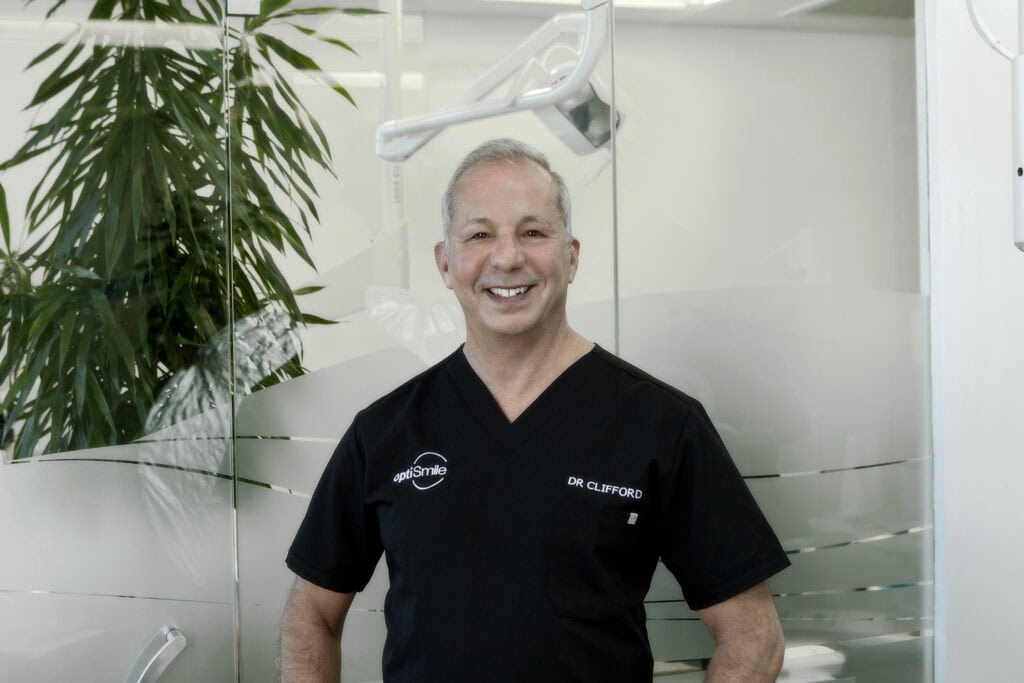
Eon Engelbrecht – E-Radio-SA: (0:04) Welcome back to Save Your Money, Save Your Teeth, and today we’re tackling a topic that often causes concern and sensitivity: gum recession. We’re joined by Dr Clifford Yudelman from OptiSmile to discuss what causes it, why it matters for your long-term dental health, and most importantly, the modern solutions available to fix it, including the most effective gum grafting techniques. Dr Yudelman, welcome back.
Dr Clifford Yudelman – OptiSmile: (0:31) Thanks, Eon. Thanks for having me back. Great to speak to you.
Eon Engelbrecht – E-Radio-SA: (0:37) Now it’s starting to cool down a bit after that hectic heat we had last week. And so with winter coming, you know, recession and sensitivity, I thought it’d be a good subject. So we’re on podcast 99 today. Next week is the big one, the milestone.
Dr Clifford Yudelman – OptiSmile: (0:52) Yeah, amazing. 100 podcasts and still got about another 40 or 50 ideas. So we’re not done yet.
Eon Engelbrecht – E-Radio-SA: (1:05) Awesome. Okay. So, Dr Yudelman, we know brushing too hard causes recession. Can we actually grow the gum back?
Dr Clifford Yudelman – OptiSmile: (1:05) So gum tissue does not grow back on its own once it’s receded. And you know, that’s something that we need to be clear about. So when gum is receded, it means that it’s moved away from the original position, which is normally at the enamel margin where the enamel meets the root. So a gum that’s receded means that the root surface is being exposed and that was never designed to be in the mouth. So while the body doesn’t naturally regenerate gum tissue, modern periodontal or gum surgery—kind of plastic surgery for your gums—allows, I say us, but we work with different periodontists, and it allows the periodontist, the gum specialist, to reposition or graft gum tissue in a way that restores coverage and health.
So we’re not actually regrowing the gums biologically. I don’t know about you, but I get on Instagram and all of that; all these things about China and stem cells and how your teeth or your gums are going to grow back, you know, just by rubbing a bit of paste on them or whatever. But this is actually rebuilding lost tissue using surgery or surgical techniques. And so recession is most commonly caused by very aggressive brushing with a very hard toothbrush or something we’ve spoken about before is thin gum biotype, meaning you’ve got thin gums as opposed to someone with thick gums, tooth position outside of the bone, especially with orthodontic movement. So we see that now patients are getting all kinds of copycat aligners that are not these proper Invisalign or other really well-known brands.
And the planning hasn’t gone according to plan and the tooth has moved too far out cheekwards and out of the bone. And then the gum will recede because there’s no bone and you need bone to have gum. The other thing is grinding. So when you’re clenching or grinding your teeth, it jiggles the teeth and that can cause what’s called an abfraction. We’ve spoken about that before. That’s that little groove at the gum line. And when you get that groove at the gum line from the tooth flexing, the gum will recede down. It can’t actually attach there anymore. And then, of course, inflammation. If you’ve got inflamed gums or gingivitis and then it gets treated, the gum can recede. But once the recession begins, it progresses slowly unless the underlying cause is addressed. And evidence shows that treating recession early, especially when there’s sensitivity or progression, it can lead to better outcomes rather than waiting until the roots are severely exposed. And while the gums don’t heal themselves, they can be predictably restored when treatment is planned correctly.
Eon Engelbrecht – E-Radio-SA: (4:11) All right. And what is the connective tissue graft? And I also want to ask you, where does that tissue actually come from?
Dr Clifford Yudelman – OptiSmile: (4:11) Connective tissue graft is the most widely used and well-researched method for treating gum recession. In this procedure, a small piece of connective tissue is taken from underneath the surface layer of your palate or the roof of your mouth. This tissue is then placed over the exposed root surface and secured in position. And over time, the graft integrates with the surrounding tissue and it establishes a new thicker band of gum over the tooth.
And the reason why we use tissue from the palate is because it’s got a similar biological or characteristic to gum tissue around the teeth and it integrates very predictably. And long-term studies consistently show high success rates for this type of root coverage and good tissue stability. From a biological standpoint, the technique not only improves appearance, but it also increases the tissue thickness and that helps to protect against future recession.
I should just say, at this point, I see quite a lot of recession and in most cases, the damage is already done and it’s self-limiting and it’s not something that’s going to carry on and on. So we monitor it with 3D scans and photos. And it’s not something that we refer every time we see a little bit of recession, that we refer people to go and have a gum graft. This is particular cases where there’s a little bit of recession on quite a few teeth and then all of a sudden you’ve got one tooth, maybe a lower front tooth where the recession is very bad and you can see there’s inflammation and it’s going to get worse. We’re not just talking about general age-related recession or some of the things that I just mentioned.
Eon Engelbrecht – E-Radio-SA: (6:25) And this may be a myth, but I just want to make sure, is it true that you take tissue from the roof of the mouth? And if it is true, does it actually hurt?
Dr Clifford Yudelman – OptiSmile: (6:25) Yeah, yes, it does actually hurt. I was going to say, yes, we take tissue from the palate. But yes, it does hurt, which is why I don’t refer people… sorry, I don’t mean to laugh. If anyone’s had that, they’ll tell you it does. It does hurt. The area that they take it from, it sounds alarming, but with modern techniques and anesthesia, the discomfort is usually manageable and temporary. A good periodontist will warn you, make sure that you take proper prescription painkillers. They say that it feels like a graze or a burn.
But I’ve had patients tell me that the palate can be pretty sore, worse than the area where you’re sticking it onto the donor site. There’s now advances in surgical techniques and protective dressings and things that have improved in the last five, 10 years. And, you know, the studies show that discomfort can be mild or moderate, but it resolves quickly. And more importantly, the benefit of stabilizing the recession and preventing long-term damage outweighs the short-term discomfort. But there’s also alternative techniques for selected cases which may avoid a second surgery altogether, which we’ll probably get into now.
Eon Engelbrecht – E-Radio-SA: (8:05) And the pinhole technique, what on earth is the pinhole technique and is it better than traditional grafting?
Dr Clifford Yudelman – OptiSmile: (8:05) So the pinhole surgical technique, there’s some dentist I think in America, he named it after himself. I don’t think his name was Pinhole, although it’s something similar. Maybe his surname. Yeah, Dr Chao, the Pinhole Surgical Technique—it’s a minimally invasive method where small entry points are made in the gum tissue and then the existing gum is loosened from like a little keyhole surgery from either side. And then a special instrument is used to loosen the gum from inside out. And then you actually reposition the gum and the gum is not like cut and peeled back. The gum is loosened up through this little pinhole and then the gum is stitched higher.
And this works well when there’s mild or moderate recession and the tissue quality is favorable. That’s more the thick biotype and the patients get very little or no discomfort in a case like this. But it’s not always possible. And there’s also much better long-term evidence for connective tissue. It doesn’t mean to say pinhole doesn’t work, but there’s actually now like a combined one. And I’m not an expert. I send patients to the periodontist and the periodontist does their thing. But it’s a combination of a pinhole that you then put a small piece of connective tissue into the pinhole—kind of to stuff it like stuffing a pillow, I guess—from inside, a small little piece like a little sausage is put into the pinhole to sort of beef up the gum from inside out. And I think that’s far less invasive.
Eon Engelbrecht – E-Radio-SA: (9:54) OK, well, that makes sense. And why would you say, doctor, is it important to treat recession? I mean, is it just about looks or is it about tooth health as well or both?
Dr Clifford Yudelman – OptiSmile: (9:54) Yeah, look, it’s not always just a cosmetic issue. Exposed root surfaces can be more vulnerable to decay, especially as you get older. There’s something called root caries that can be more vulnerable to abrasion, toothbrush abrasion and sensitivity. But these can all be dealt with in their own way. That’s not for myself. I don’t do the surgery. I send patients to a periodontist and it’s not like it’s getting done for free like anything else. It does cost good money and you need to have a good reason to do it.
Some of the things I just mentioned are probably not great reasons. The main reason, like I mentioned to you and when I always refer, is especially in a case where someone has, you know, the little piece of skin that attaches your lip, especially between your lower front teeth or between your upper front teeth, it’s called a frenum or a frenulum. And when that’s been pulling, especially on a lower front tooth and the patient has had orthodontics and then you—if you Google, you know, gum recession, lower front tooth—you can see sometimes half the root is exposed. In a case like that, that patient could end up losing that tooth because you can’t really even brush there. It collects a lot of plaque. In those cases, I always refer as a matter of urgency to get a gum graft.
And, you know, at this point, I’ll say that my late father, he taught gum surgery in Pretoria for 27 years. He practiced for 57 years. And in 1968, he and another well-known Cape Town periodontist went and traveled all over the Europe and the U.S. for about six months learning how to do these types of surgeries. And in those days, they used to take not just connective tissue, but a little piece of your palate and stitch it. And even today, we see patients who’ve got these, it’s called a free gingival graft. And I believe that Bernie Radomski, the periodontist, just recently passed away here in Cape Town. He was also in his 90s, a good friend of my late dad, who was 95 when he passed away. And they did the first outside of America and Europe, the first gum grafts, I think, in South Africa. And a lot of people who are listening to this, dentists, will know exactly what I’m talking about. And yeah, just a shout out to them.
Eon Engelbrecht – E-Radio-SA: (12:43) Now, that’s very interesting. I had to shout very loud because they’re now gone. So a big shout out. Hopefully they stream up there. Tuning in. Dr Yudelman, can we use artificial tissue instead of cutting the palate?
Dr Clifford Yudelman – OptiSmile: (12:50) So in some cases, and there are some experimental alternatives, obviously the advantage is that you don’t have a donor site. But I think that there’s limitations in long-term root coverage and tissue thickness outcomes. And, you know, the connective tissue is the gold standard. There are also now techniques where for certain surgeries, a specialist that’s doing a graft, say a bone graft or gum graft, will use what’s called PRP or platelet rich plasma, PRF, fibrin, where they take blood as if you’re giving blood for a donation, a few vials of blood, and then it gets spun in a special centrifuge for 15 minutes quite slowly. And then that separates like a yellow blood clot. And it’s almost like a putty and that can get sutured or stitched into an area. And they use that. Sometimes they mix it with what’s called bottle bone, which is freeze-dried bone or artificial bone like calcium chunks that’s similar to bone, fake bone, and make not only gum grow back, but bone grow back. So, you know, it’s up to the specialist and whatever the latest and the best is in that particular case and for that particular patient.
Eon Engelbrecht – E-Radio-SA: (14:14) And let’s talk about care afterwards. How long is the healing process and what can you eat afterwards and what can’t you eat?
Dr Clifford Yudelman – OptiSmile: (14:14) So obviously, the person doing the surgery would give specific instructions. I would make sure that… not every periodontist does a lot of these grafts and some of them get better results than others. And I would always make sure that whoever you’ve been referred to is one of these periodontists that is very familiar and gets good results with this because there’s no point getting this and then it doesn’t work properly or it’s back to square one, you know, a couple of years later. So back to the question about the healing, that takes about one or two weeks. During this time, the graft is very delicate and you can’t disturb it. And patients are given special advice on brushing and how to clean the area and soft foods. You might have a dressing placed on there. And after the first week, you’ve got to avoid hot and spicy foods and hard foods. And within about 10 to 14 days, you can start getting back to normal eating. And it can take several months for this graft to strengthen and to blend with surrounding tissue. And, you know, following the instructions that are given to you specifically is one of the most important factors in getting a successful outcome.
Eon Engelbrecht – E-Radio-SA: (15:23) Doctor, for cosmetic reasons, will the graft match the colour of your existing gums?
Dr Clifford Yudelman – OptiSmile: (15:23) So those ones that I’ve mentioned before, the palatal grafts, the free gingival grafts, they often wouldn’t match, but connective tissue grafts tend to blend very well over time. Initially, it may look a bit swollen, but as it heals, it looks better and better. I’m not sure about the artificial materials. I’m not even sure if anyone in South Africa uses the artificial materials yet. But yeah, when it’s done by someone who does a lot of these, like I mentioned, they should be able to show you before and after pictures of cases that they’ve done recently.
Eon Engelbrecht – E-Radio-SA: (16:04) Can gum grafts reduce sensitivity permanently?
Dr Clifford Yudelman – OptiSmile: (16:04) So, yes, in many cases, sensitivity that’s due to exposed root dentine and open tubules—you know, if you’re covering a fair bit of root, you’re reducing exposure and you’re protecting those sensitive cementum. I mean, there are other ways for us to reduce sensitivity. It wouldn’t be the main way to reduce sensitivity. We’ve got some varnishes and things we can paint on or give people teeth whitening trays that can be used to desensitize. And we’ve done quite a few podcasts mentioning sensitivity. I mean, one of the main things is avoiding apple cider vinegar and lemon and very acidic things and sparkling water because those things just keep the dentine sensitive all the time. And using a fluoride toothpaste or desensitizing toothpaste with a gentle toothbrush, treating sensitivity, you know, is more effective than just relying on desensitizing toothpaste alone. But also the gum graft, often there’s claims that you do it to reduce sensitivity. But that’s like I mentioned, you know, you don’t want to oversell or overprescribe gum grafts because it’s not just a walk in the park. And I think we’ve kind of covered that here.
Eon Engelbrecht – E-Radio-SA: (18:04) And then just finally, a bit of a scenario. What happens if we ignore severe recession on a lower front tooth?
Dr Clifford Yudelman – OptiSmile: (18:04) Thanks for asking for further clarification, because that, like I mentioned, is one of the main times that I actually refer people for periodontic plastic surgery, which perio means around and dental means teeth. So a periodontist is a person that works around the tooth with the gums and the bone. And it is basically plastic surgery. So these lower front teeth are particularly vulnerable. Like I mentioned, the bone is thin. People sometimes brush too hard there. They could have had aligners that weren’t planned properly or even braces where the root was pushed too far forward or angled incorrectly. And there’s no bone on the outside. Sometimes I’ve even got a case I’m doing Invisalign on now where we’re moving the tooth, angling it back and pushing it back into the bone. And without any surgery, the patient’s gum is growing back because we’re actually helping the body to make more bone.
So this is something we’re photographing and recording. It’s an interesting case. She did see a periodontist before and she sees a periodontist every three months and she may need a small graft afterwards, but it’s already almost 50 percent better. Yeah, you don’t want to lose so much attachment and bone where you get a loose tooth and even losing a tooth. People can lose a lower front tooth like that. And, you know, from a financial and biological perspective, ignoring recession often leads to much more complex treatments and even restorative work or splints or even getting a tooth out and getting an implant. So early intervention is almost always simpler and more predictable than waiting for a crisis when it comes to lower front teeth. You know, when I do see a patient and it’s quite severe and they say, “Oh, yes, my dentist in Joburg was watching this.” It’s like, you know, let’s get some photos. Let’s see what they’ve been watching. And then maybe there’s no photos or they say, “Oh, it was fine. And then it just got really bad in the last six months.” You know, that’s what you’re trying to avoid.
Eon Engelbrecht – E-Radio-SA: (20:37) That was incredibly insightful, Dr Yudelman. Thank you so much for walking us through the causes of gum recession and also explaining how modern periodontal surgery can truly stabilize the tissue, reduce sensitivity and protect teeth for years to come.
Dr Clifford Yudelman – OptiSmile: (20:58) Thank you. And thanks for your great questions once again. And looking forward to podcast number 100 next week.
Eon Engelbrecht – E-Radio-SA: (21:07) And next week, we’ll be talking about a tooth-friendly alternative for replacing missing teeth, something called the Maryland Bridge. Have a great week and speak to you next week. Until next time.
(21:40) Discover the world of dental excellence with OptiSmile. Join us for a weekly podcast featuring Dr Clifford Yudelman, a seasoned expert with 40 years of dental experience across four continents. Gain unique insights and expert dental advice by visiting OptiSmile.co.za for articles that illuminate the path to optimal oral health. If you’re seeking unparalleled dental care in Cape Town, get in touch with OptiSmile or book directly online on OptiSmile.co.za. OptiSmile, where global expertise meets local care.
Disclaimer: The content provided in this podcast, “Save Your Money Save Your Teeth” on Medical Mondays, is for informational and educational purposes only. It is not intended to serve as dental or medical advice. The insights and opinions expressed by Dr. Clifford Yudelman and any guests are designed to foster a better understanding of dental health, preventive measures, and general well-being, but should not be interpreted as professional dental or medical recommendations.Dr. Clifford Yudelman does not diagnose, treat, or offer prevention strategies for any health conditions directly through this podcast. This platform is not a substitute for the personalized care and advice provided by a licensed dental or healthcare professional. We strongly encourage our listeners to consult with their own dental care providers to address individual dental health needs and concerns.The information shared here aims to empower listeners with knowledge about dental health but must not be used as a basis for making health-related decisions without professional guidance. Your dental care provider is the best source of advice about your dental and overall health. Please always seek the advice of your dentist or other qualified health professionals regarding any questions or concerns about your dental health.