Chapters
Introduction
[00:00:04 – 00:00:49]
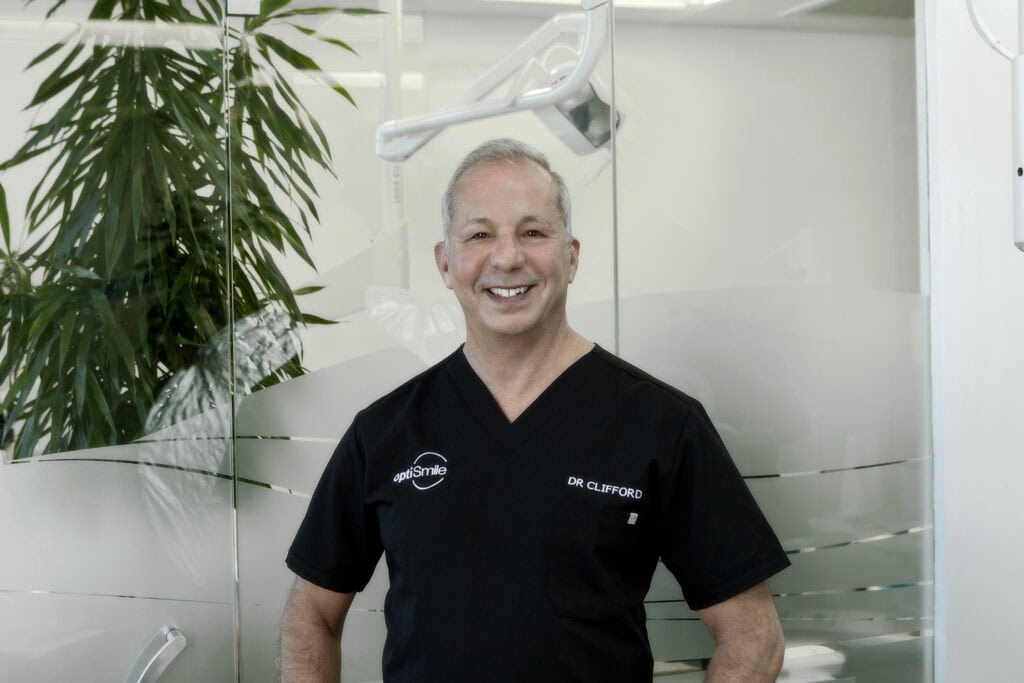
Eon Engelbrecht welcomes Dr Clifford Yudelman from OptiSmile back to discuss enamel erosion and sensitive teeth. Listeners will learn how to detect early signs, choose the right products, and protect their smiles.
Welcome Back
[00:00:50 – 00:01:13]
Dr Yudelman encourages listeners to stay tuned for practical tips to save both their money and their teeth.
Early Signs of Erosion
[00:01:13 – 00:03:58]
At OptiSmile, patients receive detailed scans, photos, and AI analyses to identify erosion signs like smooth enamel, translucent edges, and molar cupping. These often go unnoticed at home.
DIY Checks for Erosion
[00:03:58 – 00:05:14]
Use bright light or your car’s rear-view mirror to spot translucency. Feel for lost points on molars and zoom in on flash photos. Raised fillings may signal enamel loss.
Toothpaste Ingredients for Sensitivity
[00:05:14 – 00:07:04]
Effective ingredients include sodium fluoride for daily protection, stannous fluoride for desensitising, and nano-hydroxyapatite to rebuild enamel. Potassium nitrate helps numb nerve endings, but none can restore lost enamel.
Fluoride Rinses vs High-Fluoride Toothpaste
[00:07:04 – 00:08:13]
High-fluoride toothpaste like Clinpro (5000 ppm) is better for high-risk patients. Avoid alcohol-based rinses and never rinse after brushing, to preserve fluoride’s benefits.
Strengthening Pastes
[00:08:14 – 00:09:34]
Products like Tooth Mousse or MI Paste help remineralise enamel. Apply after acid exposure or before bed to maximise absorption during low saliva flow.
Morning Routine Tips
[00:09:35 – 00:10:33]
Brush immediately on waking. Avoid brushing after acidic drinks like lemon water or coffee—rinse instead and wait 30–60 minutes. Chewing xylitol gum can help post-acid exposure.
Boosting Saliva Naturally
[00:10:33 – 00:11:33]
Stay hydrated, chew sugar-free gum, and eat fibrous foods like apples and celery. Avoid smoking, as it drastically reduces saliva flow—your natural enamel defence.
When to Seek Dental Intervention
[00:11:33 – 00:12:35]
Visible erosion, persistent sensitivity, or aesthetic issues call for action. Treatments include resin infiltration, micro-bonding, and injection-moulded composite bonding to protect and restore enamel.
Advice for Reflux or Eating Disorder Recovery
[00:12:36 – 00:13:55]
Patients recovering from reflux, bulimia, or morning sickness need compassion. Rinse with water or bicarbonate post-acid exposure and avoid brushing immediately after regurgitation.
Game Plan for Athletes & Health Fanatics
[00:13:55 – 00:15:13]
Use bottles with straws to bypass teeth, carry water alongside energy drinks, and avoid citrus grazing during workouts. Book regular check-ups to catch erosion early and protect performance and smile.
Closing Thoughts
[00:15:13 – 00:17:35]
Dr Yudelman reminds listeners to make small changes for lifelong enamel health. Subscribe and visit OptiSmile.co.za for more expert insights, and always consult your own dentist for personalised care.
Transcript
[Eon Engelbrecht – E-Radio-SA] (0:04 – 0:49)
Welcome back to Save Your Money, Save Your Teeth. I’m your host Eon Engelbrecht, joined once again by Dr Clifford Yudelman from OptiSmile. In our last episode we uncovered how certain health habits, from vinegar shots to fizzy drinks, can quietly damage your enamel. So today we’re taking it further.
How do you detect the early signs of erosion? What treatments really work to reduce sensitivity? And how can you protect your teeth without giving up the lifestyle that you love?
If you’ve ever winced at an ice-cold drink or wondered if your enamel is thinning, then this episode is especially for you. We welcome back Dr Clifford Yudelman from OptiSmile.
[Dr Clifford Yudelman – OptiSmile] (0:50 – 1:13)
Great to speak to you and looking forward to today’s episode, especially after last week. And like I said last week, be sure to stick around to the end so you get all of the tips to save your money and save your teeth. Only here on this particular podcast, there’s not much else out there that has this information.
[Eon Engelbrecht – E-Radio-SA] (1:13 – 1:23)
Awesome. So firstly, Dr Yudelman, what are the early forensic signs of erosion that you spot in the chair that people miss at home?
[Dr Clifford Yudelman – OptiSmile] (1:23 – 3:58)
When we see new patients at OptiSmile, we spend an hour and a half on the first visit and we start off just chatting and speaking about which teeth are sensitive and where, and we speak about diet and habits like lemon water or apple cider vinegar and other things like fasting and coffee. And we get a lot of information before we even look in the patient’s mouth. I usually look down if they say their lower front teeth are sensitive.
I look to see if they bite their nails or their cuticles. That’s very common these days. And so we already start seeing and looking for signs that maybe will indicate what we might see when we start looking in the mouth.
Then we actually take photos of the person smiling using a special camera, and then we give them retractors and we take pictures inside the mouth from the front and also inside using a mirror. And when we blow those pictures up on the screen, they’re very high resolution. You can see all kinds of things very easily.
So I don’t just look in a patient’s mouth and tell them this is wrong and that’s wrong. We go through this process called co-discovery. We’ve spoken about it in one of our earlier podcasts, but basically after we’ve done the pictures inside the mouth, we then will do a 3D scan with our Invisalign iTero scanner.
And this has got near-infrared imaging, and that also helps us to look at these things that I’ll tell you in a second. I’ll tell you about these things in a few seconds, what we look for. And then the patient goes through and we get a 2D and sometimes even a 3D x-ray, and we put that into AI.
And the AI will also show us if there are any abfractions, missing enamel at the gum line, or any attrition wear on the top of the teeth, or erosion on the molars. So these things that I’m talking about are smooth, shiny enamel surfaces, thinning out of the edges of the front teeth that look almost translucent or glassy where the back of the tooth is eroded and the tooth almost looks see-through or grey. And then on the molars, fairly common, it’s like a cupping or it looks like someone’s drilled out these little shallow bowls at the tops where you should have points.
There are little ditches in the teeth. And yeah, I mean, patients don’t often notice these very well, but once we show them on the photos or the scans, they’re very easy to see.
[Eon Engelbrecht – E-Radio-SA] (3:58 – 4:09)
And are there DIY tests that listeners can do at home, changes in shine or cupping on molars or edge translucency to catch erosion early?
[Dr Clifford Yudelman – OptiSmile] (4:09 – 5:14)
Yeah. So if you look in a very bright light, often sometimes the best and the clearest mirror is your rear-view mirror in the car. So if it’s a nice sunny day, you’ve got all the light you need, and then you see people bring their teeth up or looking, checking their lipstick in the rear-view mirror.
But that rear-view mirror, if you get close to it, can be a very good quality mirror and especially, as I say, with the light. And then you can see if the edges look more translucent, yeah, that’s your enamel thinning. If you run your tongue on the molars and they don’t feel pointy or you look carefully, you can even take a picture with your flash and your front-facing camera of your teeth and then zoom in.
That would probably be one of the better ways. We do video consults with patients and they send us pictures of their teeth all the time and we can see that quite easily and also check if the fillings look like they’re above the tooth surface. That means that the enamel around the tooth has been dissolving and then the filling doesn’t dissolve and it looks like it’s sticking up or sticking out.
[Eon Engelbrecht – E-Radio-SA] (5:14 – 5:24)
Okay, well, that makes sense. And then beyond toothpaste, Dr Yudelman, which active ingredients genuinely reduce sensitivity and also how do they differ?
[Dr Clifford Yudelman – OptiSmile] (5:24 – 7:04)
Yeah, look, all the different companies have got their own little commercialisation of these different things. Something that’s been around for ages is stannous fluoride, which forms a protective… stannous meaning tin… that’s got some more stable type of fluoride and that can desensitise. Personally, I don’t really like a stannous fluoride toothpaste.
Oral-B used to make one. I’m not sure if it’s still around. I think it makes your food start tasting funny.
So sorry if Oral-B is listening. I’m not a fan of that. And a lot of old-school dentists like the stannous fluoride.
Most of the time, it’s sodium fluoride that’s in normal toothpaste. And then you’ve got toothpastes that have got arginine and calcium carbonate, which plugs the tubules, and the tubules are the little crikeys or holes that when you blow air on them, they make you jump. And that also improves the pH in your mouth.
And then there’s nanohydroxyapatite. Try and say that after a few drinks. So nanohydroxyapatite mimics natural enamel crystals and helps to rebuild the surface mineral.
And one of the things that’s been used a lot and for a long time in traditional Sensodyne and most other sensitivity toothpastes is called potassium nitrate. That actually seals and numbs those little nerve endings. But none of these just act as a bandage. None of these actually replace eroded or abfracted or worn down enamel.
[Eon Engelbrecht – E-Radio-SA] (7:04 – 7:16)
And can we talk about mouth rinses? When is fluoride rinse better than high fluoride toothpaste? And also, when should people avoid alcohol-based rinses?
[Dr Clifford Yudelman – OptiSmile] (7:17 – 8:13)
I’m not a fan of any alcohol-based rinse. And then we don’t get it in South Africa, but in Australia, when I was practising there and in America, Colgate had a high fluoride toothpaste. There was 5,000 parts per million, which is very good for daily prevention for high-risk patients.
In South Africa recently, we’ve been able to get something called Clinpro. You only get it from the dentist and that’s supposed to be very good. We’ve just started using that at OptiSmile.
So I’ll have to report at a later date how that’s working. I’m not really a big fan of fluoride rinses to be honest. You shouldn’t really rinse or use mouthwash after you’ve used toothpaste because it just rinses away the fluoride and the good stuff that was in the toothpaste.
[Eon Engelbrecht – E-Radio-SA] (8:14 – 8:21)
Dr Yudelman, strengthening pastes, who benefits most and how should they be timed around your acidic drinks?
[Dr Clifford Yudelman – OptiSmile] (8:21 – 9:34)
Yeah, so I mentioned Tooth Mousse. It’s called Tooth Mousse or M.I. Paste. There’s M.I. Paste or Tooth Mousse Plus, which has a little bit of fluoride in it as well. These are calcium phosphate. They’re by-products of when they make cheese and yoghurt, very healthy, very good for you. And they work well for people with high erosion or people with braces that are not brushing properly.
And they help to boost the calcium and the phosphate that you have naturally occurring in your saliva. That’s how they formulate it. And that goes directly into the enamel.
It helps to harden the enamel. And the timing is very important. If you’ve had any acid exposure and you put it on, especially before bed, when your saliva flow drops, it works well.
So if you don’t have whitening trays or desensitising trays, you rub it on your teeth and then you keep it for a couple of minutes and you swish it around and then you spit it out without rinsing. And it’s like a leave-in conditioner. I like the name Tooth Mousse. It’s like a mousse-y consistency as well.
[Eon Engelbrecht – E-Radio-SA] (9:35 – 9:48)
Yeah. Dr Yudelman, I also want to ask you any advice. What’s the right order and timing in the morning if you want coffee, lemon water and then brushing so you don’t sandblast your enamel?
[Dr Clifford Yudelman – OptiSmile] (9:48 – 10:33)
I mean, you can brush when you wake up because then you’re putting a layer of fluoride or remineralising stuff on your teeth. And then you can have your coffee or your lemon water if you have to have the lemon water. I just recommend avoiding lemon water.
And then you rinse out with plain water. Never brush immediately after acids. Wait 30 to 60 minutes after anything acidic.
But if you’ve woken up and you’ve brushed your teeth and scraped your tongue and you eat breakfast and then you have a coffee and you just rinse your mouth, chew a bit of sugar-free gum with xylitol, you don’t have to go and brush again. The brushing is to remove plaque. You won’t have new plaque on your teeth if you just brushed it when you woke up.
[Eon Engelbrecht – E-Radio-SA] (10:33 – 10:46)
And then saliva is obviously our natural defence. But how can listeners hack saliva like hydration, xylitol, sugar-free gum to speed up recovery after acids?
[Dr Clifford Yudelman – OptiSmile] (10:46 – 11:33)
Yeah. So we’ve done quite a few podcasts about this, especially more recently. So you are staying hydrated, drinking your two or three litres or as much as you can of fresh water, chewing sugar-free gum, especially with xylitol.
I like the Wrigley’s Orbit. It’s called Orbit Professional. It used to have more xylitol.
It doesn’t have as much anymore. And then snacking on fibrous foods like apples or celery or carrots is really good. Avoiding smoking.
Smoking is terrible for your saliva flow. And yeah, the saliva is the best defence. It buffers acid, it supplies minerals, and it literally rehardens your enamel.
So your saliva is very important.
[Eon Engelbrecht – E-Radio-SA] (11:33 – 11:40)
And when is dental intervention indicated versus watch and wait?
[Dr Clifford Yudelman – OptiSmile] (11:40 – 12:35)
So if the erosion is visible and the sensitivity is persistent or your aesthetics are affected, that’s when we step in. We can do resin infiltration or Icon treatment for early white spots, micro-bonding under the microscope at the gum line, and then injection moulded composite to build up worn down surfaces, especially when people have crooked teeth and then they straighten them. And then the wear and the tear is very obvious because the teeth were crossed over and then you straighten them and then you can see they look like they’ve been worn down at 45 degrees.
So injection moulded composite bonding is really good for that. And we have done a great episode on bonding and veneers and injection moulding. Yeah, all of these things build up the worn out surfaces and they protect the dentine and they give your tooth strength again.
[Eon Engelbrecht – E-Radio-SA] (12:36 – 12:56)
Okay. And then we spoke about reflux before, but I just want to ask you, reflux, silent reflux, and even eating disorder recovery, they can all supercharge erosion. So what gentle stigma-free advice should those patients hear first?
[Dr Clifford Yudelman – OptiSmile] (12:56 – 13:55)
Yeah, these are very sensitive topics, especially the eating disorder like bulimia. The reflux bathes the teeth in stomach acid, which is much stronger than food acids and patients recovering from bulimia or reflux after having multiple children with morning sickness, that’s one. Yeah, they can show dramatic enamel loss, especially on the back of the upper teeth and on the lower molars.
And the first advice is compassion and prevention. So yeah, the Tooth Mousse and fluorides, rinsing with water or even bicarb to neutralise acids and avoiding brushing straight after any regurgitation or vomiting of food, that would be a good thing. You don’t want to go and brush right away.
[Eon Engelbrecht – E-Radio-SA] (13:55 – 14:08)
And then for the athletes and health fanatics, do you have a practical game plan from bottle choice and straw angle to your drink timings around workouts to keep the gains and lose the sensitivity?
[Dr Clifford Yudelman – OptiSmile] (14:08 – 15:13)
Yeah, so those are some of the great tips that we left for the end so people will listen to the end. So here’s the game plan for athletes and health fanatics. We have done entire episodes on these, but this is if you’re only new to this.
So avoid sipping on acidic sports drinks when you’re training. You’re better off with water. Use a bottle with a straw or a nozzle and try bypass your teeth.
Rinse with water straight after. If you’re going on a five-hour cycle and you have got some sports drinks or electrolytes, you’ve got two bottle cages, always have fresh water in the second cage. That’s what I always do.
Limit your grazing on citrus fruits during long sessions. So don’t be peeling naartjies and eating them while playing six hours of tennis. Don’t just eat citrus fruit the whole time.
That will really mess up your teeth. And book regular dental check-ups to catch erosion early. And that way you can still fuel your performance without sacrificing your smile.
[Eon Engelbrecht – E-Radio-SA] (15:13 – 15:30)
That’s it for another edition of Save Your Money, Save Your Teeth. Thank you once again to you Dr Yudelman for sharing evidence-based tips with us on how to detect and protect against sensitivity and erosion. We really appreciate it.
[Dr Clifford Yudelman – OptiSmile] (15:30 – 15:51)
Thank you and thanks for having me on. And we’ve got a great episode for next week. So be sure to tune back and share and like and subscribe and all those usual things.
And you can listen on YouTube, Spotify, Apple, eRadio, and on the OptiSmile website.
[Eon Engelbrecht – E-Radio-SA] (15:51 – 16:30)
All over the show. And thanks Dr Yudelman. And remember small changes in your routine can make a huge difference in keeping your enamel strong for life.
Also, don’t forget to subscribe so you never miss an episode and visit OptiSmile.co.za for more expert advice straight from Cape Town. And also remember while we strive to provide valuable insights, always consult with your own dental professional for advice tailored to your personal health. Until next week, take care of your teeth and keep smiling with confidence.
[Announcer] (16:51 – 17:35)
Discover the world of dental excellence with OptiSmile. Join us for a weekly podcast featuring Dr Clifford Yudelman, a seasoned expert with 40 years of dental experience across four continents. Gain unique insights and expert dental advice by visiting OptiSmile.co.za for articles that illuminate the path to optimal oral health. If you’re seeking unparalleled dental care in Cape Town, get in touch with OptiSmile or book directly online on OptiSmile.co.za. OptiSmile, where global expertise meets local care.
Disclaimer: The content provided in this podcast, “Save Your Money Save Your Teeth” on Medical Mondays, is for informational and educational purposes only. It is not intended to serve as dental or medical advice. The insights and opinions expressed by Dr. Clifford Yudelman and any guests are designed to foster a better understanding of dental health, preventive measures, and general well-being, but should not be interpreted as professional dental or medical recommendations.Dr. Clifford Yudelman does not diagnose, treat, or offer prevention strategies for any health conditions directly through this podcast. This platform is not a substitute for the personalized care and advice provided by a licensed dental or healthcare professional. We strongly encourage our listeners to consult with their own dental care providers to address individual dental health needs and concerns.The information shared here aims to empower listeners with knowledge about dental health but must not be used as a basis for making health-related decisions without professional guidance. Your dental care provider is the best source of advice about your dental and overall health. Please always seek the advice of your dentist or other qualified health professionals regarding any questions or concerns about your dental health.